


Hi Paul
That does sound odd. I have the older style 123 and I seem to remember that there was some slack in the rotor that need to be taken up when turning the dizzy to get the green light. I think I had to push the rotor in the opposite direction to the dizzy itself. Is it the same on your version?
123-Tune+ static timing
#21 Re: 123-Tune+ static timing
Richard
Previous owner and restorer of a S1 3.8 FHC Opalescent Golden Sand with Tan Trim 889504 (now sold and headed for Athens)


Previous owner and restorer of a S1 3.8 FHC Opalescent Golden Sand with Tan Trim 889504 (now sold and headed for Athens)
| Link: | |
| BBcode: | |
| HTML: | |
| Hide post links |
#22 Re: 123-Tune+ static timing
I don’t know if this may be relevant- it talks about changing the position of the rotor.
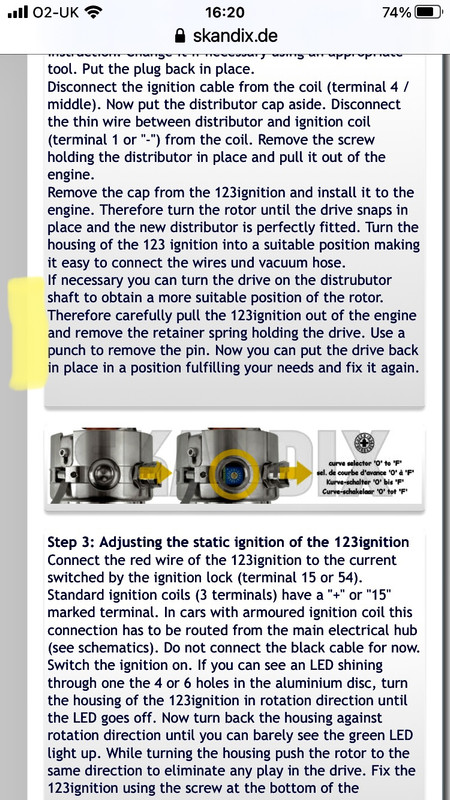
Richard
Previous owner and restorer of a S1 3.8 FHC Opalescent Golden Sand with Tan Trim 889504 (now sold and headed for Athens)
Previous owner and restorer of a S1 3.8 FHC Opalescent Golden Sand with Tan Trim 889504 (now sold and headed for Athens)
| Link: | |
| BBcode: | |
| HTML: | |
| Hide post links |
#23 Re: 123-Tune+ static timing
I just though I would update you on my progress.
Well I have finally managed to get the car started with the 123.
I took the 123 out, but left it connected. I moved the drive gear through 360 degrees, but in no position was I able to get the LED to light up when the rotor lined up with a post on the distributor cap, it always ended up between two terminals.
I reinstalled the distributor and set it so that a LED came on at 10 degrees on the crank and installed the lead for no 6 at the next post in rotation. To be honest I though I had done this before, but this time it started.
It was on the 10 degree map, but the app was showing 0 degrees at idle for some reason.
I decided to go back to the 0 degree BTDC map from the knowledge base, after resetting the timing, this started easy and showed a timing at idle of 10 degrees.
Great I thought, but checking the timing with the strobe, it was only showing 5 actual degrees on the crank.
I rotated the distributor a few degrees and this when checking brought the timing on the crank to 10 degrees, so the timing in the app now agrees with the timing of the crank.
This to my mind proves that the LED is no more than an indicator and as others have said, needs to be checked with a timing light.
It starts much easier than it did on points and condenser and with a lot less choke.
I substituted this map temporarily for one made up from figures from the Jaguar manual, but this appears to be more lumpy. I have not tested this on the road yet, as I am waiting on some more parts so will do that before finally deciding on which map to use.
I am not sure I fully understand how the MAP figures are calculated so apart from the KB map I have used numbers posted by the some of the knowledgeable people here to make up the standard map.
Paul
Well I have finally managed to get the car started with the 123.

I took the 123 out, but left it connected. I moved the drive gear through 360 degrees, but in no position was I able to get the LED to light up when the rotor lined up with a post on the distributor cap, it always ended up between two terminals.
I reinstalled the distributor and set it so that a LED came on at 10 degrees on the crank and installed the lead for no 6 at the next post in rotation. To be honest I though I had done this before, but this time it started.
It was on the 10 degree map, but the app was showing 0 degrees at idle for some reason.
I decided to go back to the 0 degree BTDC map from the knowledge base, after resetting the timing, this started easy and showed a timing at idle of 10 degrees.
Great I thought, but checking the timing with the strobe, it was only showing 5 actual degrees on the crank.
I rotated the distributor a few degrees and this when checking brought the timing on the crank to 10 degrees, so the timing in the app now agrees with the timing of the crank.
This to my mind proves that the LED is no more than an indicator and as others have said, needs to be checked with a timing light.
It starts much easier than it did on points and condenser and with a lot less choke.
I substituted this map temporarily for one made up from figures from the Jaguar manual, but this appears to be more lumpy. I have not tested this on the road yet, as I am waiting on some more parts so will do that before finally deciding on which map to use.
I am not sure I fully understand how the MAP figures are calculated so apart from the KB map I have used numbers posted by the some of the knowledgeable people here to make up the standard map.
Paul
65 Series 1 FHC, 68 Jaguar 340
| Link: | |
| BBcode: | |
| HTML: | |
| Hide post links |
-
christopher storey
- Posts: 5698
- Joined: Sun Mar 09, 2008 3:07 pm
- Location: cheshire , england

#24 Re: 123-Tune+ static timing
Paul : without wishing to teach my grandmother etc, you do know that the Jaguar figures are in distributor degrees , do you ? i.e. the 123 crankshaft degrees are twice the Jaguar manual figures
| Link: | |
| BBcode: | |
| HTML: | |
| Hide post links |
#25 Re: 123-Tune+ static timing
Hi Christopher,
Thank you for you help.
Yes I am aware that the distributor figures are half crankshaft degrees.
To be fair the Jaguar curve in the 123 is fine, it’s just at first try, the KB ones seem smoother.
I have made up several maps, mostly using the figures from posts here, so I am still experimenting.
This is a steep learning curve for me and until I test it on the road, I won’t know which one works best.
Thanks again,
Paul
Thank you for you help.
Yes I am aware that the distributor figures are half crankshaft degrees.
To be fair the Jaguar curve in the 123 is fine, it’s just at first try, the KB ones seem smoother.
I have made up several maps, mostly using the figures from posts here, so I am still experimenting.
This is a steep learning curve for me and until I test it on the road, I won’t know which one works best.
Thanks again,
Paul
65 Series 1 FHC, 68 Jaguar 340
| Link: | |
| BBcode: | |
| HTML: | |
| Hide post links |

#26 Re: 123-Tune+ static timing
Hi Paul...make sure you re read the info in the link i posted above about "relative & absolute" vacume figures....first read its difficult to understand.....but you will only get a decent vacume curve by re reading and understanding it...great that your up and running.....Steve
Steve
69 S2 2+2 (sold) ..Realm C type replica, 1960 xk150fhc
69 S2 2+2 (sold) ..Realm C type replica, 1960 xk150fhc
| Link: | |
| BBcode: | |
| HTML: | |
| Hide post links |
#27 Re: 123-Tune+ static timing
Thanks for the link Steve, very interesting and informative.
There is one thing that is still puzzling me and that is the relationship between the centrifugal degrees and the vacuum degrees in the 123.
Looking at the factory figures, you can have 21 degrees centrifugal plus maybe 18 degrees on vacuum in some circumstances and this would be plus the possible 10 degrees BTDC, a total of 49 degrees.
With the 123, I have noticed that most of the MAP curves show a maximum of around 18 degrees.
My problem is if you start with a static timing of 0 degrees, will the 123 add the 18 degrees on to the adjusted figures in the centrifugal curve, or will it simply add on 18 degrees to the 0 degrees BTDC figure?
In other words, should the MAP figures be extended by 10 degrees, I.e. to 28 degrees?
Paul
There is one thing that is still puzzling me and that is the relationship between the centrifugal degrees and the vacuum degrees in the 123.
Looking at the factory figures, you can have 21 degrees centrifugal plus maybe 18 degrees on vacuum in some circumstances and this would be plus the possible 10 degrees BTDC, a total of 49 degrees.
With the 123, I have noticed that most of the MAP curves show a maximum of around 18 degrees.
My problem is if you start with a static timing of 0 degrees, will the 123 add the 18 degrees on to the adjusted figures in the centrifugal curve, or will it simply add on 18 degrees to the 0 degrees BTDC figure?
In other words, should the MAP figures be extended by 10 degrees, I.e. to 28 degrees?
Paul
65 Series 1 FHC, 68 Jaguar 340
| Link: | |
| BBcode: | |
| HTML: | |
| Hide post links |