Compression Test

Technical advice Q&A
User avatar

mgcjag
Moderator
Posts: 9251
Joined: Fri Jul 09, 2010 6:15 pm
Location: Ludlow Shropshire
Great Britain

#21 Re: Compression Test

Post by mgcjag » Mon Dec 07, 2020 4:26 pm

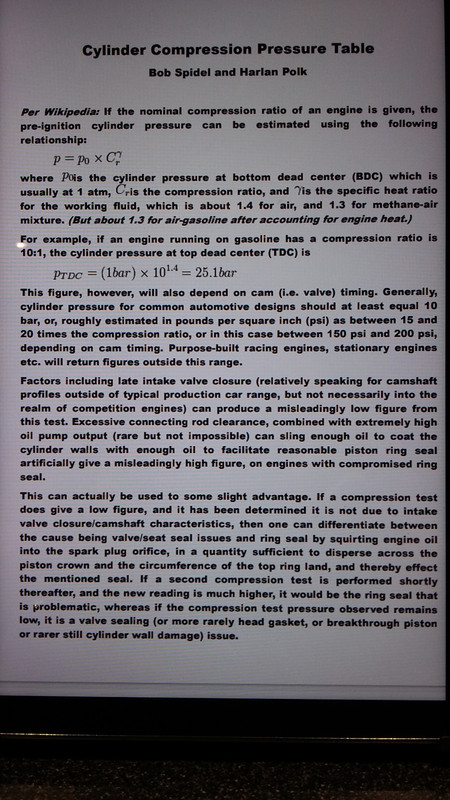
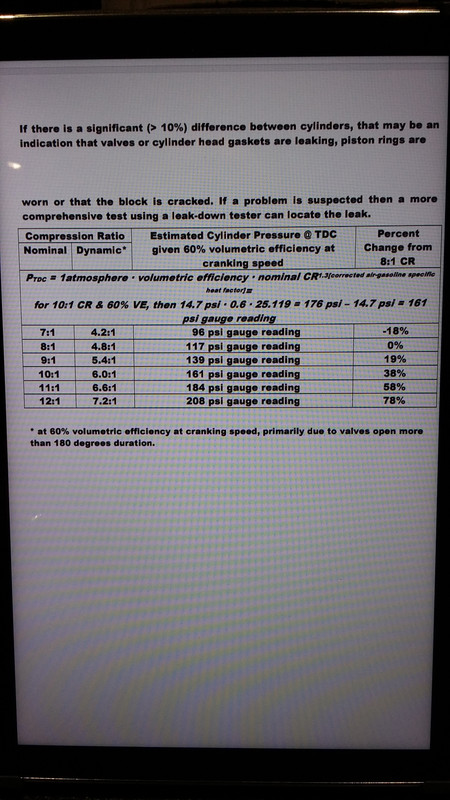
This is quite interesting on calculating compression

Image


Image
Steve
69 S2 2+2 (sold) ..Realm C type replica, 1960 xk150fhc

Link:
BBcode:
HTML:
Hide post links
Show post links

User avatar

malcolm
Posts: 2531
Joined: Fri Jan 03, 2014 10:44 am
Location: Fleet
Great Britain

#22 Re: Compression Test

Post by malcolm » Mon Dec 07, 2020 5:17 pm

Hmm. The first calculation shows that 9:1 should have 17.4 bar, (using the 1.3 specific heat ratio for warm air/gasoline) which is 250psi! However, it then talks about volumetric efficiency of 60% which would bring this down to 150 psi, but the table shows 139. Not far out I know but why the difference?
And why so different from the Haynes manual?
Malcolm
I only fit in a 2+2, so got one!
1969 Series 2 2+2
2009 Jaguar XF-S
2015 F Type V6 S

Link:
BBcode:
HTML:
Hide post links
Show post links

User avatar

mgcjag
Moderator
Posts: 9251
Joined: Fri Jul 09, 2010 6:15 pm
Location: Ludlow Shropshire
Great Britain

#23 Re: Compression Test

Post by mgcjag » Mon Dec 07, 2020 6:29 pm

As far as im aware the piston when sitting at BDC isnt at 0 pressure in the calculations its at 1atm.....so you deduct this from the calculation...1atm.....14.7psi.....why different from Haynes :shrug: ..is haynes correct?...This does make me think about compression testers......are they calibrated to 0 psi.....if so readings would need to be adjusted for your location atm......Steve
Steve
69 S2 2+2 (sold) ..Realm C type replica, 1960 xk150fhc

Link:
BBcode:
HTML:
Hide post links
Show post links

User avatar

mtnjag
Posts: 588
Joined: Tue May 21, 2019 2:19 am
Location: Santa Cruz, California
United States of America

#24 Re: Compression Test

Post by mtnjag » Mon Dec 07, 2020 11:50 pm

I have an original factory Service Manual in the green binder for the "3.8 E Type Grand Touring Models.'

See Page B.31 top of page in the engine section which notes the following, quote:

"COMPRESSION PRESSURES

8 to 1 compression ratio: 155 lbs sq in
9 to 1 compression ratio: 180 lbs per sq in.

Pressures must be taken with all the sparking plugs removed, carburetter throttles wide open and the engine at its normal operating temperature (70 C approximately)."
Layne
Car #876005, 62 OTS

Link:
BBcode:
HTML:
Hide post links
Show post links

User avatar

malcolm
Posts: 2531
Joined: Fri Jan 03, 2014 10:44 am
Location: Fleet
Great Britain

#25 Re: Compression Test

Post by malcolm » Tue Dec 08, 2020 8:38 am

Layne, I understand those numbers which are the same as those quoted in Haynes. The question is why they are so different to those derived from scientific calculation.

Steve, not sure why we deduct the 1 bar, or why you think it should be at 0? At the bottom of the cylinder it will surely be normal atmospheric pressure, which is 1 bar as in the calculation?
Malcolm
I only fit in a 2+2, so got one!
1969 Series 2 2+2
2009 Jaguar XF-S
2015 F Type V6 S

Link:
BBcode:
HTML:
Hide post links
Show post links

User avatar

mgcjag
Moderator
Posts: 9251
Joined: Fri Jul 09, 2010 6:15 pm
Location: Ludlow Shropshire
Great Britain

#26 Re: Compression Test

Post by mgcjag » Tue Dec 08, 2020 9:23 am

Hi Malcolm...I didnt actually say that the pressure at BDC was 0.......the calculations are to show psi guage readings......I dont know what the exact thinking was when they wrote the calculations.....but..my assumption is that 1atm would need to be deducted if you use a guage that starts its reading with its needle that is calibrated to start at 0 psi.......most guages we use do not actually read 0 psi.....they start with their needle on 0 but i assume this is calibrated at 1atm....Also the info i posted is just general to explain the factors involved...it is not specific for Jaguar or E types that could produce different figures. ...Im no scientist so will back out now as i may have this totally wrong....Steve
Steve
69 S2 2+2 (sold) ..Realm C type replica, 1960 xk150fhc

Link:
BBcode:
HTML:
Hide post links
Show post links


christopher storey
Posts: 5698
Joined: Sun Mar 09, 2008 3:07 pm
Location: cheshire , england
Great Britain

#27 Re: Compression Test

Post by christopher storey » Tue Dec 08, 2020 10:21 am

I must point out that in my calculations earlier I had forgotten the effect of the specific heat on the pressure of a fluid under compression . However, looking at the calculations given , it doesn't seem to make much overall difference until the CR markedly exceeds 8:1

Link:
BBcode:
HTML:
Hide post links
Show post links


MarekH
Posts: 1763
Joined: Wed Jul 21, 2010 8:30 pm
Location: Surrey
Great Britain

#28 Re: Compression Test

Post by MarekH » Tue Dec 08, 2020 1:05 pm

Volumetric efficiency of the engine is going to be a complicated topic. The whole induction system and the exhaust and rpm will all influence this. People like Degma (Pete - insert tutoral here) discovered it was possible to take the volumetric efficiency above 100% and kept his 2stroke engines in the powerband that did this. Roger Bywater makes a lot of altering the inlet and outlet flow to broadly tune towards improving the torque within the rpm range drivers are most likely to be using, rather than increasing headline power figures.

Knowing the psi figures at 120rpm where there is no exhaust gas expansion isn't massively useful datum point in the volumetric efficiency discussion by comparison, but knowing the cylinders all perform closely compared to each other is.

When I have a bit of time, I'll post an adapted fuel injection map to constant air fuel ratio to show volumetric efficiency calculation as load and rpm vary for a running engine.

kind regards
Marek

Link:
BBcode:
HTML:
Hide post links
Show post links

User avatar

mtnjag
Posts: 588
Joined: Tue May 21, 2019 2:19 am
Location: Santa Cruz, California
United States of America

#29 Re: Compression Test

Post by mtnjag » Tue Dec 08, 2020 2:33 pm

Yes, understand. Only pointing out that although the Haynes Manual is reference in this thread as perhaps being in error somehow, that the source of the info is actually the factory shop manual.

And while there is a question as to why they differ from the scientific calculation, I think an at least equal question is why the factory would give a figure that is not correct?
Layne
Car #876005, 62 OTS

Link:
BBcode:
HTML:
Hide post links
Show post links

User avatar

politeperson
Posts: 1388
Joined: Tue Jun 07, 2016 8:26 pm
Location: Boston UK
Great Britain

#30 Re: Compression Test

Post by politeperson » Tue Dec 08, 2020 3:39 pm

I have a 4.2 with 8:1 pistons which runs perfectly with 175 psi in all the bores, so I think you have nothing to worry about.
Finishing off an S1 roadster

Link:
BBcode:
HTML:
Hide post links
Show post links

User avatar

PeterCrespin
Posts: 4561
Joined: Fri Mar 05, 2010 8:22 pm
Location: Gaithersburg, Maryland.
Contact:
United States of America

#31 Re: Compression Test

Post by PeterCrespin » Tue Dec 08, 2020 9:49 pm

Marek:Degner not Degma. End of tutorial. Fascinating guy.

Malcolm/Steve, I assume that Haynes, being a DIY publisher uses values that can be replicated with garage tools. As noted, these use gauge pressure and read zero when not attached to anything. Unfortunately, ‘Zero’ varies a bit depending on weather and altitude but in DIY terms it’s not a huge problem.

Engineers and global companies have sometimes to be pickier if their audiences cover a wide range of environments and they would be more likely to use absolute pressures above zero (a figure that like absolute zero temperature is technically unobtainable). Such figures are usable by anyone anywhere anytime if they need accurate reproducibility. For our old cars, less than 10% variance between cylinders is a good enough benchmark for most purposes.
1E75339 UberLynx D-Type; 1R27190 70 FHC; 1E78478; 2001 Vanden Plas

Link:
BBcode:
HTML:
Hide post links
Show post links

User avatar

malcolm
Posts: 2531
Joined: Fri Jan 03, 2014 10:44 am
Location: Fleet
Great Britain

#32 Re: Compression Test

Post by malcolm » Wed Dec 09, 2020 9:36 am

Thanks Peter. And Layne, I agree entirely that it would be strange for the factory to give an incorrect figure (although many would query their basic 265 bhp figure!). That's why my limited technical expertise and general brain capacity is trying to grasp the difference between that presumably correct number and the calculations shown by people on here. I certainly don't disagree with you.
I think the answer lies in this volumetric efficiency business and difference between spinning the engine over and running it live.
Malcolm
I only fit in a 2+2, so got one!
1969 Series 2 2+2
2009 Jaguar XF-S
2015 F Type V6 S

Link:
BBcode:
HTML:
Hide post links
Show post links

User avatar

mgcjag
Moderator
Posts: 9251
Joined: Fri Jul 09, 2010 6:15 pm
Location: Ludlow Shropshire
Great Britain

#33 Re: Compression Test

Post by mgcjag » Wed Dec 09, 2020 10:02 am

Hi Malcolm......when you refer to" calculations shown by people on here" i presume you mean the info i posted showing compression calculations......I have already said in posts above that the info i posted is NOT Jaguar specific.....I posted it as if gives information on factors involved when calculating compression......I was not expecting anyone to look at the chart and expect their 9:1 compression engine to give exact reading as shown....I had assumed that everyone would read the information and then have a better understanding.....Steve
Steve
69 S2 2+2 (sold) ..Realm C type replica, 1960 xk150fhc

Link:
BBcode:
HTML:
Hide post links
Show post links


MarekH
Posts: 1763
Joined: Wed Jul 21, 2010 8:30 pm
Location: Surrey
Great Britain

#34 Re: Compression Test

Post by MarekH » Wed Dec 09, 2020 12:50 pm

Thank you Pete - East German Degner discovered that altering the shape of the exhaust tube on a 2stroke helped "suck" the exhaust gases out of the combustion chamber more efficiently, so helping more incoming air into the cylinder and thus allowing them to create more power. The east Germans were not pleased when he defected.

Here is a part of a fuel injection table, adjusted to strip out any difference in targeted air:fuel ratio ("AFR") and missing out any influence of the injector type. What you'd expect, is that volumetric efficiency is inversely proportional to the amount of vacuum pulled by the engine (at full throttle, i.e. wide open throttle, the mass of air getting in is twice as much as when only 50% vacuum, so you'd expect to add twice the fuel to achieve the same AFR). What this empirical analysis shows is that there are plenty of bumps and troughs in that relationship rather than a smoothly sloping surface. On top of that, the left side of the graph is between 250rpm to 1300rpm for a car with lumpy cams - the engine doesn't breathe nicely predictably at low rpm. It also implies that this can be tuned out if you have the capability to adjust these things. David (Heuer) did a similar type of analysis (but only in 2D) with the inlet trumpets on his 3.8. The numbers on the side are indicative only.
volumetric table.png
volumetric table.png (90.56 KiB) Viewed 6697 times
kind regards
Marek

Link:
BBcode:
HTML:
Hide post links
Show post links

User avatar

malcolm
Posts: 2531
Joined: Fri Jan 03, 2014 10:44 am
Location: Fleet
Great Britain

#35 Re: Compression Test

Post by malcolm » Wed Dec 09, 2020 1:59 pm

mgcjag wrote: ↑
Wed Dec 09, 2020 10:02 am
Hi Malcolm......when you refer to" calculations shown by people on here" i presume you mean the info i posted showing compression calculations......I have already said in posts above that the info i posted is NOT Jaguar specific.....I posted it as if gives information on factors involved when calculating compression......I was not expecting anyone to look at the chart and expect their 9:1 compression engine to give exact reading as shown....I had assumed that everyone would read the information and then have a better understanding.....Steve
Steve, crossed messages here. I was referring to you and Christopher, both people who have much better technical understanding than I. And I understand that neither Christopher's post nor yours were trying to establish facts about specific E Type compression, but were simply providing general info. I know you weren't trying to show how to work out an E Type's compression figures. But I found both posts very interesting; mainly because both your general table and Christopher's back-of-envelope calculation came very close to my actual figures, and a long way from the published Jaguar figures, so I'm simply trying to get my head round what the facts are. No offense intended! :shock:
Malcolm
I only fit in a 2+2, so got one!
1969 Series 2 2+2
2009 Jaguar XF-S
2015 F Type V6 S

Link:
BBcode:
HTML:
Hide post links
Show post links


Topic author
colinevans
Posts: 180
Joined: Thu Sep 24, 2015 6:54 am
Location: Dorset, UK
Great Britain

#36 Re: Compression Test

Post by colinevans » Wed Dec 09, 2020 9:03 pm

Wow. My initial question- which I appreciate was a bit subjective- seems to have sparked a very technical debate. Love these forums! The consensus (I think) seems to be that whilst the close grouping of the readings suggests no major concerns, they may be a little low and worthy of investigation if the budget allows. Thanks everyone.
Colin
Series 2 OTS, 280SL

Link:
BBcode:
HTML:
Hide post links
Show post links

Post Reply Previous topicNext topic