


Well just to make this thread even longer, I to have had a long chat with Colin who was also very helpful but it seems the stats they had hoped to get they can't & the only way forward is a mod along the lines as per my older post.
Those with the deeper slot will have an better chance of success .
Could I ask Jim where you got the Smiths type from.
Thanks Neal.
Thermostat
-
neal herridge
- Posts: 172
- Joined: Wed Aug 13, 2014 4:20 pm
- Location: devon


#22
Coventry Auto Components sell them: http://www.ebay.co.uk/itm/NOS-BOXED-Smi ... SwkNZUlGO1
or try here: http://tinyurl.com/j457lg5
or try here: http://tinyurl.com/j457lg5
David Jones
S1 OTS OSB
1997 Porsche 911 Guards Red
2026 Lexus LBX
Add your E-Type to our World Map: http://forum.etypeuk.com/viewtopic.php?f=1&t=1810
S1 OTS OSB
1997 Porsche 911 Guards Red
2026 Lexus LBX
Add your E-Type to our World Map: http://forum.etypeuk.com/viewtopic.php?f=1&t=1810
| Link: | |
| BBcode: | |
| HTML: | |
| Hide post links |

#23
I have now received my modified Thermostats from WatJag and as Ralf has said with the different characteristics and manifold designs, this is starting to get confusing, I have started a new post clearly identified as "Modified Thermostat for a 4.2 Series 1 E type".
My thermostats have a moving 48mm diameter sleeve to move down on opening to close off a by pass slot on a 4.2 Series 1 E type manifold.
regards,
Dave
My thermostats have a moving 48mm diameter sleeve to move down on opening to close off a by pass slot on a 4.2 Series 1 E type manifold.
regards,
Dave
Dave Rose
1967 Series 1 4.2 FHC
1967 Series 1 4.2 FHC
| Link: | |
| BBcode: | |
| HTML: | |
| Hide post links |
#24
Just to confirm the excellent service from Colin, who I chatted to at Stoneleigh..left him my original thermostat cover (as I had already polished it so wanted to keep it)...and today received the machined version plus thermostat and gasket
Great service, really friendly helpful chap, definately recommended
The thermostat fits perfectly in the new groove, a nice snug fit
Jonathan
Great service, really friendly helpful chap, definately recommended
The thermostat fits perfectly in the new groove, a nice snug fit
Jonathan
1963 3.8 FHC ..now finished …………….
1974 2.7 Carrera now as an RS Touring
1974 2.7 Carrera now as an RS Touring
| Link: | |
| BBcode: | |
| HTML: | |
| Hide post links |

#25
Hi Neal,Could I ask Jim where you got the Smiths type from.
I got mine on eBay, though from an individual selling various bits and bobs, not from Coventry Auto Components. They do turn up now and again, if you can wait.
Regards,
Jim
1964 FHC Project
1E20078
1E20078
| Link: | |
| BBcode: | |
| HTML: | |
| Hide post links |
#26
It looks like I need to tidy the ridge off then and take things from there.
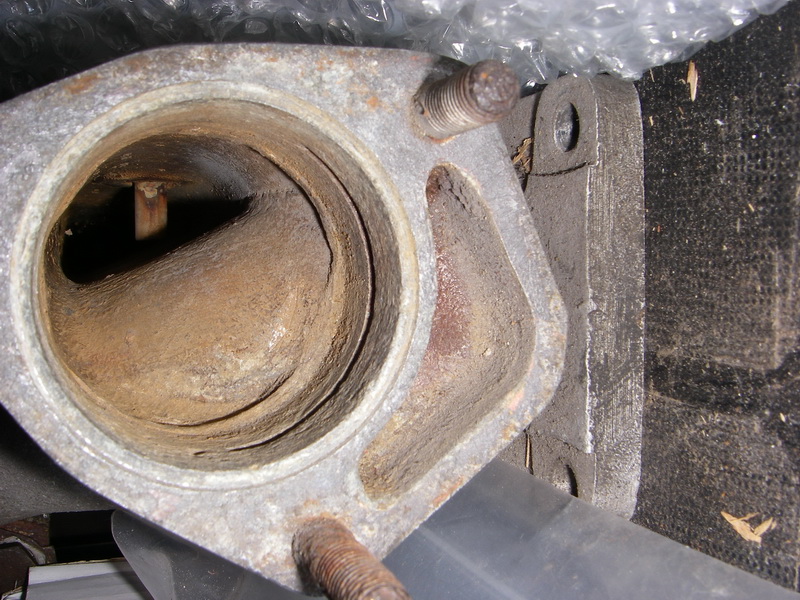
Job done.
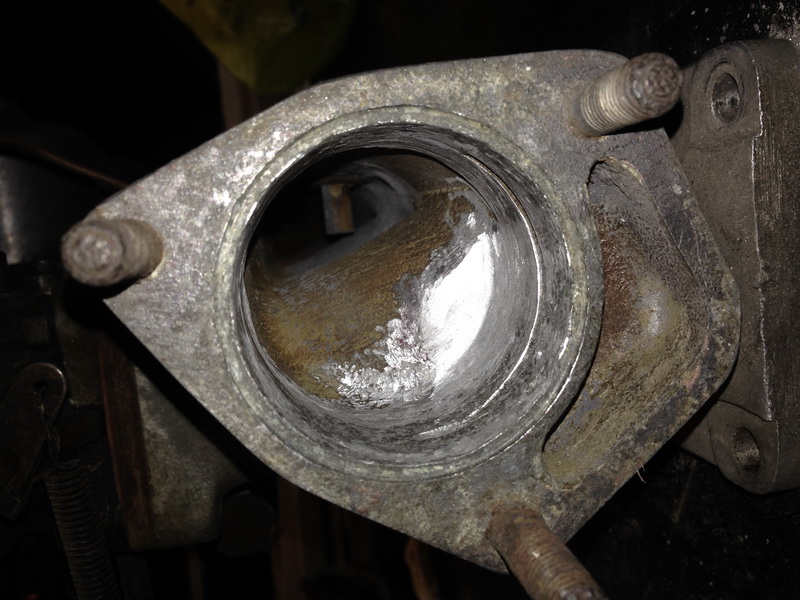
The thermostat now sits in its recess and is tight against the No. 6 Cylinder inlet port.
Last edited by JimmyS on Tue Apr 17, 2018 11:18 am, edited 3 times in total.
1964 FHC Project
1E20078
1E20078
| Link: | |
| BBcode: | |
| HTML: | |
| Hide post links |
-
neal herridge
- Posts: 172
- Joined: Wed Aug 13, 2014 4:20 pm
- Location: devon
#27
Many thanks David & Jim, the Coventry Auto ones are 84 c so I won't go that way.
I have had success with modifying the stat housing & making a clamp ring. I also made a fixture to hold the stat while turning down the od of the clamp flange end. It looks like it will work well also you can change the depth that the stat sits in the housing to match the slot depth. The big plus is that because you do not need to cut down the sleeve length you get a bigger dia. I have a cut down one that WatJag sent & the sleeve dia. is 47.5mm dia where as the unmodified one is 48.5mm dia & that does help.
If any one wants the details & dim's. I am happy to send them, also I can help with machining if needs be.
Neal.
I have had success with modifying the stat housing & making a clamp ring. I also made a fixture to hold the stat while turning down the od of the clamp flange end. It looks like it will work well also you can change the depth that the stat sits in the housing to match the slot depth. The big plus is that because you do not need to cut down the sleeve length you get a bigger dia. I have a cut down one that WatJag sent & the sleeve dia. is 47.5mm dia where as the unmodified one is 48.5mm dia & that does help.
If any one wants the details & dim's. I am happy to send them, also I can help with machining if needs be.
Neal.
| Link: | |
| BBcode: | |
| HTML: | |
| Hide post links |
#28
Some photos and detail would be helpful Neal.
David Jones
S1 OTS OSB
1997 Porsche 911 Guards Red
2026 Lexus LBX
Add your E-Type to our World Map: http://forum.etypeuk.com/viewtopic.php?f=1&t=1810
S1 OTS OSB
1997 Porsche 911 Guards Red
2026 Lexus LBX
Add your E-Type to our World Map: http://forum.etypeuk.com/viewtopic.php?f=1&t=1810
| Link: | |
| BBcode: | |
| HTML: | |
| Hide post links |
-
neal herridge
- Posts: 172
- Joined: Wed Aug 13, 2014 4:20 pm
- Location: devon
#29
Here is a photo to show how it works. The housing needs to be bored out to 50.5mm dia & the flange of the stat turned down to just under 50.5mm dia.
The depth of the bore depends on where your slot is in the inlet manifold. The clamp ring also has a OD just under 50.5mm & a wall thickness of about 0.3mm with a flange on the end of 54mm dia & 1mm wide - this is to fit where the old type of stat would go.
Neal.

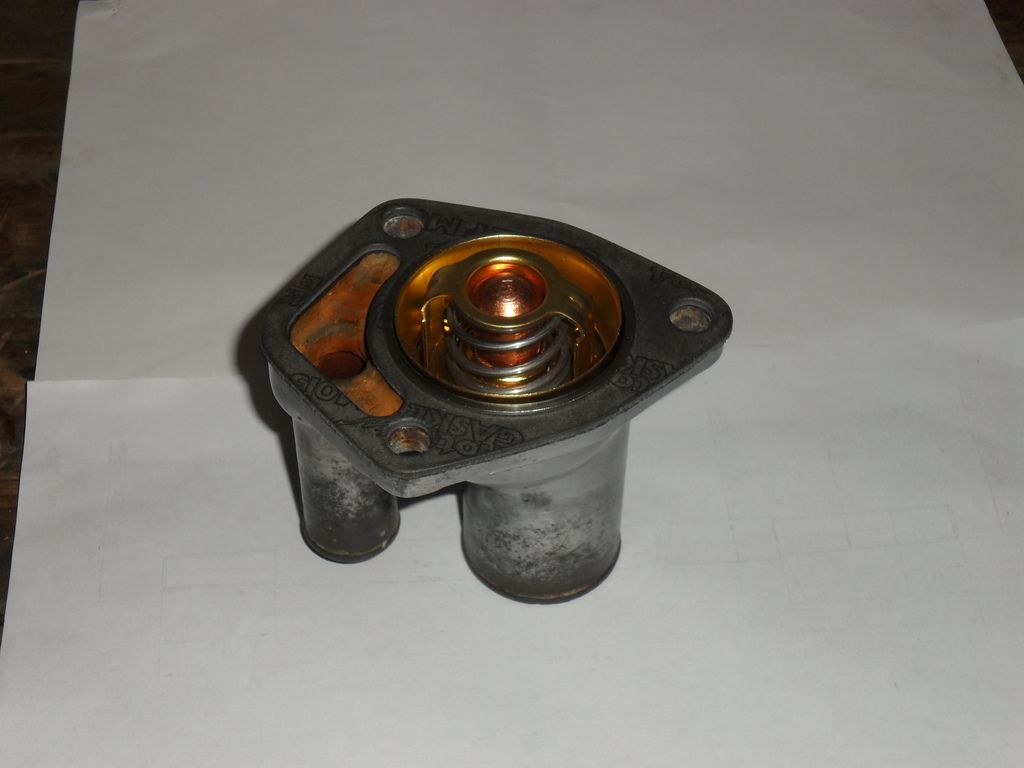
The depth of the bore depends on where your slot is in the inlet manifold. The clamp ring also has a OD just under 50.5mm & a wall thickness of about 0.3mm with a flange on the end of 54mm dia & 1mm wide - this is to fit where the old type of stat would go.
Neal.
| Link: | |
| BBcode: | |
| HTML: | |
| Hide post links |
#30
Now I am mighty confused - especially over such a small component as a thermostat !! Can Neal please identify what model of E type he has to need this modification to both the housing and thermostat, plus need a clamp ring?
Neal's photo showing the thermostat in the housing - I can't see the other photo for some reason, just the "photobucket " reference code - shows what looks to me a 4.2 thermostat housing, Jaguar part number C23233. (Update - I have since been able to see this photo - see next post.) This housing does not have to be machined to take a WatJag modified 74 degree thermostat with a sleeve which moves in toward the by-pass slot when over 74 degrees. The modified thermostat sits into the standard machined register in the inlet manifold to locate the thermostat with the sleeve facing inwards and is retained in position by the gasket and housing once tightened up.
The reason the thermostat has to sit in the stock machined register in the inlet manifold is to ensure that when the sleeve moves inward as it heats up, it is perfectly concentric to the bore of the inlet manifold. Potentially if you machine the housing, the diameter centre in the housing may not align with the centre of the 50 mm diameter bore of the inlet manifold as there is now a tighter tolerance available with the modified thermostat sleeve.
My separate post "Modified Thermostat for a 4.2 Series 1 E type" hopefully showed that application which works perfectly with the sleeve at 13 mm into the manifold when cold and extending around 20 mm into the manifold when hot to blank off the by-pass slot. Unlike the very different 3.8 Series I thermostat housing, there is very little metal available to machine into the C23233 housing both in depth and diameter to avoid breaking out or into the by-pass outlet moulded area of the housing casting.
regards,
Dave
Neal's photo showing the thermostat in the housing - I can't see the other photo for some reason, just the "photobucket " reference code - shows what looks to me a 4.2 thermostat housing, Jaguar part number C23233. (Update - I have since been able to see this photo - see next post.) This housing does not have to be machined to take a WatJag modified 74 degree thermostat with a sleeve which moves in toward the by-pass slot when over 74 degrees. The modified thermostat sits into the standard machined register in the inlet manifold to locate the thermostat with the sleeve facing inwards and is retained in position by the gasket and housing once tightened up.
The reason the thermostat has to sit in the stock machined register in the inlet manifold is to ensure that when the sleeve moves inward as it heats up, it is perfectly concentric to the bore of the inlet manifold. Potentially if you machine the housing, the diameter centre in the housing may not align with the centre of the 50 mm diameter bore of the inlet manifold as there is now a tighter tolerance available with the modified thermostat sleeve.
My separate post "Modified Thermostat for a 4.2 Series 1 E type" hopefully showed that application which works perfectly with the sleeve at 13 mm into the manifold when cold and extending around 20 mm into the manifold when hot to blank off the by-pass slot. Unlike the very different 3.8 Series I thermostat housing, there is very little metal available to machine into the C23233 housing both in depth and diameter to avoid breaking out or into the by-pass outlet moulded area of the housing casting.
regards,
Dave
Last edited by 44DHR on Thu Mar 31, 2016 1:49 pm, edited 2 times in total.
Dave Rose
1967 Series 1 4.2 FHC
1967 Series 1 4.2 FHC
| Link: | |
| BBcode: | |
| HTML: | |
| Hide post links |
#31
Neal, I can now see your first photo thanks and this now explains what you have done with some pretty tight machining tolerances.
I think the difference between what you have achieved, is that although you have machined the thermostat mounting face diameter and depth down, the WatJag thermostat also machines the depth of the thermostat sleeve down to a much reduced depth to avoid having to machine into the Thermostat housing and produce a very tight tolerance clamping ring within which a larger depth of sleeve has to slide and have clearance.
Your solution achieves the same end in a more complex way, but I would still be concerned on the machining into the housing, any potential alignment issues in the inlet manifold and clamping ring, plus the fact you need both a modified housing and modified thermostat, whereas the WatJag thermosat is a straight swop into the stock inlet manifold and thermostat housing.
regards,
Dave
I think the difference between what you have achieved, is that although you have machined the thermostat mounting face diameter and depth down, the WatJag thermostat also machines the depth of the thermostat sleeve down to a much reduced depth to avoid having to machine into the Thermostat housing and produce a very tight tolerance clamping ring within which a larger depth of sleeve has to slide and have clearance.
Your solution achieves the same end in a more complex way, but I would still be concerned on the machining into the housing, any potential alignment issues in the inlet manifold and clamping ring, plus the fact you need both a modified housing and modified thermostat, whereas the WatJag thermosat is a straight swop into the stock inlet manifold and thermostat housing.
regards,
Dave
Dave Rose
1967 Series 1 4.2 FHC
1967 Series 1 4.2 FHC
| Link: | |
| BBcode: | |
| HTML: | |
| Hide post links |
-
neal herridge
- Posts: 172
- Joined: Wed Aug 13, 2014 4:20 pm
- Location: devon
#32
Dave, you need to look back at my posts to see why I had to go this way.
My bypass slot is only about 5mm in from the front face, picture on older post. talking to WatJag I am not the only one.
I have not modified the moving ring in any way which the Watjag one has to have done which reduces its OD as before its cut down there is a small upturn on its end.
I have a WatJag one but it blocks the bypass at cold.
As for machining the housing yes it has to be concentric also there is a flange on the spacer ring which locates in the counter bore in the inlet manifold just like the old stat which means the bore of the stat housing has to line up .
I agree its a bit much just to get a stat but any feed back Dave always welcome.
I have fitted it to the car & all seems to work ok but its not easy to tell if it is opening only that the car does not get hot.
I am also working with Colin to make a spacer plate to go between the housing & the inlet manifold so as to remove the need to bore out the housing the down side of that is you would need to fit longer studs & the old ones may not want to come out.
regards Neal
My bypass slot is only about 5mm in from the front face, picture on older post. talking to WatJag I am not the only one.
I have not modified the moving ring in any way which the Watjag one has to have done which reduces its OD as before its cut down there is a small upturn on its end.
I have a WatJag one but it blocks the bypass at cold.
As for machining the housing yes it has to be concentric also there is a flange on the spacer ring which locates in the counter bore in the inlet manifold just like the old stat which means the bore of the stat housing has to line up .
I agree its a bit much just to get a stat but any feed back Dave always welcome.
I have fitted it to the car & all seems to work ok but its not easy to tell if it is opening only that the car does not get hot.
I am also working with Colin to make a spacer plate to go between the housing & the inlet manifold so as to remove the need to bore out the housing the down side of that is you would need to fit longer studs & the old ones may not want to come out.
regards Neal
| Link: | |
| BBcode: | |
| HTML: | |
| Hide post links |
#33
I understand now Neal - my apologies as I did not realise the issue with your by-pass slot being in a different position to mine.
I have now gone back and read through all the various posts. So much about thermostats and issues we did not think or consider an issue before !
As I said in one of my earlier posts, I have sat in the South of France in very high temperatures and never had any over heating problems - all with a conventional thermostat. Even with that one leaving the by-pass open once the main thermostat had opened, once it has turned through 90 degrees into the small by-pass slot, coolant is directed into the top of the radiator with the by-pass pipe.
It is just our quest to get more coolant through the main hoses with these sleeved thermostats.
Regards,
Dave
I have now gone back and read through all the various posts. So much about thermostats and issues we did not think or consider an issue before !
As I said in one of my earlier posts, I have sat in the South of France in very high temperatures and never had any over heating problems - all with a conventional thermostat. Even with that one leaving the by-pass open once the main thermostat had opened, once it has turned through 90 degrees into the small by-pass slot, coolant is directed into the top of the radiator with the by-pass pipe.
It is just our quest to get more coolant through the main hoses with these sleeved thermostats.
Regards,
Dave
Dave Rose
1967 Series 1 4.2 FHC
1967 Series 1 4.2 FHC
| Link: | |
| BBcode: | |
| HTML: | |
| Hide post links |
#34
Just received this from Julian Barratt:
"Hi David,
So, we have had the chance to sit down and work through these. Basically, we have re- arranged our listing to make the guidance clear in the following way:
S1 Cars ? Bellows type thermostat (C3731/1*)
S1.5 and S2 Cars ? foot type thermostat (various numbers based on temperatures)
In more detail the supersessions will be:
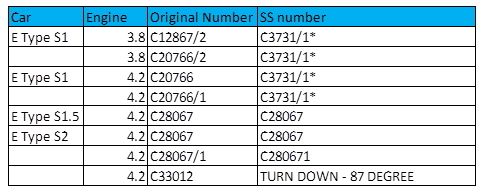
We do not currently list an 87 degree foot type thermostat so we will source this and add to the range. With the bellow- type thermostat we will continue to give the guidance sheet that I showed you previously in case of cars where the bypass slot is in a different position ? these cars will need to use a sleeve.
Hope this has cleared up the guidance. Our internal systems are updated as of now and the web structure will be updated on Friday morning.
Best regards
Julian
p.s the C3731/1* does indeed work satisfactorily on the S1 manifold."
"Hi David,
So, we have had the chance to sit down and work through these. Basically, we have re- arranged our listing to make the guidance clear in the following way:
S1 Cars ? Bellows type thermostat (C3731/1*)
S1.5 and S2 Cars ? foot type thermostat (various numbers based on temperatures)
In more detail the supersessions will be:
We do not currently list an 87 degree foot type thermostat so we will source this and add to the range. With the bellow- type thermostat we will continue to give the guidance sheet that I showed you previously in case of cars where the bypass slot is in a different position ? these cars will need to use a sleeve.
Hope this has cleared up the guidance. Our internal systems are updated as of now and the web structure will be updated on Friday morning.
Best regards
Julian
p.s the C3731/1* does indeed work satisfactorily on the S1 manifold."
David Jones
S1 OTS OSB
1997 Porsche 911 Guards Red
2026 Lexus LBX
Add your E-Type to our World Map: http://forum.etypeuk.com/viewtopic.php?f=1&t=1810
S1 OTS OSB
1997 Porsche 911 Guards Red
2026 Lexus LBX
Add your E-Type to our World Map: http://forum.etypeuk.com/viewtopic.php?f=1&t=1810
| Link: | |
| BBcode: | |
| HTML: | |
| Hide post links |
#35
Well look what I found in my FHC:
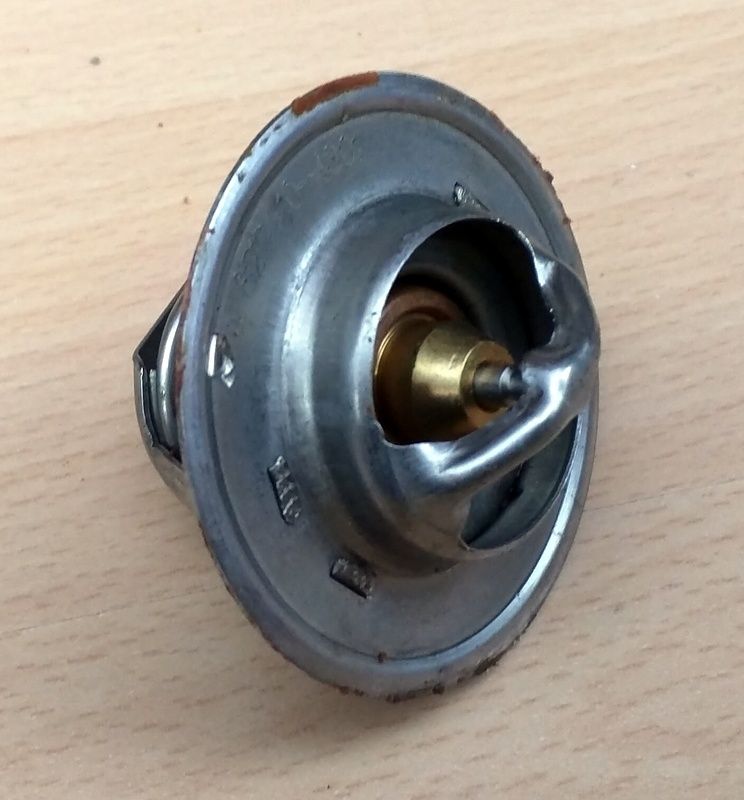
Not only is it the wrong design of thermostat but some clown put in an 87?C version Now replaced with the Land Rover thermostat from Wat-Jag along with their modified elbow. Temperature gauge now registers 70?C rather than the 80?C I previously saw.
Not only is it the wrong design of thermostat but some clown put in an 87?C version
Now replaced with the Land Rover thermostat from Wat-Jag along with their modified elbow. Temperature gauge now registers 70?C rather than the 80?C I previously saw.David Jones
S1 OTS OSB
1997 Porsche 911 Guards Red
2026 Lexus LBX
Add your E-Type to our World Map: http://forum.etypeuk.com/viewtopic.php?f=1&t=1810
S1 OTS OSB
1997 Porsche 911 Guards Red
2026 Lexus LBX
Add your E-Type to our World Map: http://forum.etypeuk.com/viewtopic.php?f=1&t=1810
| Link: | |
| BBcode: | |
| HTML: | |
| Hide post links |

#36 Just to be safe
... Can I order SNG C3731 for my S1 2+2 ?
Here's a pic of the inlet:

Here's a link to SNG:
http://www.sngbarratt.com/ProductDetail ... df6f288830
Carsten
Here's a pic of the inlet:
Here's a link to SNG:
http://www.sngbarratt.com/ProductDetail ... df6f288830
Carsten
Jag E '66 S1 2+2, 74’Citroen DS 23 Pallas iE, 73’ Citroen SM 3.0, 54’ Citroen 11 BL, 71‘ Velosolex, 88‘ Unimog U1650
| Link: | |
| BBcode: | |
| HTML: | |
| Hide post links |
#37
Yes, the SNGB will work or the Wat-Jag detailed in this thread: viewtopic.php?t=8654
David Jones
S1 OTS OSB
1997 Porsche 911 Guards Red
2026 Lexus LBX
Add your E-Type to our World Map: http://forum.etypeuk.com/viewtopic.php?f=1&t=1810
S1 OTS OSB
1997 Porsche 911 Guards Red
2026 Lexus LBX
Add your E-Type to our World Map: http://forum.etypeuk.com/viewtopic.php?f=1&t=1810
| Link: | |
| BBcode: | |
| HTML: | |
| Hide post links |
#38
Came across this in a Ken Ball Autobook:
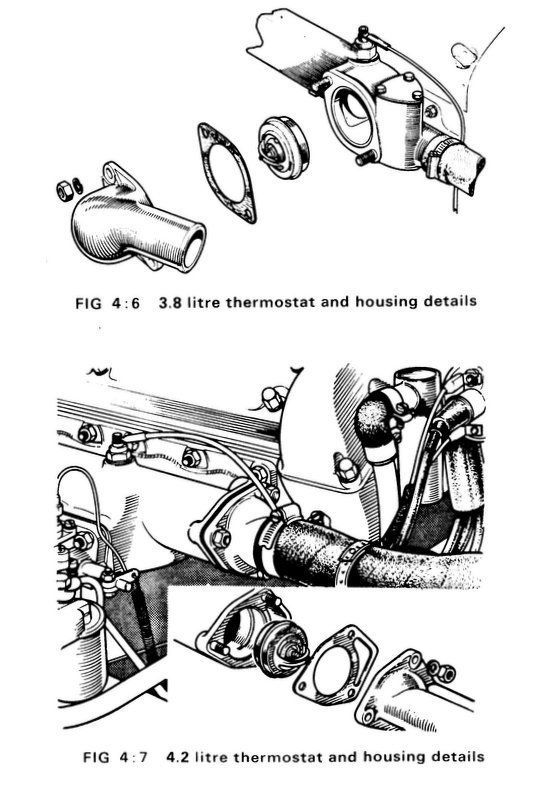
I have just spoken to Colin at Wat-Jag and he says he has only seen one manifold with the shallower slot (Neal's), all the others have the 11mm deep by-pass slot and the above tends to confirm it. Colin has the modified 4.2 thermostat and gasket on the shelf for ?25.
I have just spoken to Colin at Wat-Jag and he says he has only seen one manifold with the shallower slot (Neal's), all the others have the 11mm deep by-pass slot and the above tends to confirm it. Colin has the modified 4.2 thermostat and gasket on the shelf for ?25.
David Jones
S1 OTS OSB
1997 Porsche 911 Guards Red
2026 Lexus LBX
Add your E-Type to our World Map: http://forum.etypeuk.com/viewtopic.php?f=1&t=1810
S1 OTS OSB
1997 Porsche 911 Guards Red
2026 Lexus LBX
Add your E-Type to our World Map: http://forum.etypeuk.com/viewtopic.php?f=1&t=1810
| Link: | |
| BBcode: | |
| HTML: | |
| Hide post links |
-
 PeterCrespin
- Posts: 4561
- Joined: Fri Mar 05, 2010 8:22 pm
- Location: Gaithersburg, Maryland.
- Contact:

#39
Heuer wrote:Temperature gauge now registers 70?C rather than the 80?C I previously saw.
I'd call that a downgrade and prefer 80?C in Europe.
Better efficiency and less engine wear. What's not to like?
There will be no difference at the limit when both stats are fully open and not cycling.
Pete in Arizona
1E75339 UberLynx D-Type; 1R27190 70 FHC; 1E78478; 2001 Vanden Plas
| Link: | |
| BBcode: | |
| HTML: | |
| Hide post links |
#40
There is nothing wrong with an 87'c thermostat per se. Most cars run that hot since passing emissions tests became mandatory.
The purpose of the thermostat is keep the engine hot.
It is always fighting the radiator. The cycling of the thermostat undoes all of "the good" of having a radiator with spare cooling capacity - as soon as the radiator succeeds in cooling the car, the thermostat just tries to reduce the proportion of water reaching the radiator again and thus get the temperature back up.
Since the cooling is actually done by the radiator and most people report problems in stationary traffic, I'd change the pulley size to increase the water flow at low rpm (the thermostat will cycle away the excess cooling at higher rpm) and fit a more efficient fan for more airflow. I'd also check the clearance on the water pump impellor if some internet hotshot has recently rebuilt their engine.
On the plus side, the lower temperature spec of a thermostat simply means you'll have more headroom before failure, but you'll probably never know whether your radiator or fans are any good.
People should feel free to machine their thermostat housings and alter their thermostat sleeves, but if the thermostat was cycling between its normally open and normally closed positions beforehand, it'll just do the same as before but on a slightly different basis and you will have achieved absolutely nothing.
The only point at issue with all of these cooling threads is:-
"If the thermostat gets fully open at some engine operating point, does the radiator (and fan) contribute enough cooling to get the thermostat cycling again?".
To answer that, look at the water flow and the air flow at that operating point. You can machine the thermostat to your heart's content, but if you idle at 650rpm on a retarded engine in a stationary car, you may simply not have enough air and water flow to do the job and especially so if you have excessive water pump/impellor clearance.
kind regards
Marek
The purpose of the thermostat is keep the engine hot.
It is always fighting the radiator. The cycling of the thermostat undoes all of "the good" of having a radiator with spare cooling capacity - as soon as the radiator succeeds in cooling the car, the thermostat just tries to reduce the proportion of water reaching the radiator again and thus get the temperature back up.
Since the cooling is actually done by the radiator and most people report problems in stationary traffic, I'd change the pulley size to increase the water flow at low rpm (the thermostat will cycle away the excess cooling at higher rpm) and fit a more efficient fan for more airflow. I'd also check the clearance on the water pump impellor if some internet hotshot has recently rebuilt their engine.
On the plus side, the lower temperature spec of a thermostat simply means you'll have more headroom before failure, but you'll probably never know whether your radiator or fans are any good.
People should feel free to machine their thermostat housings and alter their thermostat sleeves, but if the thermostat was cycling between its normally open and normally closed positions beforehand, it'll just do the same as before but on a slightly different basis and you will have achieved absolutely nothing.
The only point at issue with all of these cooling threads is:-
"If the thermostat gets fully open at some engine operating point, does the radiator (and fan) contribute enough cooling to get the thermostat cycling again?".
To answer that, look at the water flow and the air flow at that operating point. You can machine the thermostat to your heart's content, but if you idle at 650rpm on a retarded engine in a stationary car, you may simply not have enough air and water flow to do the job and especially so if you have excessive water pump/impellor clearance.
kind regards
Marek
| Link: | |
| BBcode: | |
| HTML: | |
| Hide post links |