


I have a series 1.5 OTS that has covered 64K. My father bought it in the mid 70’s, and I have owned it since 2012. It has been running well although it does use oil, and for the last couple of years has lost a bit of coolant - say about 1/2 pint over a hundred miles, but no sign of leakage anywhere.
A couple of months ago the oil loss reduced but water loss stayed the same. Then a big increase in water loss and increase in oil level - may be 2 or 3 pints!!. Oil and water had mixed but car was starting and running well, no overheating or other issues.
So clearly I think the head gasket has gone, but worried something more serious such as a cracked block. Would the car still run ok if the block has cracked. Have drained and flushed the engine oil. Will now start removing the head as a start.
Has any one had similar symptoms before.
Many thanks Pop
Water in the Oil
#1 Water in the Oil
Pop
E Type Series 1 1/2 OTS [last one off production line] 1968
TVR Chim 1996
Porsche Panamera 4
E Type Series 1 1/2 OTS [last one off production line] 1968
TVR Chim 1996
Porsche Panamera 4
| Link: | |
| BBcode: | |
| HTML: | |
| Hide post links |
-
christopher storey
- Posts: 5698
- Joined: Sun Mar 09, 2008 3:07 pm
- Location: cheshire , england

#2 Re: Water in the Oil
My guess would be that the back of the front cover has perforated just behind the water pump impeller . This is an area that frequently erodes over the years and eventually becomes paper thin . The first thing I would do is run a compression test - if these are normal i.e. cylinders within about 10% of each other then head gasket failure can be pretty well excluded . If that is satisfactory, then the next thing I would do is remove the water pump and carefully examine the rear wall of the front cover, prodding with a screwdriver if any suspicious areas are seen . If a perforation is found, then you will need to remove the head and then the front cover ( it will not come off without removing the head ) and take the cover to a specialist Aluminium welder to have the perforation(s) repaired
| Link: | |
| BBcode: | |
| HTML: | |
| Hide post links |
#3 Re: Water in the Oil
Can you get the cover off without removing the sump?
Series 1 FHC purchased 50 years ago. Courted my wife in it.
Series 1 2+2 when the kids were small now sold.
Series 1.5 OTS in opalescent maroon, Californian car. My retirement present.
Series 1 2+2 when the kids were small now sold.
Series 1.5 OTS in opalescent maroon, Californian car. My retirement present.
| Link: | |
| BBcode: | |
| HTML: | |
| Hide post links |
-
christopher storey
- Posts: 5698
- Joined: Sun Mar 09, 2008 3:07 pm
- Location: cheshire , england
#4 Re: Water in the Oil
Tim : not dogmatic about it, but I think so - once the front sump bolts are removed the cover can be lifted out when the head is off ; in any event, removing the sump is not a big deal compared with the head
PS you have set me thinking about whether if the sump were removed, it might be possible to remove the front cover without removing the head - I do not think so, but I cannot remember why - perhaps others might give a definitive answer on this
PPS I've just looked at photos, and the problem is those 4 blind vertical studs at the top of the cover
PS you have set me thinking about whether if the sump were removed, it might be possible to remove the front cover without removing the head - I do not think so, but I cannot remember why - perhaps others might give a definitive answer on this
PPS I've just looked at photos, and the problem is those 4 blind vertical studs at the top of the cover
| Link: | |
| BBcode: | |
| HTML: | |
| Hide post links |
-
 politeperson
- Posts: 1388
- Joined: Tue Jun 07, 2016 8:26 pm
- Location: Boston UK
#5 Re: Water in the Oil
You could try pressurising the cooling system with an appropriate setup for a few hours to check the pressure droop/leaks.
To remove the timing cover the sump has to be removed and also the head raised. Those vertical studs in the timing cover are difficult to remove with the the motor in situ.
I find it easier to remove the head than the sump when the engine is in situ. Takes about an hour to remove the head.
So I would start off by removing the water pump and inspect the timing cover. The clearance between the picture frame and the two pulleys is so tight you will probably have to gently pry back the engine and gearbox a couple of mm with 2x2 wood to slide them off the nose of the water pump.
Then remove the head and inspect the gasket/get the head tested then lower the sump, which entails raising the engine and gearbox an inch to enable sufficient clearance between the sump and reaction plate to be achieved, removing the pulley, damper, cone, front oil seal and distance piece. It is not easy in situ but can be done.
Then finally, take off the front cover if you haven't found the problem.
To remove the timing cover the sump has to be removed and also the head raised. Those vertical studs in the timing cover are difficult to remove with the the motor in situ.
I find it easier to remove the head than the sump when the engine is in situ. Takes about an hour to remove the head.
So I would start off by removing the water pump and inspect the timing cover. The clearance between the picture frame and the two pulleys is so tight you will probably have to gently pry back the engine and gearbox a couple of mm with 2x2 wood to slide them off the nose of the water pump.
Then remove the head and inspect the gasket/get the head tested then lower the sump, which entails raising the engine and gearbox an inch to enable sufficient clearance between the sump and reaction plate to be achieved, removing the pulley, damper, cone, front oil seal and distance piece. It is not easy in situ but can be done.
Then finally, take off the front cover if you haven't found the problem.
Finishing off an S1 roadster
| Link: | |
| BBcode: | |
| HTML: | |
| Hide post links |
#6 Re: Water in the Oil
Many thanks for your thoughts and suggestions. I think to do some tests first is a good idea. So at the weekend, i will do a compression test. I know water is going into the engine oil - its just a question of from where. That’s why it crossed my mind about a crack in the block.
I will take it from there, but head off and timing chain cover [and sump] seem like the next job.
Many thanks and i will keep you posted.
I will take it from there, but head off and timing chain cover [and sump] seem like the next job.
Many thanks and i will keep you posted.
Pop
E Type Series 1 1/2 OTS [last one off production line] 1968
TVR Chim 1996
Porsche Panamera 4
E Type Series 1 1/2 OTS [last one off production line] 1968
TVR Chim 1996
Porsche Panamera 4
| Link: | |
| BBcode: | |
| HTML: | |
| Hide post links |
#7 Re: Water in the Oil
Hi doing a compression test will tell u nothing the slight coolant leak into the oil will not show on a compression test drive the car to the nearest garage with a 4 gas exhaust analyzer all mot stations have them and get them to put the probe into the expansion tank and check for H C gasses if it has head gasket leaking or a cracked head or block it will have a lot of H C gasses showing on the tester it is a common test we carry out in the motor trade hope that helps u
Regards Rob
Regards Rob
Rob 1972 s3 roadster
Aston Martin DB9 Volante
Aston Martin DB9 Volante
| Link: | |
| BBcode: | |
| HTML: | |
| Hide post links |
#8 Re: Water in the Oil
Thanks Rob. I have a friendly local MOT/Service garage, so i will give him a call.
Pop
E Type Series 1 1/2 OTS [last one off production line] 1968
TVR Chim 1996
Porsche Panamera 4
E Type Series 1 1/2 OTS [last one off production line] 1968
TVR Chim 1996
Porsche Panamera 4
| Link: | |
| BBcode: | |
| HTML: | |
| Hide post links |

#9 Re: Water in the Oil
You can remove the timing cover without removing the head but you do need to remove the sump. As Christopher says, getting the sump off in situ isn't usually a really big deal. You might wreck the front part of the head gasket though, especially if the engine is old, as opposed to a fresh rebuild.
With this car, if the timing cover has a hole in it behind the water pump impeller, you could probably just take the water pump off and inspect the area. You might see the hole, and if you were looking for a quick and dirty fix you might be able to get the cover welded in situ.
The big problem here though is that this is already a tired old engine which, in addition, has probably had water sitting in the sump on and off for a while. To me it's an engine rebuild prospect.
With this car, if the timing cover has a hole in it behind the water pump impeller, you could probably just take the water pump off and inspect the area. You might see the hole, and if you were looking for a quick and dirty fix you might be able to get the cover welded in situ.
The big problem here though is that this is already a tired old engine which, in addition, has probably had water sitting in the sump on and off for a while. To me it's an engine rebuild prospect.
Andrew.
881824, 1E21538. 889457. 1961 4.3l Mk2. 1975 XJS. 1979 MGB (supercharged).
Adelaide, Australia
881824, 1E21538. 889457. 1961 4.3l Mk2. 1975 XJS. 1979 MGB (supercharged).
Adelaide, Australia
| Link: | |
| BBcode: | |
| HTML: | |
| Hide post links |
-
christopher storey
- Posts: 5698
- Joined: Sun Mar 09, 2008 3:07 pm
- Location: cheshire , england
#10 Re: Water in the Oil
I respectfully beg to differ . This is not a "slight leak " when 2 to 3 pints of water is in the sump . It does not require the car to be moved , or even for that matter the engine to be run . A leak of this magnitude , if it is head gasket failure , inevitably will show up
| Link: | |
| BBcode: | |
| HTML: | |
| Hide post links |
#11 Re: Water in the Oil
Hi i disagree i compression test for head gasket failure is a total waste of time a small amount of fluid in the bores lifts the compression giving a inaccurate diagnosis anyway ive been in motor trade repairing motor cars successfully for 43yrs what do i know
Regards
Regards
Rob 1972 s3 roadster
Aston Martin DB9 Volante
Aston Martin DB9 Volante
| Link: | |
| BBcode: | |
| HTML: | |
| Hide post links |
#12 Re: Water in the Oil
Jack if you did a leak down instead would that show up a leak?
Andrew.
881824, 1E21538. 889457. 1961 4.3l Mk2. 1975 XJS. 1979 MGB (supercharged).
Adelaide, Australia
881824, 1E21538. 889457. 1961 4.3l Mk2. 1975 XJS. 1979 MGB (supercharged).
Adelaide, Australia
| Link: | |
| BBcode: | |
| HTML: | |
| Hide post links |
-
christopher storey
- Posts: 5698
- Joined: Sun Mar 09, 2008 3:07 pm
- Location: cheshire , england
#13 Re: Water in the Oil
And I have been rebuilding engines since 1959, so we will just have to agree to differ . The points which you seem to ignore are that this is not a minor leakage : it is a gross leak admitting 2 to 3 pints of water into the sump which in the unlikely event ( in the circumstances ) that it was head gasket failure would unquestionably show up as a compression anomaly, and secondly that the course you advocate of driving the car to a garage carries with it a high risk of causing really serious bearing damage
| Link: | |
| BBcode: | |
| HTML: | |
| Hide post links |
-
 flatfloor 3.8
- Posts: 216
- Joined: Sun Feb 12, 2012 4:35 pm
- Location: Thorpe Bay Essex UK
#14 Re: Water in the Oil
I agree that the front cover is the most likely source of the leak. Surely if the head gasket had failed with that much of a leak you would see a lot of white vapor in the exhaust. A friends front cover failed and we removed the sump and with the radiator pressurized i could lay under the car and with a torch we could see the water dripping down into the front of the block.
Last edited by flatfloor 3.8 on Thu Jan 09, 2020 9:18 pm, edited 1 time in total.
Bill S1 3.8 OTS.
| Link: | |
| BBcode: | |
| HTML: | |
| Hide post links |
#15 Re: Water in the Oil
Flat floor,
That’s interesting. There was definitely no white smoke from the exhaust. My last trip was a 100 mile run and the car was fine. Started easily and ran smooth with good low tick over when at full temperature. Was it possible to replace the front cover without damaging the head gasket. Or would you just bite the bullet and remove the head and front cover / sump.
That’s interesting. There was definitely no white smoke from the exhaust. My last trip was a 100 mile run and the car was fine. Started easily and ran smooth with good low tick over when at full temperature. Was it possible to replace the front cover without damaging the head gasket. Or would you just bite the bullet and remove the head and front cover / sump.
Pop
E Type Series 1 1/2 OTS [last one off production line] 1968
TVR Chim 1996
Porsche Panamera 4
E Type Series 1 1/2 OTS [last one off production line] 1968
TVR Chim 1996
Porsche Panamera 4
| Link: | |
| BBcode: | |
| HTML: | |
| Hide post links |
-
christopher storey
- Posts: 5698
- Joined: Sun Mar 09, 2008 3:07 pm
- Location: cheshire , england
#16 Re: Water in the Oil
POP : you have a number of sensible options, with the amount of work varying between them
1.This really does not sound like Head gasket failure to me : with a gross leak of the sort you have had, you would expect uneven running, misfiring, loss of power , compression into the coolant circuit, boiling etc
2.Block cracking and/or head failure are very rare in these engines ; similarly , although porosity of the head is not completely unknown, again it is rare , and in any event would be unlikely to cause leakage in the quantities involved
3.So, the number one suspect at this stage has to be front cover leakage , and there are a number of approaches you can adopt
i.remove the dome at the front of the head, and the underlying mesh, and with a good light ( LED headband is a good option and one of those cheap plastic dental mirrors ) see if you can examine the back wall of the front cover from the timing chain side : if there is any sign of water ingress there, it is a strong pointer
ii.If that does not give you a view because of the timing chains, take one or other cam cover off and see if that gives you a better view
iii.If you find water, or if the view is inconclusive, move on to the removal of the water pump ; although it is a bit fiddly, if you take your time it is relatively easy to do, and it will give you the definitive answer to whether it is a front cover failure or not
iv. If it is a failure , then I am still of the view - because of the blind studs - that the only easy way to get the cover off is to remove the head( and even if it is not a failure you would probably want to do this to try and find the cause )
v. finally, as an alternative you could try flatfloor and Andrew Bowie's suggestions of sump removal and examination from underneath
Having said all that,I don't want to depress you , but I had a similar occurrence on my TR3A for which
no cause was ever found, and the problem never recurred . Best of luck, anyway
1.This really does not sound like Head gasket failure to me : with a gross leak of the sort you have had, you would expect uneven running, misfiring, loss of power , compression into the coolant circuit, boiling etc
2.Block cracking and/or head failure are very rare in these engines ; similarly , although porosity of the head is not completely unknown, again it is rare , and in any event would be unlikely to cause leakage in the quantities involved
3.So, the number one suspect at this stage has to be front cover leakage , and there are a number of approaches you can adopt
i.remove the dome at the front of the head, and the underlying mesh, and with a good light ( LED headband is a good option and one of those cheap plastic dental mirrors ) see if you can examine the back wall of the front cover from the timing chain side : if there is any sign of water ingress there, it is a strong pointer
ii.If that does not give you a view because of the timing chains, take one or other cam cover off and see if that gives you a better view
iii.If you find water, or if the view is inconclusive, move on to the removal of the water pump ; although it is a bit fiddly, if you take your time it is relatively easy to do, and it will give you the definitive answer to whether it is a front cover failure or not
iv. If it is a failure , then I am still of the view - because of the blind studs - that the only easy way to get the cover off is to remove the head( and even if it is not a failure you would probably want to do this to try and find the cause )
v. finally, as an alternative you could try flatfloor and Andrew Bowie's suggestions of sump removal and examination from underneath
Having said all that,I don't want to depress you , but I had a similar occurrence on my TR3A for which
no cause was ever found, and the problem never recurred . Best of luck, anyway
| Link: | |
| BBcode: | |
| HTML: | |
| Hide post links |
#17 Re: Water in the Oil
Many thanks to all of you for your comments.
Thinking about it, when ever i have had a head gasket go in the past on other cars, i have always had some overheating, usually a misfire on start up , and some times Creamy water in the rad [ie oil in the water- not the other way round]. And i know this is an old car/engine and there is a lot of sense in pulling out the engine and doing a full rebuild - but i would prefer not to if possible.
It sounds like the front cover is worth a look. I have replaced the water pump in the past, and as its a straight forward job, i think i will take this off, as it will give me a good view of the front cover.
I should be home by Sunday and will make a start then, and keep you posted.
Many thanks Pop
Thinking about it, when ever i have had a head gasket go in the past on other cars, i have always had some overheating, usually a misfire on start up , and some times Creamy water in the rad [ie oil in the water- not the other way round]. And i know this is an old car/engine and there is a lot of sense in pulling out the engine and doing a full rebuild - but i would prefer not to if possible.
It sounds like the front cover is worth a look. I have replaced the water pump in the past, and as its a straight forward job, i think i will take this off, as it will give me a good view of the front cover.
I should be home by Sunday and will make a start then, and keep you posted.
Many thanks Pop
Pop
E Type Series 1 1/2 OTS [last one off production line] 1968
TVR Chim 1996
Porsche Panamera 4
E Type Series 1 1/2 OTS [last one off production line] 1968
TVR Chim 1996
Porsche Panamera 4
| Link: | |
| BBcode: | |
| HTML: | |
| Hide post links |
#18 Re: Water in the Oil
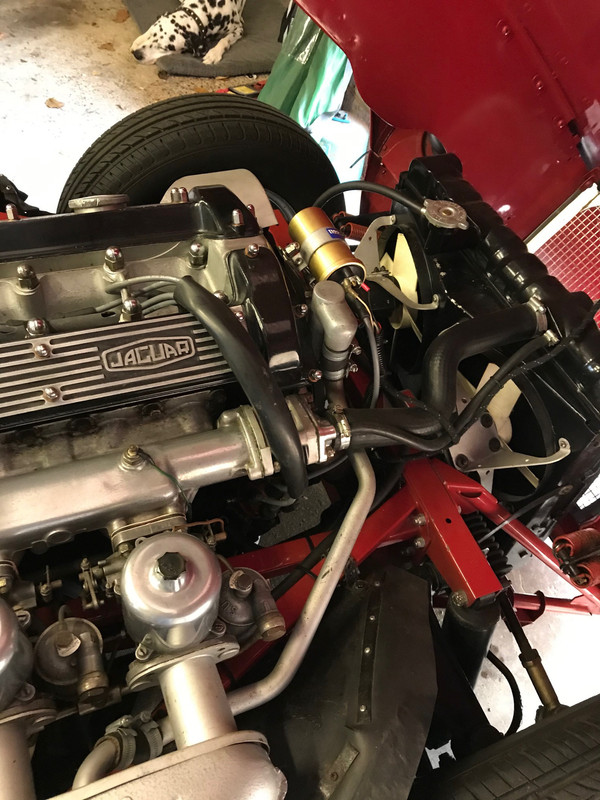
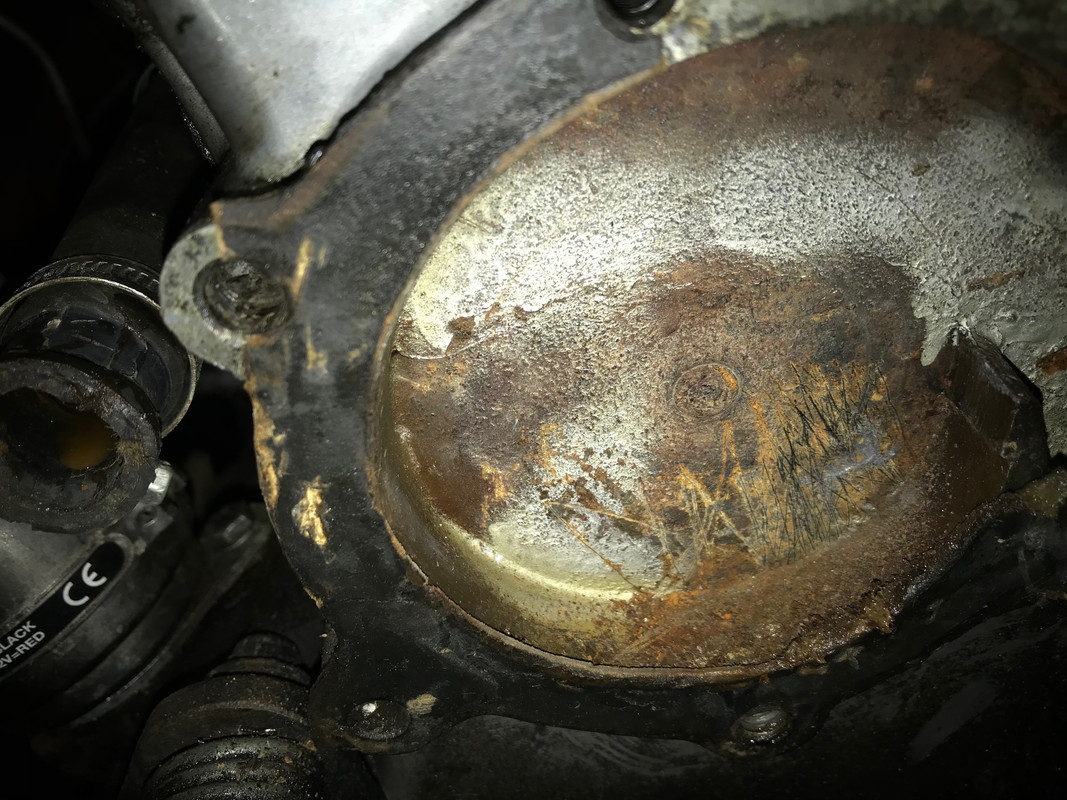
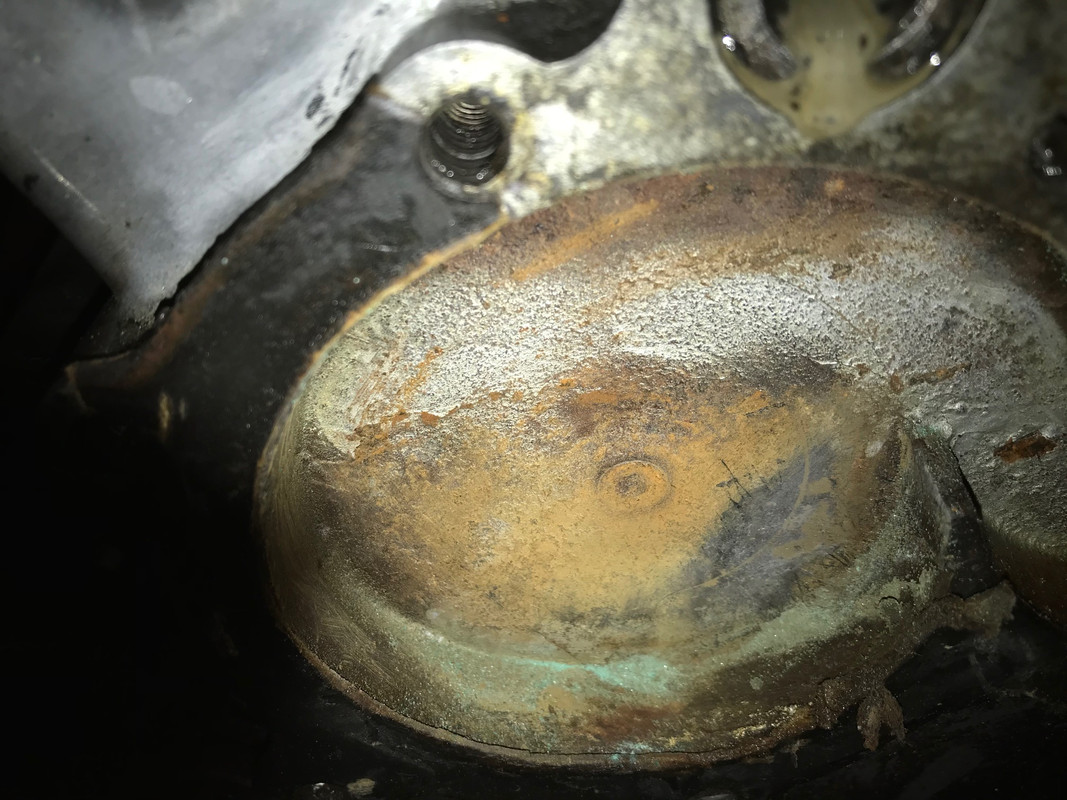
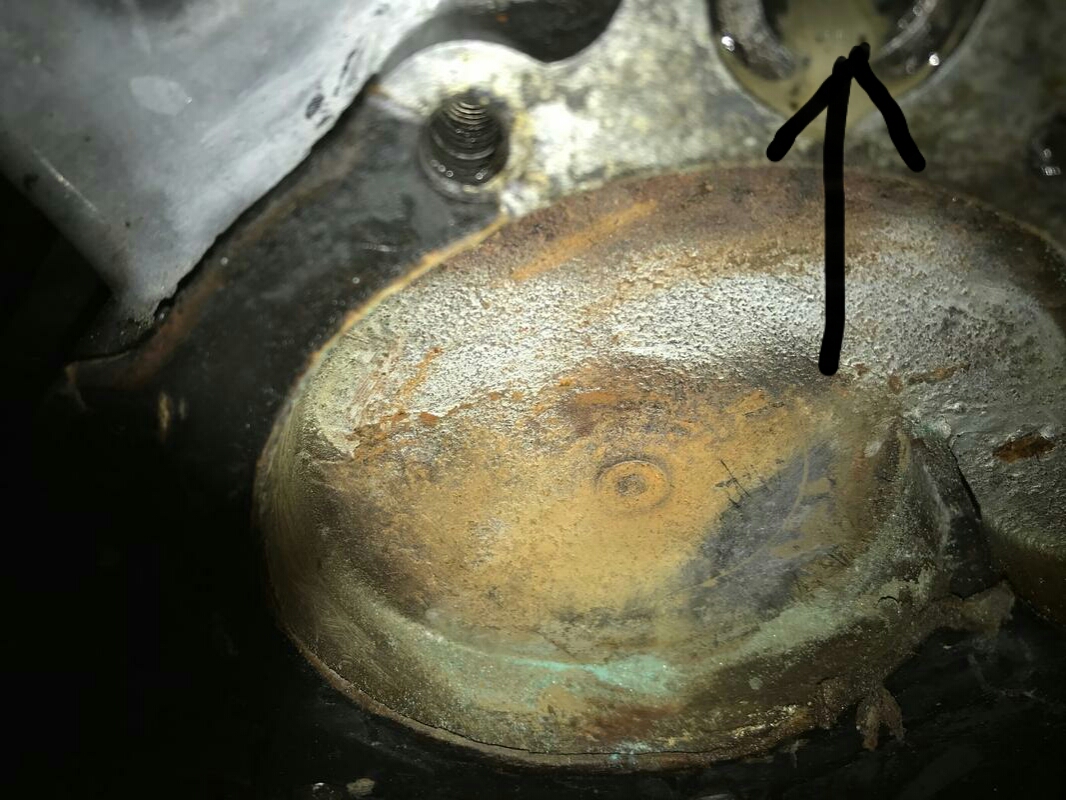
So started to remove the water pump.
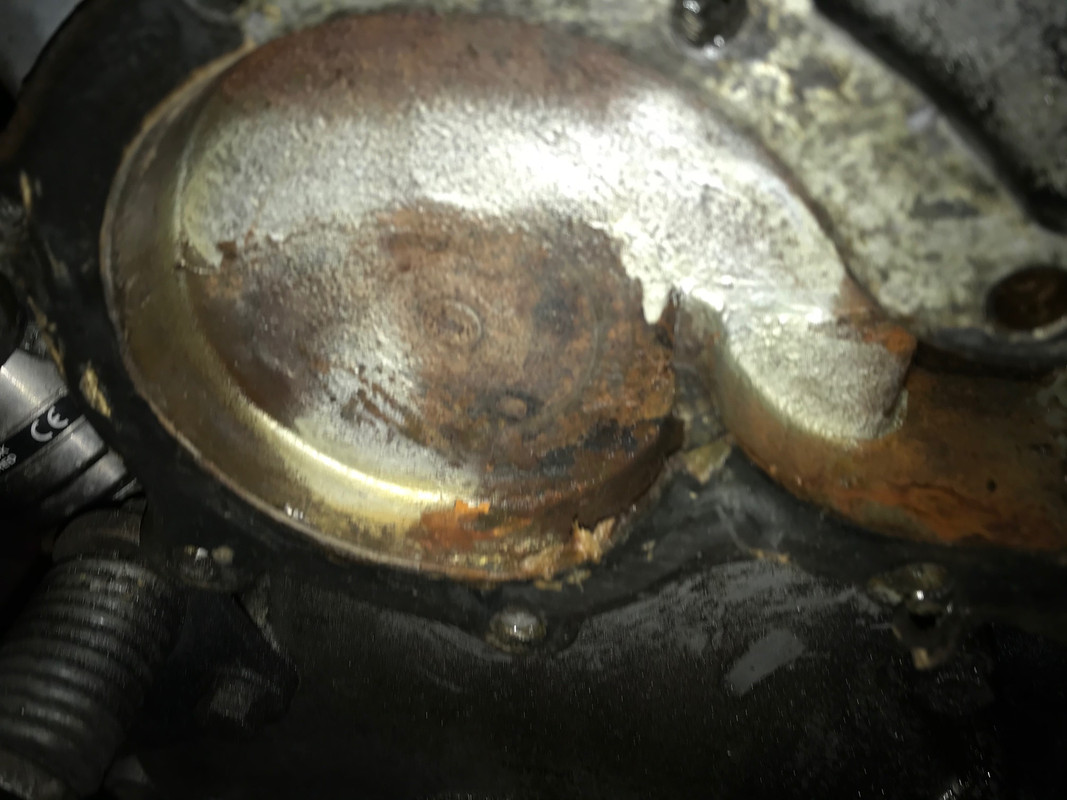
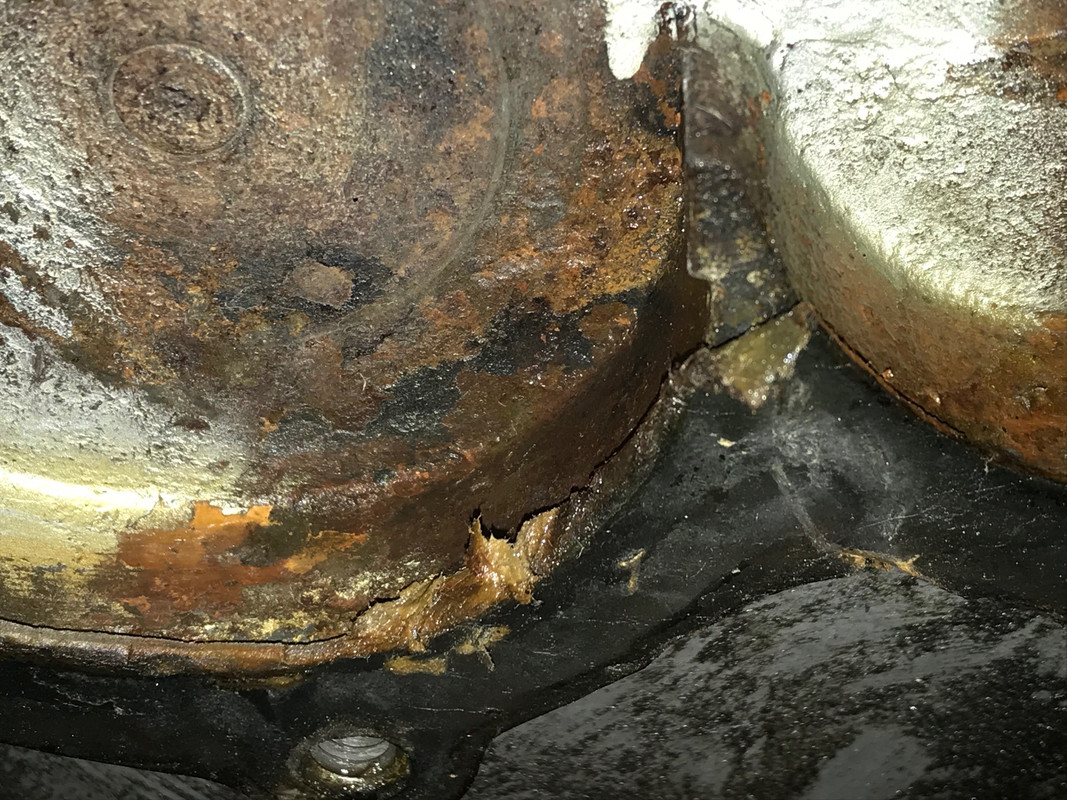
The black area looked perforated. So i prodded with a screwdriver
Seemed reasonably solid so rubbed down with abrasive paper
I can see anything bad enough to let a large amount of water down. So i recon next age is to take the head off.
Pop
Pop
E Type Series 1 1/2 OTS [last one off production line] 1968
TVR Chim 1996
Porsche Panamera 4
E Type Series 1 1/2 OTS [last one off production line] 1968
TVR Chim 1996
Porsche Panamera 4
| Link: | |
| BBcode: | |
| HTML: | |
| Hide post links |

#19 Re: Water in the Oil
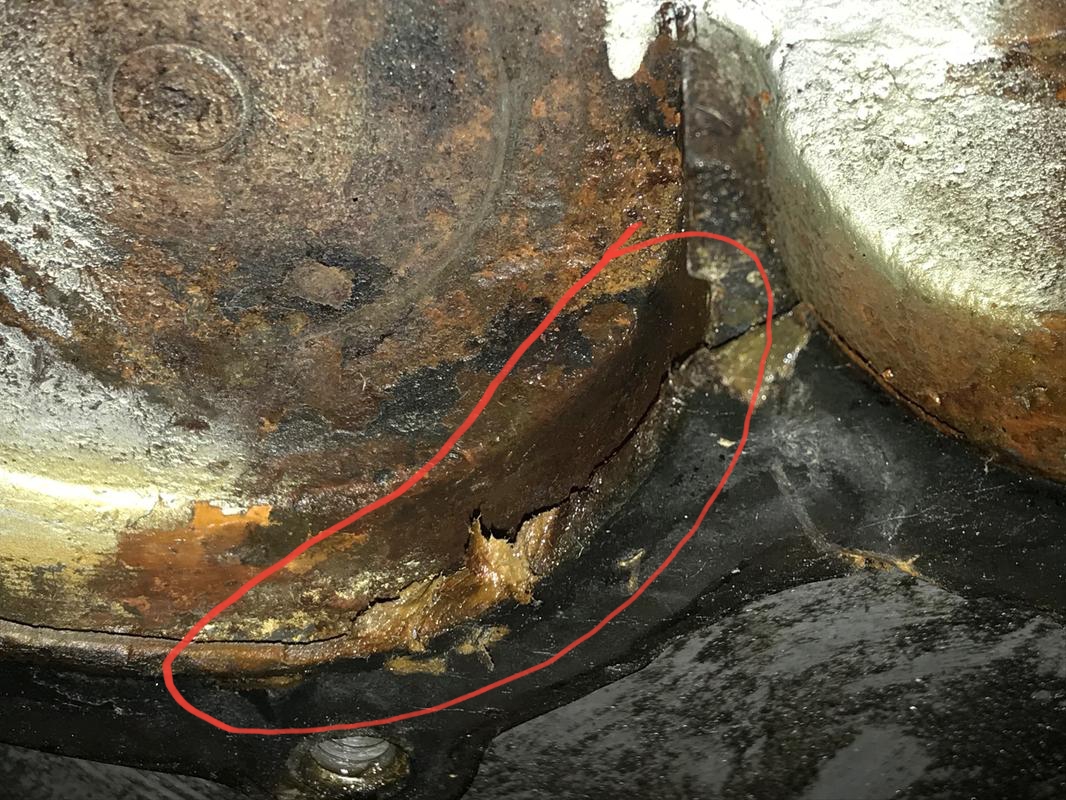
Maybe it's just the photo but something doesn't look quite right. It's almost as if the inside of the water pump housing is de laminating. Are you sure it's not been repaired with something like araldite.
Simon
Simon
Simon
1969 S2 OTS
1969 S2 OTS
| Link: | |
| BBcode: | |
| HTML: | |
| Hide post links |

#20 Re: Water in the Oil
How about through where iv arrowed
Steve
69 S2 2+2 (sold) ..Realm C type replica, 1960 xk150fhc
69 S2 2+2 (sold) ..Realm C type replica, 1960 xk150fhc
| Link: | |
| BBcode: | |
| HTML: | |
| Hide post links |