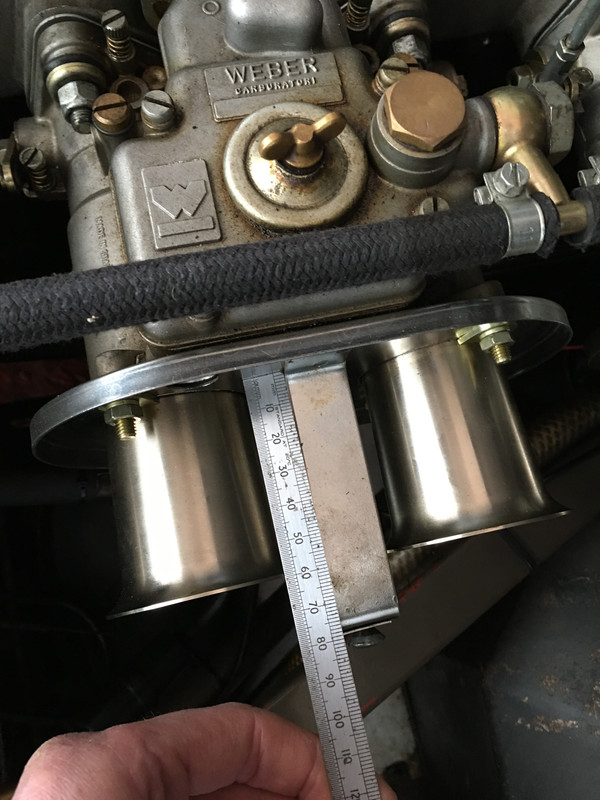
When I had my car on the rolling road, one of the comments passed by the operators was that the end of the ram pipes were too close to the end plates of the air filters. They removed the filters, expecting to see an increase in maximum power, but it made no difference. I have 60mm ram pipes, and the end plate of the filter sits 20mm from the end of the ram pipe. The filters have solid end caps, so all the air entering the ram pipe must approach from the side. Basic geometry shows that the surface area of the circle at the open end of the ram pipe is lower than that of the cylinder created by projecting the end of the ram pipe towards the filter end plate, possibly explaining why the test on the dyno showed no improvement. What I would also take from the dyno test is that the air filter is not the restrictive element in the system, maximum volumetric efficiency being limited by something else.
I’m not interested in chasing headline power numbers, or increasing the maximum BHP by revving the engine harder. I’m happy with the characteristics of my engine for a road car. However, increasing the value of maximum torque, and, as much as possible, pulling up the curve either side of the peak would be beneficial. On the dyno, maximum torque was made at 3250rpm. So, to do this, I need to get more mixture into the cylinders, and burn it more efficiently.
As they’re easy to change, thoughts turn to experimenting with ram pipes. What’s on the car at the moment is only on there because that’s what it came with. However, conventional wisdom suggests that longer ram pipes benefit torque lower down, and the XK engine in particular benefits from a long induction tract. Packaging space being more of a limiting factor to selecting the optimum than anything else. My intake manifold is quite short, so the available space for ram pipes is longer than some, but 60mm would seem to be the practical limit, still allowing space for a filter before hitting the bonnet inner wing.
The standard Weber ram pipes don’t look great from a flow point of view, when reviewed against that sheet that compares all the common forms, being apparently 1.2% worse (No 6) than a bare carb. The optimum elliptical form (No 11) flowing 5.8% better. However, this test makes no reference to the final tuned length of the intake system. I don’t know what baseline pressure or flow rate was used for this study, or what absolute difference in power and torque one would expect to see from switching between one ram pipe and the next.
My initial thoughts would be that I may see an improvement in changing to a full radius ram pipe, but I should try and keep the ram pipe length to the practical maximum. This assumes that ram pipe shape is actually a limiting factor in cylinder filling. If the restriction is further downstream, or the engine is actually benefiting from increased gas velocity due to an inefficient shape, then swapping may see no change, or actually a reduction in torque.
So, if you’re still reading this, then what have people tried with their Weber’s and found to work or not work? These look interesting https://www.med-engineering.co.uk/med-45-dcoe-dcr, though when you have to buy 3 sets, and pay for rolling road time, experimenting becomes an expensive game.
For reference, here’s what I have at the moment.