Page 1 of 3
#1 Voltmeter wiring
Posted: Sun Sep 13, 2020 4:07 pm
by lyons
Car is positive earth 3.8 and as part of a Dynamator installation in order to cope with the extra output we are changing the existing ammeter to Voltmeter.
There are 2 heavy wires brown and brown/white so how are these now attached to new meter.
Thanks
#2 Re: Voltmeter wiring
Posted: Sun Sep 13, 2020 4:25 pm
by Heuer
They are NOT! Connect them to the voltmeter and you will destroy it. It is a simple conversion providing you do it correctly.
Full instructions here:
viewtopic.php?p=713#p713
#3 Re: Voltmeter wiring
Posted: Sun Sep 13, 2020 10:54 pm
by Series1 Stu
Why not just change to a 60 Amp ammeter and preserve a bit more of the originality?
I fitted the movement from a 60 Amp gauge into my original gauge and kept the original face. Nobody could tell that it isn't original just by looking at it.
Took about an hour to do
Regards
#4 Re: Voltmeter wiring
Posted: Mon Sep 14, 2020 8:41 am
by Heuer
Explanation of why a voltmeter is preferred over an ammeter:
"Which is better for monitoring a vehicle's electrical system - a Voltmeter or an Ammeter? Short answer: A voltmeter, by far.
Electrical guru Mark Hamilton of M.A.D. Enterprises points out that amperage is a measure of current flow, so an ammeter is actually a "flow meter" that's intended to measure current flow to the battery (under normal conditions) or discharge from the battery (in the case of alternator system failure). On a typical flow meter, all output must be directed through the device to obtain an accurate reading. In the ammeter's case, that means all the alternator output used to recharge the battery must first be routed through the ammeter under the dash. Which requires a heavy-gauge cable and presents a possible fire hazard. And the ammeter itself must be able to handle all this current flow, so it must have a higher current rating than the alternator's maximum rated output.
All this might be worth the hassle if the ammeter produced reliable information. But the ammeter can only measure the amount of current output to the battery for recharging purposes: When the alternator recharges a "low" battery, the ammeter indicates a high charge rate; with a fully charged battery the voltage regulator reduces alternator output, and the ammeter is supposed to indicate a very low charge rate. But how can you really tell the regulator has reduced alternator output because the battery is fully charged? Maybe a diode in the alternator rectifier failed, or the alternator belt slipped after it warmed up, just as if the battery were fully charged. Or maybe the meter indicates a medium charge rate most of the time-does the battery want this much or could the voltage regulator be overcharging the battery?
On the other hand, a voltmeter works like a fuel pressure gauge-but instead of measuring fluid in psi, the voltmeter measures electrical system pressure in volts. Just like a fuel pressure gauge, a voltmeter only needs to tap into a circuit; all the fuel (or electricity) does not have to detour through the gauge itself. Voltmeter installation is easy, quick, and safe: It hooks up to a fused, ignition-switched "off/on" source and does not require any modification of the circuit used to recharge the battery or any part of the alternator/regulator system. In short, the voltmeter installed at the dash will be a stand-alone circuit.
The voltmeter directly measures the result of charging-system performance. With normal alternator/voltage-regulator function, battery voltage is maintained at 14.0 to 14.5 volts-and this is reported directly by the voltmeter. In the event of alternator-system failure, voltage will be low and continue to drop as the battery discharges. In the event of an "overcharge" condition, the voltmeter will climb above its normal zone. In summary, there is no chance for misinterpreting a voltmeter's readings as can happen with an ammeter."
#5 Re: Voltmeter wiring
Posted: Mon Sep 14, 2020 1:25 pm
by cactusman
A perfect explanation David....a volt meter is much more use...with a 3.8 I would not simply change to a 60 amp meter either....id be suspicious that the existing cables to the ammeter are not rated at 60 amps

My 3.8 retains it dynamo and pretty useless ammeter but I have a volt meter under the dash

#6 Re: Voltmeter wiring
Posted: Wed Sep 16, 2020 1:37 pm
by Series1 Stu
Nobody was disputing the relative merits of ammeters and voltmeters and its no surprise that voltmeters were subsequently fitted to many different cars.
I was just offering up an alternative solution to simply parking both wires on the same terminal of the ammeter. This way the car keeps its original appearance and functionality.
Still, its always nice to be reminded about things you've been doing for years.

#7 Re: Voltmeter wiring
Posted: Wed Sep 16, 2020 2:04 pm
by Heuer
Good of you to take the trouble of course but the OP asked
"and as part of a Dynamator installation in order to cope with the extra output we are changing the existing ammeter to Voltmeter. There are 2 heavy wires brown and brown/white so how are these now attached to new meter."
There does not seem to be anything asked that seeks an alternative solution or opinion.

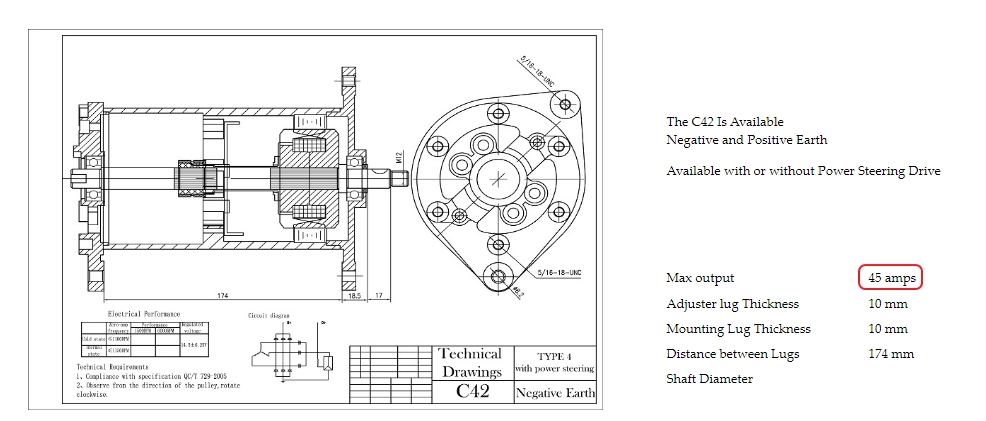
Also the Dynamator is rated at 45 Amps so there would be no advantage to fitting a 60A ammeter over the original ammeter.
#8 Re: Voltmeter wiring
Posted: Mon Apr 04, 2022 8:08 pm
by rfs1957
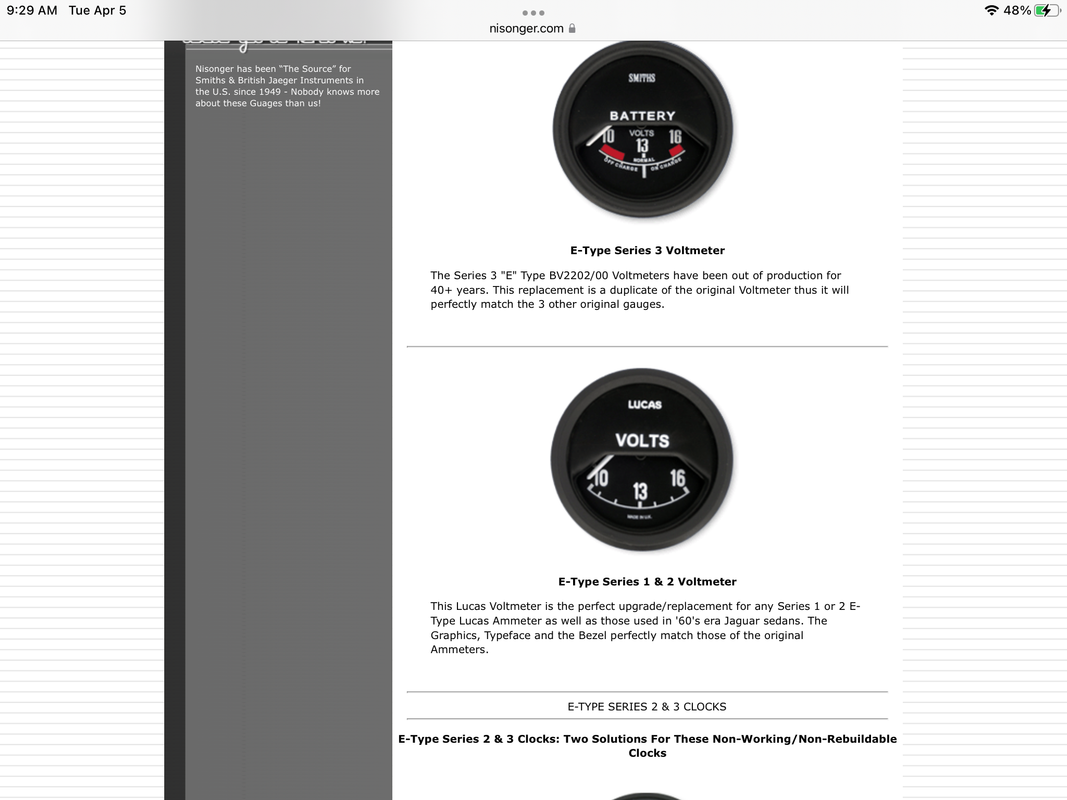
Can I float this back to the top to ask for confirmation as to the most convincingly period-looking voltmeter to replace the ammeter in a 1962 car ? I read Series 3, is that still the best solution and if so, where do you buy them please ?
#9 Re: Voltmeter wiring
Posted: Tue Apr 05, 2022 3:32 pm
by Geoff Allam
This is from the Nissonger site.
#10 Re: Voltmeter wiring
Posted: Tue Apr 05, 2022 3:56 pm
by Gfhug
Caerbont have the same if that helps
Geoff
#11 Re: Voltmeter wiring
Posted: Tue Apr 05, 2022 5:31 pm
by MarekH
Not mentioned in the instructions is that there are two types of bimetallic gauges and the replacement gauge needed has to be a voltmeter gauge, not an old oil or water gauge with a replacement face. The voltmeter gauges are similar to the other bimetallic style gauges but different. If you put an ohm meter across the terminals, the other gauges will have a resistance of about 60-65ohms. The voltmeter gauge you need will have a resistance of about 115-120 ohms.
If you use the wrong gauge (e.g. one from a water or oil gauge) then it will read too high.
kind regards
Marek
#12 Re: Voltmeter wiring
Posted: Tue Apr 05, 2022 5:48 pm
by DWW
I actually got the Smith volt meter which is on its way to me, see how that will fare. Since my alternator negative earth conversion, the stock ammeter has become useless.
#13 Re: Voltmeter wiring
Posted: Tue Apr 05, 2022 6:03 pm
by MarekH
The opposite is also true. If you fit a voltmeter gauge (but with a changed faceplate) in place of an oil gauge then the oil gauge will read low. See
viewtopic.php?f=6&t=13176&hilit=pressure&start=20 The gauge is the wrong gauge and the sender works correctly in this case.
These things are easy to check.
kind regards
Marek
#14 Re: Voltmeter wiring
Posted: Tue Apr 05, 2022 7:21 pm
by rfs1957
Some useful nuggets there, many thanks.
Will try Caerbont then.
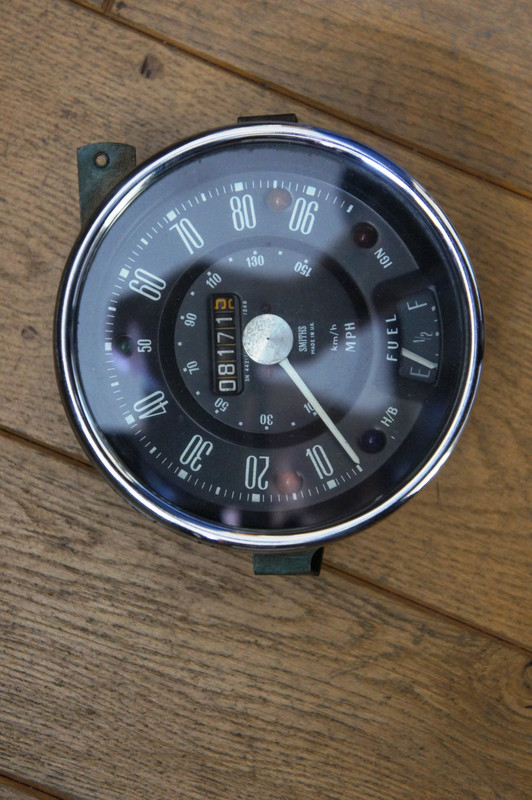
They recalibrated my 1380cc Mini Van speedo, which couldn't cope with 105mph as standard, and they added various warning lights and titles, very clever - and indescernible to the untrained eye.
Same sepeedo, Before :
and After :
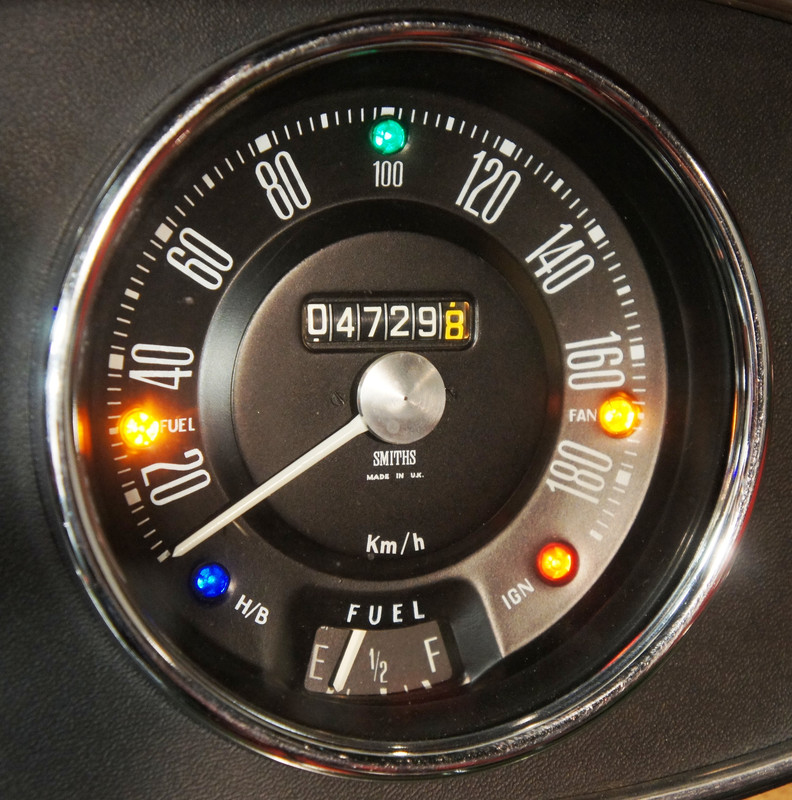
And they recalibrated the Jag speedo now come to think of it.
#15 Re: Voltmeter wiring
Posted: Wed Apr 06, 2022 8:31 pm
by rfs1957
I've got an exchange going with Caerbont, who admit that they do have stuff which is not visible on the web-site, including exactly what is needed for a Series 1 dash ............
However, to be mega-clear and avoid tears, can someone remind me what the nuances are about bezel shapes and profiles ?
Caerbont talk about "Full Vee" and "Half Round" bezels, am I right in thinking S1 is "Full Vee" ?
#16 Re: Voltmeter wiring
Posted: Fri Apr 08, 2022 3:38 pm
by rfs1957
The Caerbont version is indeed LUCAS branded like the one illustrated by our America friend, and with a V black bezel, and works out at £59 inc VAT so have pulled the trigger ; 6 weeks delay.
#17 Re: Voltmeter wiring
Posted: Sat Apr 09, 2022 9:02 pm
by caveman
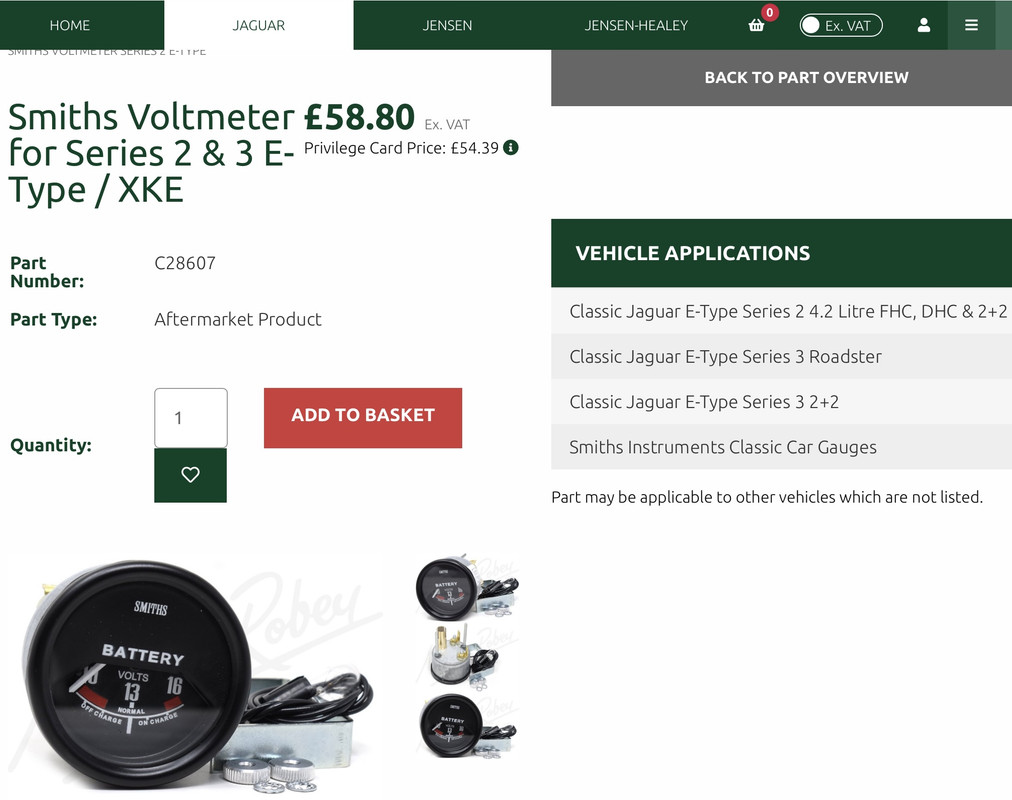
And this from Martin Robey;
#18 Re: Voltmeter wiring
Posted: Sat Apr 09, 2022 10:19 pm
by caveman
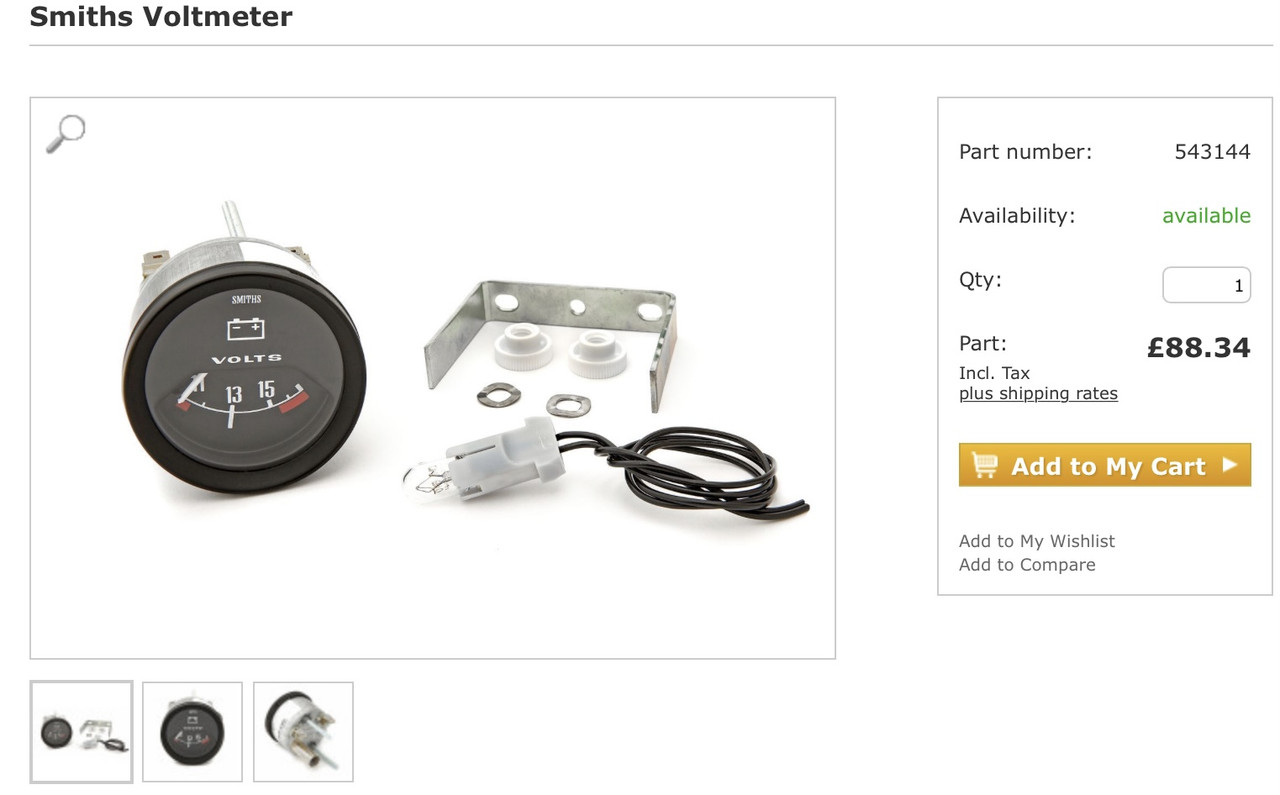
And SC Parts;
#19 Re: Voltmeter wiring
Posted: Sun Apr 10, 2022 12:49 am
by DWW
That is the one I used on my Series 1 but I only paid £55.14 inc Vat for it from Merlin Motorsport. Note: on s1 you need to switch the bezel and glass with the one on the original gauge.
#20 Re: Voltmeter wiring
Posted: Sun Apr 10, 2022 7:24 am
by rfs1957
Those would be easier sources indeed, but the nuance is that those gauges have red to either side of the centre, and I want to keep the monochrome appearance of the centre dash.
The Caerbont Lucas one is just plain white on black, everywhere.
And there’s something to be said for buying direct from the manufacturer, and especially for not having anything to do with SC Parts.