Page 1 of 1
#1 Cylinder head thickness
Posted: Thu Jul 31, 2025 6:33 pm
by mgcjag
Hi All...had a search but couldn't find it.....is there a measurement for the 4.2 cylinder head thickness and where would you measure it.....i have a head on the bench and don't know if its been skimmed befor....your thoughts....thanks....Steve...ps...its straight
#2 Re: Cylinder head thickness
Posted: Thu Jul 31, 2025 7:05 pm
by Gfhug
Steve, would it be worth asking Rob Beere or CMES what they consider the original thickness? I’d expect them to know if a head has been skimmed and how much more could be taken off

. Best I can offer without taking a head off and then still not knowing if it had been skimmed.
Geoff
#3 Re: Cylinder head thickness
Posted: Thu Jul 31, 2025 7:12 pm
by mgcjag
Hi Geoff...were the E type forum

...it must be here somewhere.....or one of our members will know....there must be a spec for it.....Steve
#4 Re: Cylinder head thickness
Posted: Fri Aug 01, 2025 11:06 am
by Jaguar12
Hi Steve,
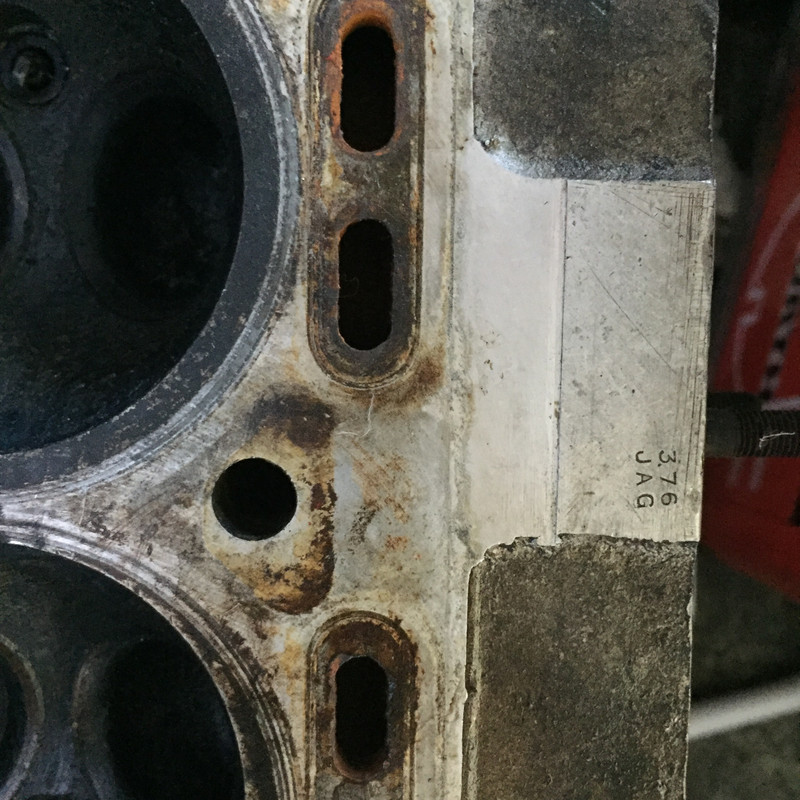
This is a picture of my Jan.1966 OTS with matching numbers. I looks as it as never been machined since on the side there is still a stamped number on the „rib“ (not sure this is the right term). Since the head is still on the bench (even so it was taken off more than a decade ago), I could do some measuring if there is agreement on what would be a reliable way to do it.
Daniel
#5 Re: Cylinder head thickness
Posted: Fri Aug 01, 2025 1:14 pm
by mgcjag
Hi Daniel..thanks for the offer...I'm really after a specification or jaguar documentation that details it.. cheers...
Steve. ...PS...just found out that at the factory Jaguar didn't skim across the full width of the head as can be seen in your photo the skim line just to the left of your jag stamp number........machine shops skim the whole width....still want to find a thickness spec though
#6 Re: Cylinder head thickness
Posted: Fri Aug 01, 2025 2:55 pm
by Dawnpatrol
Hi Danial,
You could measure the combustion chamber volume. Should be about 98cc +/- a couple IIRC, you would /should know that for a rebuild if trying to achieve a sensible CR across all 6 chambers.
Additionally, as you have noticed the main face that the gasket would cover is generally proud of the other faces that tend to have the casting numbers / part numbers and inspection stamps when the head has little work. Once you see the outer shoulders taking a skim and starting to take down the numbers, I would suggest there is at least a couple of mm removed.
Sorry I cant help with a finite reference or dimension, I have never seen it published.
Good luck.
Regards,
Michael
#7 Re: Cylinder head thickness
Posted: Fri Aug 01, 2025 3:53 pm
by mgcjag
Just haveing a re think here....the factory started with a blank cast head.....they must have had a measurement they needed to machine it down to....and a way to measure it ..Steve
.
#8 Re: Cylinder head thickness
Posted: Fri Aug 01, 2025 9:06 pm
by Series1 Stu
Absolutely right, Steve, but I can't find it written down anywhere. Des Hamill's book on power tuning says there's around 0.060" maximum skim allowance but, unfortunately, no mention of head thickness or chamber volume.
The factory will have taken around 1/8" off each face to clean up the casting but that is of no help at all.
The dimensions must be in the factory archives somewhere. I wonder how this kind of information could be made available.
Regards
#9 Re: Cylinder head thickness
Posted: Fri Aug 01, 2025 9:31 pm
by Jaguar12
Hi,
Assuming the process for the Mk2 was the same, this video shows at approx. 5:40 that the head was clamped for skimming. At 5:50 it looks as if the head is sitting on the 14 surfaces where the d-washers under the domed nuts for the head studs go (quite a complicated description but I hope it is understandable). Not certain, but a possibility…
Regards
Daniel
#10 Re: Cylinder head thickness
Posted: Sun Aug 03, 2025 10:07 am
by mgcjag
Great video....interesting how the head is mounted..pressing up on the 4 unmachined head areas..then skimmed down the center...Steve
#11 Re: Cylinder head thickness
Posted: Mon Aug 04, 2025 9:23 am
by 40GT
mgcjag wrote: ↑Sun Aug 03, 2025 10:07 am
Great video....interesting how the head is mounted..pressing up on the 4 unmachined head areas..then skimmed down the center...Steve
The 4 areas are actually machined already and probably very early on, they form a basis of reference for most machining prior to the head skin. They are most likely the ref you are looking for.
Interesting in the film the head is skimmed along it's length with an adequate width tool, but this would miss the sides of the timing chain area, I'm guessing this is a two operation pass with 90 degrees to the length first and then a pass down the length.
#12 Re: Cylinder head thickness
Posted: Mon Aug 04, 2025 9:28 am
by mgcjag
Hi..yes I thought that when I watched the video...then zoomed in as the head was removed and could see the timing chain area skimmed........yes those 4 areas could be the key..so it could be a depth measurement instead of a total thickness measurement that was used....Steve
#13 Re: Cylinder head thickness
Posted: Sat Dec 06, 2025 11:06 pm
by mashmole
Hi, I have a 1967 4.2 FHC 2+2 originally a US car imported into the UK early 1990s and converted to RHD. The car had undergone a major restoration but not quite finished when I acquired the car a few weeks ago. There are copious records of work carried out on the car including all mechanicals and suspension but nothing on the engine apart from a new electronic distributer being fitted. I am concerned that the head may have been skimmed more than 0.060" as all the head stud nuts have 2 washers and the dome nuts are seized to the studs as they have been driven to the end of the threads! I've not had the head off yet as the engine runs well with good compression. Daniel mentions that he has a head on the bench that may not have been skimmed so what would serve as a good bench mark for me would be to take a vernier or micrometer to measure the head from the head gasket face to the landing of the rear most head stud holes. I suspect any work that was carried out on the engine was along time ago in the states. I think I may well be in the market for a replacement head!
Cheers Mark
#14 Re: Cylinder head thickness
Posted: Sun Dec 07, 2025 12:02 am
by abowie
mashmole wrote: ↑Sat Dec 06, 2025 11:06 pm
. I think I may well be in the market for a replacement head!
Cheers Mark
Cometic offer MLS head gaskets up to 3mm in thickness so you should be fine.
You may have a long stud block as well, in which case it is possible that your studs weren't fully screwed in and are sitting proud.
#15 Re: Cylinder head thickness
Posted: Sun Dec 07, 2025 8:33 am
by mgcjag
If your engine runs well with good compression then leave it alone.....there was a batch of aftermarket domed head nuts that didn't have the threads cut deep enough this could be the reason for the 2 washers.....Steve...Ps always measure any aftermarket parts carefully before use
#16 Re: Cylinder head thickness
Posted: Sun Dec 07, 2025 9:41 am
by mashmole
Many thanks for the helpful replies! The engine indeed has long studs apart from the the 2 rearmost and 2 front studs which are short. I assume that the existing stud nuts are original factory fitted. Many were corroded to some extent with the chrome plating damaged. It was in the process of replacing these that it became apparent that even with an additional washer under the nut there was insufficient thread available on the studs to allow the head to be correctly torqued. I had already removed a selection of studs and I can confirm that the studs are fully home in the block. I have ordered a full set of new studs and I can compare lengths against the original. Until I have a head thickness size confirmed I'm assuming that the head has been excessively skimmed in the distant past as the stud lengths would indicate that the head is more than 0.120" thinner than it should be! The thicker head gasket is an option that I will investigate. There are a few heads available of the correct type on the SH market but it really would be good to know what the original thickness should be. Cheers Mark
#17 Re: Cylinder head thickness
Posted: Sun Dec 07, 2025 10:08 am
by mgcjag
From info iv read a figure of 4.885in is mentioned from face on the head where a stud enters to the machined underside...although I doubt this was a measurement ever used by the factory......you mentioned you removed studs.....you cannot simply screw in a new stud as sediment in the block will fall down the hole....you would need to thoroughly clean out the block with core plugs removed and use a bottoming tap to clean up the stud hole thread......if you dont do this your studs will stick up too far....possibly whats happened previously....Steve
#18 Re: Cylinder head thickness
Posted: Sun Dec 07, 2025 10:48 am
by mgcjag
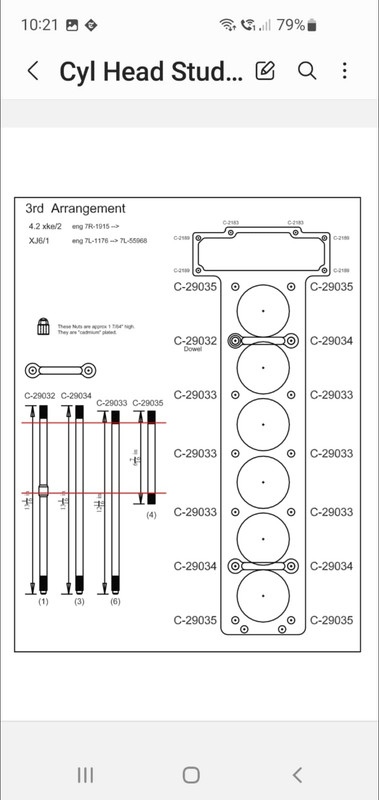
There are other stud drawings
https://www.georgiajag.com/Documents/HeadStud.html but this may help check engine number....measurements left to right..
13 1/16in..13 1/16in..12 11/16...6 7/16in
#19 Re: Cylinder head thickness
Posted: Sun Dec 07, 2025 4:11 pm
by mashmole
Hi Steve, Many thanks for your response. All very helpful. I would say that the cylinder head stud threaded holes were clean with the short section on the bottom of the studs that is of reduced diameter hard on the base of the tapped hole. I fully intend to check the threaded holes for cleanliness and thread condition once I have the head off. As a matter of interest the replacement new dome nuts recently acquired need cleaned with a plug tap prior to fitting! I'll need to acquire a long series plug tap for the long stud tapped holes. The head thickness provided should be most helpful as a comparison for previous skimming of the head.
Cheers Mark