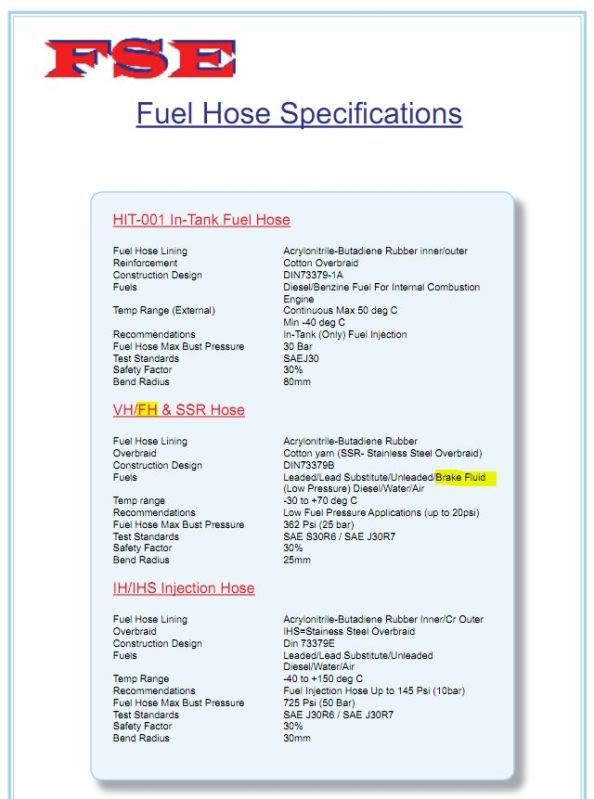
Ordered a 1 metre length of pipe off Stevson ?18/metre + VAT & postage
http://www.stevsonmotors.co.uk They say their pipe (which is blue on the inside and charcoal grey on the outside) is guaranteed impervious to DOT4 fluid but not DOT5 (silicone). I will do a comparison between all types of pipe and report back.
Whilst I was talking to them they mentioned they produce a IRS remote brake bleed kit including all pipes and brackets at £50 + VAT. Someone here was enquiring about a such a kit which is pretty much essential if you are re-building the IRS. I have added a link to the Knowledge Base.
Edit: I have now received the Stevson hose which is Cohline 2322 but with the outer fabric weave dyed grey. From all my research it seems only the Cohline hose will remain sweat proof as it has a Butyl IIR inner with a moulded in cloth outer. The cloth is there to protect because Butyl has a low resistance to oils and fuel but a very high resistance to glycol. Incidentally Butyl IIR is used in the manufacture of tyres and chewing gum!
So only one I can recommend would be the Cohline if you value the paint on your frames.

Here is a summary of what I found out:
1. Demon-Tweeks supply this AP Racing 'remote reservoir hose' made from neoprene and AP claim it does not sweat:
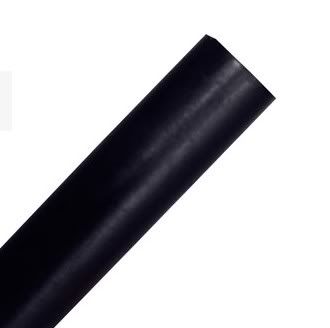

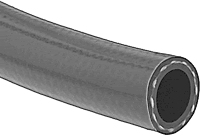
2. The SNG hose seems to be made of Buna-N (tube and cover; aka Acrylonitrile-butadiene rubber) reinforced with an Aramid braid. Mine sweated after 5 years:
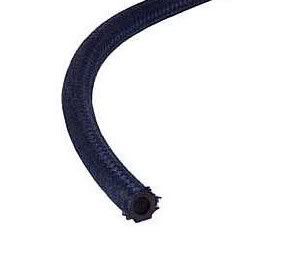
3. FSE supply their FH hose made by Sytec of Nitrile Butadiene rubber with a cotton yarn overbraid. Chemically similar to SNG one above:
4. Girling Yellow Stripe hose was OEM for the E-Type and apparently caused no problems. No longer available but the last 'new stock' I used sweated after 5 years:
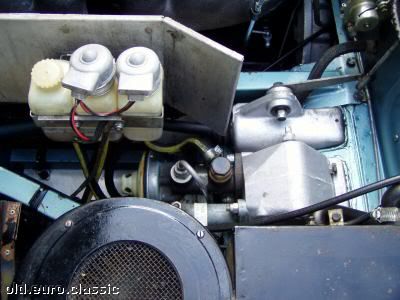
5. VW Beetle/Bus owners and kit car builders seem to swear by this "brake refill hose" made by Cohline GmbH, specialist automotive hose manufacturers, made from Butyl rubber aka IIR (Cohline 2322-0613 with blue cloth braid moulded cover and blue inner). They will provide a certificate (for SVA purposes e.g kit cars) saying it is suitable only for DOT3 and DOT4 fluid. Supplier to Porsche, Mercedes, Audi and VW. Costs ?7/metre from
http://www.carlton-hydraulics.co.uk
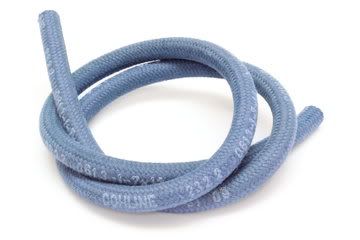

6. Stevson supply this hose - Cohline 2322-0613 dyed grey - at ?18/metre:
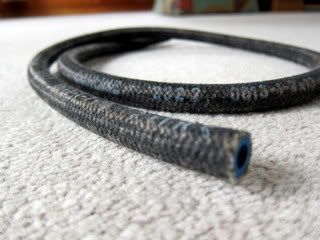
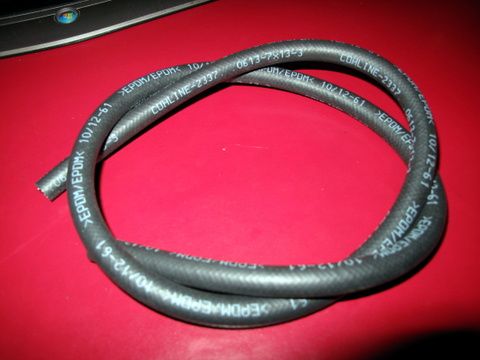
7. Hutsons and Merlin Motorsport supply Cohline 2337 EPDM at ?7/metre. It is actually produced specifically for VAG:
 Note 1
:
Nitrile (Buna-N, NBR)
Nitrile rubber is the general term for acrylonitrile butadiene terpolymer. The acrylonitrile content of nitrile sealing compounds varies considerably (18% to 50%) and influences the physical properties of the finished material. The higher the acrylonitrile content, the better the resistance to oil and fuel. At the same time, elasticity and resistance to compression set is adversely affected. In view of these opposing realities, a compromise is often drawn, and a medium acrylonitrile content selected. Nitrile has good mechanical properties when compared with other elastomers and high wear resistance. Nitrile is not resistant to weathering and ozone.
Heat resistance: Up to 212?F (100?C) with shorter life at 250?F (121?C).
Cold flexibility: Depending on individual compound, between ?30?F and ?70?F (?34?C and ?57?C).
Chemical resistance:
Aliphatic hydrocarbons (propane, butane, petroleum oil, mineral oil and grease, diesel fuel, fuel oils) vegetable and mineral oils and greases
HFA, HFB and HFC fluids
Dilute acids, alkali and salt solutions at low temperatures
Water (special compounds up to 212?F (100?C)).
*Not compatible with:
Fuels of high aromatic content (for flex fuels a special compound must be used)
Aromatic hydrocarbons (benzene)
Chlorinated hydrocarbons (trichlorethylene)
Polar solvents (ketone, acetone, acetic acid, ethyleneester)
Strong acids
Brake fluid with glycol base
Ozone, weather and atmospheric aging.
EPDM (Ethylene Propylene, EPM)
EPM is a copolymer of ethylene and propylene. Ethylenepropylene-diene rubber (EPDM) is produced using a third monomer and is particularly useful when sealing phosphate-ester hydraulic fluids and in brake systems that use fluids having a glycol base.
Heat resistance: Up to 300?F (149?C) (max. 400?F (204?C) in water and/or steam).
Cold flexibility: Down to approximately ?70?F (?57?C).
Chemical resistance:
Hot water and steam up to 300?F (149?C) with special compounds up to 400?F (204?C)
Glycol based brake fluids up to 300?F (149?C)
Many organic and inorganic acids
Cleaning agents, soda and potassium alkalis
Phosphate-ester based hydraulic fluids (HFD-R)
Silicone oil and grease
Many polar solvents (alcohols, ketones, esters)
Ozone, aging and weather resistant.
Not compatible with:
Mineral oil products (oils, greases and fuels).
Neoprene (Chloroprene, CR)
Neoprene was the first synthetic rubber developed commercially and exhibits generally good ozone, aging and chemical resistance. It has good mechanical properties over a wide temperature range.
Heat resistance: Up to approximately 250?F (121?C).
Cold flexibility: Down to approximately ?40?F (?40?C).
Chemical resistance:
Paraffin base mineral oil with low DPI, e.g. ASTM oil No. 1
Silicone oil and grease
Water and water solvents at low temperatures
Refrigerants
Ammonia
Carbon dioxide
Improved ozone, weathering and aging resistance compared with nitrile rubber.
*Limited compatibility:
Naphthalene based mineral oil (IRM 902 and IRM 903 oils)
Low molecular aliphatic hydrocarbons (propane, butane, fuel)
Glycol based brake fluids.
Not compatible with:
Aromatic hydrocarbons (benzene)
Chlorinated hydrocarbons (trichloroethylene)
Polar solvents (ketones, esters, ethers, acetones).
Butyl (IIR)
Butyl rubber is produced by many companies in different types and varies widely in isoprene content. Isoprene is necessary for proper vulcanization. Butyl has a very low permeability rate and good electrical properties.
Heat resistance: Up to approximately 250?F (121?C).
Cold flexibility: Down to approximately ?75?F (?59?C).
Chemical resistance:
Hot water and steam up to 250?F (121?C)
Brake fluids with glycol base
Many acids (see Fluid Compatibility Table)
Salt solutions
Polar solvents, e.g. alcohols, ketones and esters
Poly-glycol based hydraulic fluids (HFC fluids) and phosphate-ester bases (HFD-R fluids)
Silicone oil and grease
Ozone, aging and weather resistant.
Not compatible with:
Mineral oil and grease
Fuels
Chlorinated hydrocarbons.
More detail on the various materials here:
http://www.sealanddesign.com/category/2 ... 62/62.aspx or download as pdf:
http://dl.dropbox.com/u/8496016/www-sea ... gn-com.pdf
Note 2:
If a hose is able to 'sweat' brake fluid is it very likely to allow moisture to permeate the other way!
Note 3:
If you are building a C-Type or D-Type replica the SVA examination will require you to either have brake hoses marked as being suitable for use with DOT fluids or you will have to provide a letter of compliance from the hose manufacturer. Cohline will provide such documentation.