Page 1 of 2
#1 Exhaust manifold nuts
Posted: Sun May 13, 2012 4:17 pm
by Heuer
Now I have moved over to cast manifolds I am finding the bronze nuts are coming loose particularly the eight at the bottom securing the secondary pipes. I did them up tight but after less than 100 miles three of the have already dropped off. I have put split washers beneath them now but will that be sufficient or should I be using something else?
#2
Posted: Sun May 13, 2012 4:46 pm
by daverawle
Mine stay tight with split/spring washers but they loose tempering with heat and have to be replaced once removed.
Dave
#3
Posted: Sun May 13, 2012 5:32 pm
by Heuer
I was wondering if these would be effective?

#4
Posted: Sun May 13, 2012 7:03 pm
by PeterCrespin
I can think of one or two issues David, although yes, you definitely ought to have used locking washers as this fastening is the archetype of a semi-rigid connection that undergoes major heat/cooling, vibration/movement cycles to loosen many fasteners.
That sort of flange nut requires quite a bit of 'real estate' around the base of the fastener. The flange may foul the pipe?
They are also steel and might seize - which is why they used brass in the first place.
Being self-locking all metal they might unscrew the stud intead of unscrewing from it. Manifold lugs are easy to damage when fitting/refitting fasteners which is why they used 'permanent' studs in the first place.
That sort of nut is what I'll be using on my D-type cam covers and they are handy in lots of other places. Maybe with antiseize they will work on the manifolds, but the normal fasteners are generally fine if fitted as per original. One of the joys of my FHC which is so unmolested, is seeing the exact type, combination and sequence of fasteners/washers the factory used. I doubt they normally survived the first 'laying on of hands' by the dealers of the day, but fastener technology is a hugely underrated aspect of complex assemblies like cars. If botched, this aspect can give the car a bad name for reliability etc. in a way that is not the fault of the original design. Con rod castle nuts being a case in point, although the later twelve-point design is undoubtedly an improvement.
Be interested to see how you get on if you decide to try these...
Pete (avoiding the paeage so far this trip).
#5
Posted: Sun May 13, 2012 8:48 pm
by Dave K
David,
How thread stick out the top of the studs after the bronze nuts are fitted up tight?
If there is enough room why not cut a bronze nut in half and use it as a lock nut?
Those of you who are real mech engineers will know from your apprenticeship days that the small nut should go at the bottom and the larger nut on top to form a locking action.
Taken from a book "Notes for NCB mechanical apprentices" that I was given on my first day as an apprentice fitter on August 9th 1976.
It's funny that for one I did read the book from cover to cover and another that always stuck with me and I have had no end of arguments whether the lock nut should go on the top or the bottom.
All I know is that some Dr of mech engineering wrote the book and that was in it.
Dave
Dave
#6
Posted: Sun May 13, 2012 8:55 pm
by Heuer
Not enough thread for a second (lock) nut unfortunately. I have a 3,000 mile trip ahead so losing three in 100 miles is not a good omen!
#7
Posted: Mon May 14, 2012 2:51 pm
by PeterCrespin
At least brass is easy to drill at a tangent David for lockwire around all four. Too hot there for Loctite of course. There' might a tab washer you can abut to the pipe or fold over the edge of the manifold and the other tab up against the nut?
The correct hick single-use lock washer should work though. mine don't come loose.
#8
Posted: Mon May 14, 2012 8:31 pm
by kingzetts
+1 for lock washers. I have standard cast manifolds, brass nuts and split lock washers and they survived 3.000 miles to Geneva and back with no issues.
#9
Posted: Mon May 14, 2012 8:50 pm
by Dave K
There are also lock washer with a tab that goes into a hole then the two tabs knock up around the nut. We use them on our RR Avon's.
I don't know if there is enough room on the casting to drill a small 1/16" hole about 1/8" deep.
I don't know where you buy them from but if you get them from RR they will cost about ?25 each!!
Dave
#10
Posted: Tue May 15, 2012 10:33 am
by Heuer
Thanks. I have put split lock washers on and now waiting for some more brass nuts before taking the car out to check they are doing the job.
#11
Posted: Tue May 15, 2012 1:24 pm
by PeterCrespin
Here's hoping your nuts don't drop off then David.
I think I still have all eight of mine present and correct :-)
A few more hard exhaust bangs against high Parisien 'gendarmes dormant' (?) may change that, but so far so good...
Pete
#12
Posted: Tue May 15, 2012 1:42 pm
by Heuer
Underground car parks in Paris (or France generally) are the killer - all with a flat to sharp 45 degree angle and nothing in between. Obviously they only teach very basic geometry in French schools

#13 BMW use self locking copper nuts
Posted: Tue May 22, 2012 12:12 am
by bfeng
I would search your UK hardware suppliers to find some copper or bronze, self locking nuts in an AF size. The BMW nuts are either eccentric (slightly squished) or have a partially cut off top that's crimped down to lock the nut when tightened.
I've never had one come loose, but they can corrode away after years of heat and large quantities of salt.
#14
Posted: Sat Sep 29, 2012 12:55 pm
by Heuer
Ray Livingston has just brought this subject up on Jag-Lovers coincidentally with me installing a new exhaust system. Although all eight nuts I fitted in May were still in place on my manifolds after 4,000 miles, all were only finger tight. I found the spring lock washers had been flattened and the 'split' welded closed by the heat so they were totally ineffective. I am now going to try the suggested Nord-Lock washers:
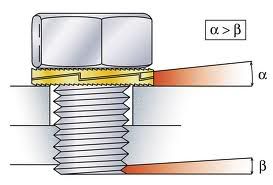 http://www.grampianfasteners.com/Produc ... 42131.aspx
The easiest solution though, and the one I am surprised is not available, would be something like this:

Maybe SNG can be encouraged to make them because every E-Type with cast manifolds needs a set!
#15
Posted: Sat Sep 29, 2012 1:07 pm
by osgii
David, is Loctite not suitable for that kind of problem?
#16
Posted: Sat Sep 29, 2012 1:14 pm
by Heuer
Not with temperatures of up to 900C depending on revs and load. Problem is there are three types of metal, each with different coefficients of expansion - steel studs, cast iron manifold and brass nuts. As I have said the heat is sufficient to remove any 'spring' in a washer and weld it flat so I think we need a strong mechanical rather than chemical solution to overcome the extremes of heat, expansion/contraction and vibration.
bfeng
The squish nuts would not stop the stud coming loose at the cast manifold end.
#17
Posted: Sat Sep 29, 2012 1:43 pm
by osgii
900??

I did not expect that bolts and studs of the exhaust manifold would become that hot.
#18
Posted: Sat Sep 29, 2012 2:36 pm
by Heuer
As I said the EGT is dependent on revs and load. This is a graph of a BMW 3 litre 6 cylinder engine:

So Locite or similar may work providing you don't exceed 3,000 rpm or use WOT. Might as well buy a pious Prius
#19
Posted: Sat Sep 29, 2012 3:29 pm
by Heuer
This could be another neat option:
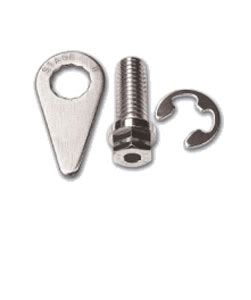
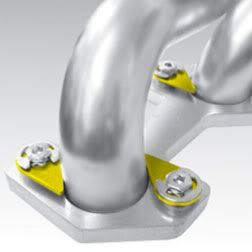 http://www.stage8.com/mopar.html
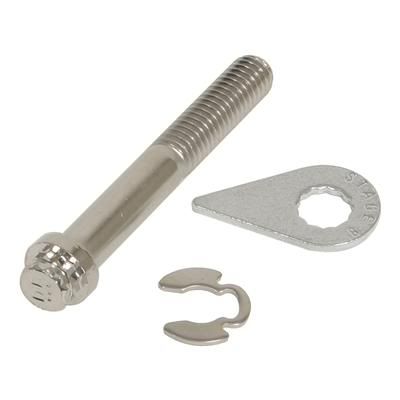
Available via eBay but not cheap but highly regarded. They would also be excellent to replace the manifold to head studs which also come loose. This is the 'stud' version:
#20
Posted: Sat Sep 29, 2012 6:02 pm
by christopher storey
David : I was reading my MG Owners Club magazine today , and advertised from MGOC are triple length 5/16 brass nuts at 50 pence each . Might be worth a try since there will be very much more thread contact? Or are the Jaguar studs bigger ?