


Hi everyone.
Has anyone changed the bakelite "paddles" on the six toggle switches in the central dashboard panel. I have a new set from SNG Barrett and would appreciate any advice on how to change them. Looking at the new ones they appear to just push onto the metal spigots of the switches. The tickly bit is how do you get the old ones off. I have tried to pull them off to no avail. Is it a case of resorting to brute force, choosing the right hammer and breaking them?
Thanks in advance
Alan Cochrane
1962 S1 OTS
S1 TOGGLE SWITCHES
-
 ALAN COCHRANE
Topic author - Posts: 712
- Joined: Sun May 06, 2012 9:37 am
- Location: Fife

#2 Re: S1 TOGGLE SWITCHES
Alan, I'm afraid that brute force might be the only resort. Try warming them up (not too much heat). However, try cleaning the orignals with chrome cleaner first, you might get a decent result! Let us know how you do.
Angus
Angus
Angus 67 FHC 1E33656
61 OTS 875047
61 OTS 875047
| Link: | |
| BBcode: | |
| HTML: | |
| Hide post links |

#3
Alan
Angus is right, you have to break the old ones off. I would use a pair of pliers to 'crush' the hard plastic so as not to put any stress on the switch itself. You could use a hammer I suppose but there is a risk of knackering the switch if your aim is not true.
Angus is right, you have to break the old ones off. I would use a pair of pliers to 'crush' the hard plastic so as not to put any stress on the switch itself. You could use a hammer I suppose but there is a risk of knackering the switch if your aim is not true.
Last edited by Heuer on Mon Jun 25, 2012 6:47 pm, edited 1 time in total.
David Jones
S1 OTS OSB
1997 Porsche 911 Guards Red
2024 Lexus LBX
Add your E-Type to our World Map: http://forum.etypeuk.com/viewtopic.php?f=1&t=1810
S1 OTS OSB
1997 Porsche 911 Guards Red
2024 Lexus LBX
Add your E-Type to our World Map: http://forum.etypeuk.com/viewtopic.php?f=1&t=1810
| Link: | |
| BBcode: | |
| HTML: | |
| Hide post links |
-
 PeterCrespin
- Posts: 4561
- Joined: Fri Mar 05, 2010 8:22 pm
- Location: Gaithersburg, Maryland.
- Contact:

#4
The new are not the same material as the old and look/feel different. This is one of those quintessential 'patina' issues. Do you want bright squeaky-clean polyurethane repro or do you want toggles (and gear knob, steering wheel, instruments etc.) that have seen action and been experienced by a dozen thrilled previous owners/drivers down the decades all feeling what you are feeling in the same car in history?
There's no right or wrong answer, and in the case of steering wheel rims a badly-splintered rim needs replacement regardless. But for the other bits? I would fell bad purposely crunching some perfectly good Brown's Lane Bakelite to slide on a repro oily/shiny modern toggle. Same as I'd rather put a new rim on the old wheel than buy a whole new wheel.
The old stuff can be dyed black again and presumably polished if you want to spend the time with a Dremel or whatever buffing the patina off them. I'm not saying that would be sacrilege but crunching intact toggles to dust comes pretty close IMHO. Chacun ? son go?t I suppose <shrug>.
Pete
There's no right or wrong answer, and in the case of steering wheel rims a badly-splintered rim needs replacement regardless. But for the other bits? I would fell bad purposely crunching some perfectly good Brown's Lane Bakelite to slide on a repro oily/shiny modern toggle. Same as I'd rather put a new rim on the old wheel than buy a whole new wheel.
The old stuff can be dyed black again and presumably polished if you want to spend the time with a Dremel or whatever buffing the patina off them. I'm not saying that would be sacrilege but crunching intact toggles to dust comes pretty close IMHO. Chacun ? son go?t I suppose <shrug>.
Pete
1E75339 UberLynx D-Type; 1R27190 70 FHC; 1E78478; 2001 Vanden Plas
| Link: | |
| BBcode: | |
| HTML: | |
| Hide post links |
#5
Alan,
I wholeheartedly concur with Angus and Peter, I haved just cleaned the toggle switches as part of the resto on my car. After trying a couple of different cleaners, some chrome cleaner came up trumps removing years of ingrained dirt but leaving a wonderful aged patina. Unless the switches you have are damaged beyond repair I would try and save them. This is only my opinion of course.... :)
I wholeheartedly concur with Angus and Peter, I haved just cleaned the toggle switches as part of the resto on my car. After trying a couple of different cleaners, some chrome cleaner came up trumps removing years of ingrained dirt but leaving a wonderful aged patina. Unless the switches you have are damaged beyond repair I would try and save them. This is only my opinion of course.... :)
Steve - 1966 2+2 1E50101 slow restoration
| Link: | |
| BBcode: | |
| HTML: | |
| Hide post links |
#6
Brasso also works very well on bakelite. Somebody was offering totally refurbished sets of switches on eBay a while back I seem to recall.
David Jones
S1 OTS OSB
1997 Porsche 911 Guards Red
2024 Lexus LBX
Add your E-Type to our World Map: http://forum.etypeuk.com/viewtopic.php?f=1&t=1810
S1 OTS OSB
1997 Porsche 911 Guards Red
2024 Lexus LBX
Add your E-Type to our World Map: http://forum.etypeuk.com/viewtopic.php?f=1&t=1810
| Link: | |
| BBcode: | |
| HTML: | |
| Hide post links |
-
ALAN COCHRANE
Topic author - Posts: 712
- Joined: Sun May 06, 2012 9:37 am
- Location: Fife
#7 RE:TOGGLE SWITCHES
Gents
Thanks for all your replies. Yes I too am a bit loath to replace them. I will try and dye and polish them with my trusty dremel. I will keep the replacements in case any of the originals break. One of the switches appears to have worn to the point of being see-through. Has anyone else had this happen?
I'll let you know how I get on.
Cheers
Alan
P.S. I was only joking about the hammer at least till I had lost my temper!
Thanks for all your replies. Yes I too am a bit loath to replace them. I will try and dye and polish them with my trusty dremel. I will keep the replacements in case any of the originals break. One of the switches appears to have worn to the point of being see-through. Has anyone else had this happen?
I'll let you know how I get on.
Cheers
Alan
P.S. I was only joking about the hammer at least till I had lost my temper!
| Link: | |
| BBcode: | |
| HTML: | |
| Hide post links |
-
PeterCrespin
- Posts: 4561
- Joined: Fri Mar 05, 2010 8:22 pm
- Location: Gaithersburg, Maryland.
- Contact:
#8
High fives all round gents, for saving a batch of irreplaceable Bakelite toggles from turning into floor sweepings. Result! :-)
('High fives' - yuk. Can you tell I've emigrated? Time was it would have been a firm manly hanshake and muttered congratulatory half-sentences over a pint of warm bitter.)
('High fives' - yuk. Can you tell I've emigrated? Time was it would have been a firm manly hanshake and muttered congratulatory half-sentences over a pint of warm bitter.)
1E75339 UberLynx D-Type; 1R27190 70 FHC; 1E78478; 2001 Vanden Plas
| Link: | |
| BBcode: | |
| HTML: | |
| Hide post links |
-
ALAN COCHRANE
Topic author - Posts: 712
- Joined: Sun May 06, 2012 9:37 am
- Location: Fife
#9 IDLE SPEED
Gents
Another question for the experts.
When the engine is fully warmed up after a good run the idle speed rises to approximately 1200-1300rpm. When the engine is warming up the idle speed is about 1000rpm. I have checked the fast idle screws and adjusted them all exactly as the workshop manual describes. the throttle linkage appears to be closed as far as possible because any further unscrewing of the idle screws does not result in any corresponding movement in the linkage. I have also topped up the carb dashpots, to no avail.
I have noticed that the carb float chambers are all leaking/flooding to some degree, especially after acceleration. I intend to buy repair kits for these. Could this be reason? An over-rich mixture at idle after an increase in revs.
Any advice would be appreciated.
Thanks In Advance
Alan
Another question for the experts.
When the engine is fully warmed up after a good run the idle speed rises to approximately 1200-1300rpm. When the engine is warming up the idle speed is about 1000rpm. I have checked the fast idle screws and adjusted them all exactly as the workshop manual describes. the throttle linkage appears to be closed as far as possible because any further unscrewing of the idle screws does not result in any corresponding movement in the linkage. I have also topped up the carb dashpots, to no avail.
I have noticed that the carb float chambers are all leaking/flooding to some degree, especially after acceleration. I intend to buy repair kits for these. Could this be reason? An over-rich mixture at idle after an increase in revs.
Any advice would be appreciated.
Thanks In Advance
Alan
| Link: | |
| BBcode: | |
| HTML: | |
| Hide post links |
-
PeterCrespin
- Posts: 4561
- Joined: Fri Mar 05, 2010 8:22 pm
- Location: Gaithersburg, Maryland.
- Contact:
#10
The fuel leakage needs sorting and if it's all three you may have an unsuitable pump or a tank full of gritty rust.
However, high idle needs high air flow. So somewhere there is too much air getting in. Check vacuum leaks, carb flange leaks and eventually maybe, butterflies not centred in the choke.
I had intermittent high idle trouble when hot, due to aftermarket shiny carb return springs bought from eBay. They looked right and worked when cold but after a hard run they just didn't pull the carbs quite shut unless you blipped the throttle. Fitting an original spring at Willem Kemper's place in Venlo has fixed the 'laziest' carb and sorted the issue, to be followed by the others when I dig out three oldies and send Willem's back in due course. Side by side you can just see/feel the thicker wire and stronger pull of the SU part but on its own the repro looked OK.
However, high idle needs high air flow. So somewhere there is too much air getting in. Check vacuum leaks, carb flange leaks and eventually maybe, butterflies not centred in the choke.
I had intermittent high idle trouble when hot, due to aftermarket shiny carb return springs bought from eBay. They looked right and worked when cold but after a hard run they just didn't pull the carbs quite shut unless you blipped the throttle. Fitting an original spring at Willem Kemper's place in Venlo has fixed the 'laziest' carb and sorted the issue, to be followed by the others when I dig out three oldies and send Willem's back in due course. Side by side you can just see/feel the thicker wire and stronger pull of the SU part but on its own the repro looked OK.
1E75339 UberLynx D-Type; 1R27190 70 FHC; 1E78478; 2001 Vanden Plas
| Link: | |
| BBcode: | |
| HTML: | |
| Hide post links |
-
ALAN COCHRANE
Topic author - Posts: 712
- Joined: Sun May 06, 2012 9:37 am
- Location: Fife
#11 IDLE SPEED
Peter
Thanks for the reply. I think the leaking float chambers are probably due to that old favourite the punctured float. I've only had the car for 9 months so I am unsure of how long anything has been on the car. On the plus side the filter bowl is clean so it 's unlikely to be caused by rust coming from the tank.
As far as the idle problem goes the throttle linkage seems to be closed as far as it will go, even when you use your fingers to force it any further. So I think the springs are OK. As to excess air that may be a possibility. Although I've recently had to rebuild the brake master cylinder and at the same time took the opportunity to repaint the vacuum tank. I had a good look at all the hoses and they seemed fairly new and in good order. I even went to the extreme of changing all the jubilee clips for shiny new ones. In addition when you press the brake pedal with the engine idling the revs drop slightly, indicating a good vacuum is present.
Sorry to ramble on a bit. I'll refurbish the float chambers and see how that goes. I'll keep you posted.
Cheers
Alan
Thanks for the reply. I think the leaking float chambers are probably due to that old favourite the punctured float. I've only had the car for 9 months so I am unsure of how long anything has been on the car. On the plus side the filter bowl is clean so it 's unlikely to be caused by rust coming from the tank.
As far as the idle problem goes the throttle linkage seems to be closed as far as it will go, even when you use your fingers to force it any further. So I think the springs are OK. As to excess air that may be a possibility. Although I've recently had to rebuild the brake master cylinder and at the same time took the opportunity to repaint the vacuum tank. I had a good look at all the hoses and they seemed fairly new and in good order. I even went to the extreme of changing all the jubilee clips for shiny new ones. In addition when you press the brake pedal with the engine idling the revs drop slightly, indicating a good vacuum is present.
Sorry to ramble on a bit. I'll refurbish the float chambers and see how that goes. I'll keep you posted.
Cheers
Alan
| Link: | |
| BBcode: | |
| HTML: | |
| Hide post links |
#12
Fluctuating idle can be a sign of worn carb throttle bushes allowing air into the system. Maybe time to consider a rebuild?
David Jones
S1 OTS OSB
1997 Porsche 911 Guards Red
2024 Lexus LBX
Add your E-Type to our World Map: http://forum.etypeuk.com/viewtopic.php?f=1&t=1810
S1 OTS OSB
1997 Porsche 911 Guards Red
2024 Lexus LBX
Add your E-Type to our World Map: http://forum.etypeuk.com/viewtopic.php?f=1&t=1810
| Link: | |
| BBcode: | |
| HTML: | |
| Hide post links |
-
ALAN COCHRANE
Topic author - Posts: 712
- Joined: Sun May 06, 2012 9:37 am
- Location: Fife
#13 IDLE SPEED
David
Thanks for the reply. I have since been trawling the internet for similar problems relating to SU carburetors and see the phrase "False Air" mentioned. This seems to be what you were suggesting. I think I'll start by puttying up the linkages where they enter the carb bodies and hopefully this will indicate whether this is the source of the problem. It certainly seems to fit the bill. I'm assuming from initial start-up that the gaps are small due to the carb being cold and only after a long run with everything hot/warmed up the gaps increase making the problem noticeable.
If this is the case and the carb body has been worn over the years what remedies are their short of replacing the whole unit? I also wonder if the mixture is slightly too lean and is only noticeable at idle.
Cheers
Alan
Thanks for the reply. I have since been trawling the internet for similar problems relating to SU carburetors and see the phrase "False Air" mentioned. This seems to be what you were suggesting. I think I'll start by puttying up the linkages where they enter the carb bodies and hopefully this will indicate whether this is the source of the problem. It certainly seems to fit the bill. I'm assuming from initial start-up that the gaps are small due to the carb being cold and only after a long run with everything hot/warmed up the gaps increase making the problem noticeable.
If this is the case and the carb body has been worn over the years what remedies are their short of replacing the whole unit? I also wonder if the mixture is slightly too lean and is only noticeable at idle.
Cheers
Alan
| Link: | |
| BBcode: | |
| HTML: | |
| Hide post links |
#14
A quick look at the plugs will tell you all you need to know about the mixture. There are several people who can refurbish the carbs and I can personally recommend David Lonsdale of Classic Carburettors who did mine - T: 07786 912011 david@classiccarburetters.co.uk He will collect and deliver, takes 6 to 8 weeks and costs about ?600 but the job he does is superb:
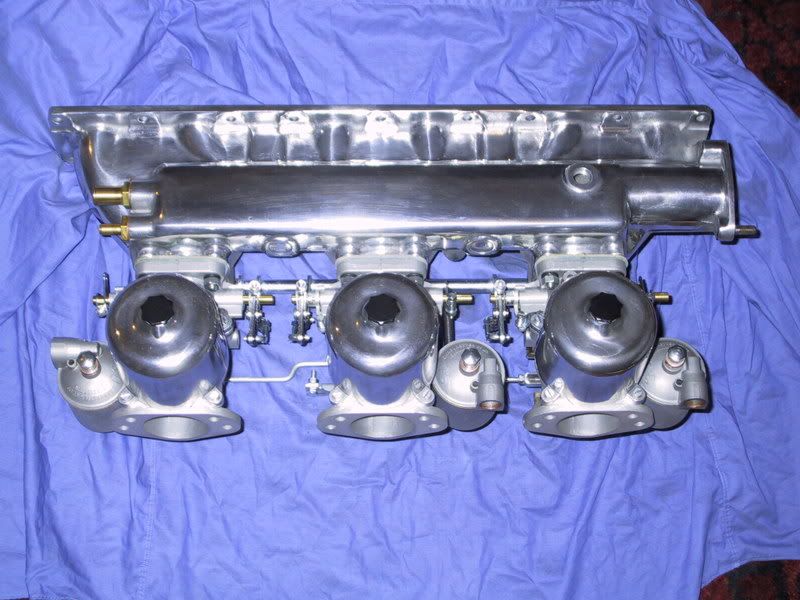

Trying to just replace the bushes is going to be pretty pointless as you will discover other wear problems.
Trying to just replace the bushes is going to be pretty pointless as you will discover other wear problems.
David Jones
S1 OTS OSB
1997 Porsche 911 Guards Red
2024 Lexus LBX
Add your E-Type to our World Map: http://forum.etypeuk.com/viewtopic.php?f=1&t=1810
S1 OTS OSB
1997 Porsche 911 Guards Red
2024 Lexus LBX
Add your E-Type to our World Map: http://forum.etypeuk.com/viewtopic.php?f=1&t=1810
| Link: | |
| BBcode: | |
| HTML: | |
| Hide post links |
-
PeterCrespin
- Posts: 4561
- Joined: Fri Mar 05, 2010 8:22 pm
- Location: Gaithersburg, Maryland.
- Contact:
#15 Re: IDLE SPEED
It's a near certainty really, if you think about it. Let's go back to basics...ALAN COCHRANE wrote: As to excess air that may be a possibility.
An internal combustion engine is basically just an air pump whose speed is controlled by changing the intake orifice (i.e 'throttling' it). Just as the rather colourful language suggests, if you strangle or throttle the engine completely it will stop dead, because it can no longer flow any air. The fuel is just the motive power source and in this case happens to be burned inside the cylinders, but there are other options.
Ergo, whereas we normally control the engine revs and power by altering the airflow, here your engine has found some airflow you don't know about and consequently you are powerless to control the revs and are asking for ideas.
Find the air leak and you will successfully throttle back the engine. Timing and mixture strength have minor but real effects, so yes, try to sort out your floats etc. But all those parameters mean is that once they are optimised you STILL have to throttle back the airflow to get the running speed you desire. Seemples!
1E75339 UberLynx D-Type; 1R27190 70 FHC; 1E78478; 2001 Vanden Plas
| Link: | |
| BBcode: | |
| HTML: | |
| Hide post links |
-
christopher storey
- Posts: 5698
- Joined: Sun Mar 09, 2008 3:07 pm
- Location: cheshire , england
#16
Alan : the one thing that has not been mentioned so far is that the throttles DO NOT control the idle speed ( or more accurately should not control it) . The idle should be controlled by the 3 air bleed screws, 1 in each carburetter. These are pointed screws which seat on a rubber O ring in the base of the socket , and bleed air to the downstream side of the butterfly via a drilling. It is very common for the O ring to go hard or break , in which case there is an excess bleed of air. Since you are satisifed that your butterflies are fully closing, I would look at these before going in for expensive surgery
| Link: | |
| BBcode: | |
| HTML: | |
| Hide post links |
-
ALAN COCHRANE
Topic author - Posts: 712
- Joined: Sun May 06, 2012 9:37 am
- Location: Fife
#17 IDLE SPEED
Gents
Thanks again for all your efforts.
I was going to check the plugs as a matter of course. If i'm really lucky they may show signs of a lean mixture and possibly I'll only have to open the jets up slightly-one flat at a time.
If not I'll take Chris's point as the next thing to do since it is the simplest and cheapest solution-good engineering practice.
After that I'll just work methodically through all the options you suggest, hopefully stopping short of a full rebuild.
A quick resume of the car:-
The whole front end of the car was rebuilt 5 years ago including a new picture frame, engine rebuild and complete rewire with a conversion to negative earth. The brakes were uprated to 4.2 spec and the gearbox is a Jaguar rather than Moss unit. The body work has been rebuilt at least twice in it's life and is nicely patina'd rather than pristine. I have the original log book and the full history of the car as well. All in all I think I've been really lucky in choosing this particular car to buy.
Anyway any work will have to wait until I get back from my holidays in St. Lucia. But never fear one book I'll be taking is Chris Rooke's DIY resto of his E-Type which is an entertaining read.
I'll let you know how I fair once I return to these sunny shores in July.
Thanks Again
Alan
Thanks again for all your efforts.
I was going to check the plugs as a matter of course. If i'm really lucky they may show signs of a lean mixture and possibly I'll only have to open the jets up slightly-one flat at a time.
If not I'll take Chris's point as the next thing to do since it is the simplest and cheapest solution-good engineering practice.
After that I'll just work methodically through all the options you suggest, hopefully stopping short of a full rebuild.
A quick resume of the car:-
The whole front end of the car was rebuilt 5 years ago including a new picture frame, engine rebuild and complete rewire with a conversion to negative earth. The brakes were uprated to 4.2 spec and the gearbox is a Jaguar rather than Moss unit. The body work has been rebuilt at least twice in it's life and is nicely patina'd rather than pristine. I have the original log book and the full history of the car as well. All in all I think I've been really lucky in choosing this particular car to buy.
Anyway any work will have to wait until I get back from my holidays in St. Lucia. But never fear one book I'll be taking is Chris Rooke's DIY resto of his E-Type which is an entertaining read.
I'll let you know how I fair once I return to these sunny shores in July.
Thanks Again
Alan
| Link: | |
| BBcode: | |
| HTML: | |
| Hide post links |
-
PeterCrespin
- Posts: 4561
- Joined: Fri Mar 05, 2010 8:22 pm
- Location: Gaithersburg, Maryland.
- Contact:
#18 Re: IDLE SPEED
Alan my friend, I think you are wasting your time, or will be in July. Just think about it...ALAN COCHRANE wrote:Gents
Thanks again for all your efforts.
I was going to check the plugs as a matter of course. If i'm really lucky they may show signs of a lean mixture and possibly I'll only have to open the jets up slightly-one flat at a time.
Imagine a car set up correctly and idling well and let us assume your car was like that once upon a time. For some reason the car is now idling too high and therefore inevitably, and by definition, flowing too much air at idle (swept volume x revs x filling efficiency, etc.). Leave aside for a moment the question of whether flowing too much air is cause or effect.
The engine is not racing upwards, it is steady state but settled at too high idling revs, right? Although higher vacuum flows more fuel as well, the mixture is very likely to be weak, assuming the air filter is clear and the settings have not been messed with since the fault began. It will take a long time idling with freshly-cleaned plugs to coat the electrode enough to show definitively if it is weak or not. Your engine might even get a bit hot under the collar waiting and a Colortune is quicker, but.....
By what logic is tweaking your mixture/adding more fuel to match the excessive air going to slow your engine down? You would be creating a better-burning mixture during high-vacuum idle, and that slows the engine down? I think not. In fact, what you can try is to squirt something like Easy Start at the carb spindles, carb flanges, vacuum connections and air screws as pointed out by Chris. You will almost certainly find the engine revs even higher temporarily, as the extra combustible material is sucked in with the air leak, to produce a better mixture. This naturally produces more power and creates an even higher pumping effort (i.e. vacuum) against whatever level of throttling the engine already has. Then it will settle back down as the power tails off again and the balance between weak-mixture power and air restriction is regained.
I would go back to basics, tune up as per the book, bear Chris's note very much in mind if fiddling with those screws seems to have no effect. If it does but for some reasonn you still can't get a decent idle use the Easy Start test to confirm the presence of an external the air leak rather than an internal air bleed.
Pete
1E75339 UberLynx D-Type; 1R27190 70 FHC; 1E78478; 2001 Vanden Plas
| Link: | |
| BBcode: | |
| HTML: | |
| Hide post links |
#19
Alan,
You might just check that the choke cams are seated properly when the choke lever is set to off. I did have an instance where the idle speed increased to ~1000rpm with the choke off. I eventually found that on the RH carburetor the choke cam had become twisted and had ridden up onto the edge of the rail that it normally slides in. This had the effect of opening one carb to its fast idle position. Difficult to describe but if you operate the choke and look down between the gaps between the carbs you will see the operation of the choke mech and you can check that the choke mechs are set the same on all 3 carbs.
Nick
You might just check that the choke cams are seated properly when the choke lever is set to off. I did have an instance where the idle speed increased to ~1000rpm with the choke off. I eventually found that on the RH carburetor the choke cam had become twisted and had ridden up onto the edge of the rail that it normally slides in. This had the effect of opening one carb to its fast idle position. Difficult to describe but if you operate the choke and look down between the gaps between the carbs you will see the operation of the choke mech and you can check that the choke mechs are set the same on all 3 carbs.
Nick
1965 S1 FHC
| Link: | |
| BBcode: | |
| HTML: | |
| Hide post links |