Page 1 of 1
#1 Tuning questions
Posted: Sun Jan 06, 2013 2:11 pm
by ChrisC
2 questions:
Number 1:
If I blip the throttle the engine revs happily, drops below tick over level and then come back up ( or sometimes the engine just stalls because of the momentary low revs). Idle speed is around 700rpm with fast road cams but normal air filters. Why might this be?
Number 2:
As can be seen in the photo below: Cylinders 3&4 are running at a different temperature than the others. Is a low temperature caused by a richer mixture or weaker?
Engine revs are a mere 1500rpm when I took this picture...

#2
Posted: Sun Jan 06, 2013 2:49 pm
by christopher storey
Dear me!! Tell me you are having us on , and that those pipes are not glowing cherry red ( or that you were using some sophisticated Infra-red camera) . If they are, my own opinion would be that there is something disastrously amiss , either very weak mixture, or horribly over advanced or ( more probably ) excessively retarded ignition timing . I have never ever seen pipes glow red in daylight under no real load
#3
Posted: Sun Jan 06, 2013 4:26 pm
by Dave K
Chris,
Is that a real photo? I like Christopher have never seen a manifold glow red like that before.
Is the paint on your bonnet and frames blistering?
I honestly don't what the problem is but at such low revs something is wrong.
Dave
#4
Posted: Sun Jan 06, 2013 4:35 pm
by ChrisC
The photo shows them as being far more red than they were in reality - the photo was taken in the garage with no lights on. I also took one with a flash and it looked like this:

I.e. pretty normal, so its not as bad as the first picture looks...
But I will check the timing etc
Questions still stand though... it must be fuel that changes the temperature but a colortune is not showing it as weak
#5
Posted: Sun Jan 06, 2013 5:18 pm
by christopher storey
Ah, well , that looks more like it. A photographer friend of mine did mention when I showed it to him this p.m. that some digital cameras have an infra-red setting which can be superimposed on the visible light setting and which if it were inadvertently switched on could produce that effect . Incidentally, as far as relative settings are concerned , I would say that the centre carburetter is probably set slightly richer than the outer two , hence the slightly lower apparent temperature
#6
Posted: Sun Jan 06, 2013 6:47 pm
by Heuer
I hate to think what that level of heat is doing to the adjacent frame rail though. Ohh, just a minute I do know:
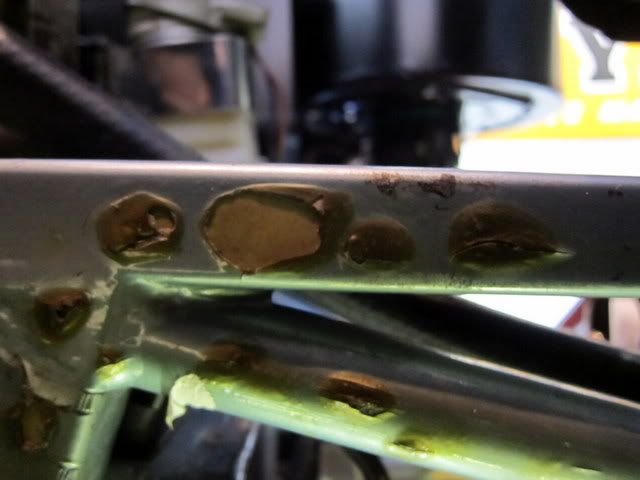
Mine after using tubular manifolds! You need to make up a frame heat shield like this:

#7
Posted: Mon Jan 07, 2013 3:37 am
by PeterCrespin
There is a third question you haven't asked:
Q: "Will I get brake trouble, especially in traffic, when my servo fries due to the missing heat shield?"
A: "Yes."
#8
Posted: Mon Jan 07, 2013 8:21 am
by ChrisC
Ha-ha We have had this discussion before - this is where people show us the stainless steel versions they have made and then we talk about heat reflective materials

I will get round to it - the cars off the road for a few months now.
#9
Posted: Mon Jan 07, 2013 9:27 am
by 1954Etype
PeterCrespin wrote:There is a third question you haven't asked:
Q: "Will I get brake trouble, especially in traffic, when my servo fries due to the missing heat shield?"
A: "Yes."
David knows all about this!
#10
Posted: Wed Jan 09, 2013 10:13 am
by Woolfi
Most people don't understand "mixture".
1. The mixture can be as week as possible at idle or part throttle. Nothing bad can happen because of to high temperatures to the motor ( pistons or valves). The temperature of the exhaust gases it much to low.
2. With a colortune you can check the mixture only at idle or part throttle.
3. Important that the mixture is becoming rich (lambda 0.85 - 0,95) , when the motor is producing more than 70% of it's maximum power. At full throttle, the temperature of the exhaust gases can reach more than 900 degree celsius. Normally this is the temperature 'border' where life is becoming dangerous for the pistons and valves. With a lean mixture at part throttle, the motor is not reaching this temperature.
4. The different colours of the headers show that exactly at 1500 rpm and part throttle there is a difference in mixture. At full throttle it can be different. If you measure your needles, maybe you can see, that one is thicker in a low area of the needle. But the differences in diameter are very, very small. Maybe less than 1/100 mm.
5. To be sure, that the mixture is not to lean at your motor, you have to check the mixture of each carb with a lambda-meter like "innovate", when driving under full throttle conditions.
6. If the airfilter or the exhaust system has been "opened", the chance is high that the mixture has become to weak IF the needles have NOT been changed. If you are able to drive 5 mintes with full throttle, shut the motor and check the sparkplugs you would be able to see if the mixture is weak. The electrodes must be bright brown, not grey or white. Driving in town and checking the electrodes says NOTHING about full throttle mixture.
7. If your mixture seems to week because of white electrodes, you can make the needles in the top 20% area about 2 - 5/100 mm thinner. It is NOT possible to make your mixture less lean, by lowering the jet. The lowering of the jet has it's biggest effect at idle or low throttle. At full throttle the change of the mixture is much too small.
7 . How I do know this? I have a lambda-meter mounted 5 years ago in my EV12 and checked how the mixture at full throttle changed,
- when I opened the exhaust, (drilling the 2 mufflers lengthwise with 50 mm) + 60 mm wide pipes from mufflers without back muffler,
- when I made the inlet of my airfilters much wider ,
- when I tried to change the mixture by "turning" screws at the carbs,
- when I mounted a 6.0 litre motor from a 1993 XJ8 limousine into my E-type.
IF a sports exhaust system is mounted and this system has less back pressure, the needles MUST be changed. If not, your motor has less power, because of too lean mixture. Soon it will have nearly NO power, because of holes in the pistons. Sure ! ! ! Most people don't believe this, because they misunderstand that more roar is not automatically more power.
Also it is possible to check the mixture on a rolling road. But the cheapest system from "Innovate" is cheaper, than going three times to a rolling road.
If you want to know all about "mixture" buy the book from Des Hammill "SU-carbs". All you want to know is explained very exactly. Also the "tuning" of needles for a more "sporty" motor.
Regards Wolfgang Gatza
#11
Posted: Wed Jan 09, 2013 3:19 pm
by ChrisC
Many thanks Woolfi
That was an interesting read...
So I will do what I can to check mixture at idle then have my Jaguar specialist check the tuning at wider throttle openings as I do not have that kind of equipment at home :)
#12
Posted: Wed Jan 09, 2013 5:15 pm
by Woolfi
"So I will do what I can to check mixture at idle then have my Jaguar specialist check the tuning at wider throttle openings as I do not have that kind of equipment at home."
I think that many Jaguar-"specialists" don't understand "mixture" and they will also will not have the equipment in their garages.
Testing the mixture at idle with a gas analyser is worthless, because the mixture at foll throttle can be much different, if the cams or the exhaust or the airfilter have been changed.
In Germany most of the Jaguar-specialists talk some garbage like "brown plugs are okay".
Regards Wolfgang Gatza
#13
Posted: Wed Jan 09, 2013 5:45 pm
by ChrisC
:) You are probably right but I am lucky in that the owners of winspeedmotorsport.com live in the same road as myself - They are my Jaguar *specialist* and they also race a number of Jaguars. I believe they have the equipment you mention.
But like the rest of my restoration - i am trying to do everything myself as its the best way to learn.
To be fair - I am still running in the engine, but once that is completed (another 250 miles) - I will give them the car to 'tune'.
#14
Posted: Thu Jan 10, 2013 1:15 pm
by Woolfi
Hello Chris !
With this lambda gauge you can check the mixture of your motor or every carb, depending on the point where the lambda-sensor is mounted at the exhaust system. It is cheaper, than 2 hours on a rolling road.
http://www.ebay.co.uk/itm/INNOVATE-DB-R ... 45eff79950
Regards Wolfgang Gatza
#15
Posted: Thu Jan 10, 2013 2:46 pm
by Heuer
+1 for the Innovate - I have one although I use it on the resonators tips rather than drilling the manifolds. I can also recommend the winsu software
http://www.winsu.co.uk/ which is free to try but requires a small payment for full activation. Very clever because it allows you to put in data about your car and engine and then tells you which needles would be best:


Superb bit of software that can make needle selection very easy and complements the Innovate perfectly.
#16
Posted: Thu Jan 10, 2013 3:41 pm
by Woolfi
Innovate LC-1 is one of the best tools , I have ever bought. Before I have first used it, my car had a light flat spot, below 3000 rpm, when pressing the pedal to the metal. With the Lambda-Gauge you I was able to see, why. The mixture was becoming lean to roundabout AFR 18 (= Lambda 1,22). With this lean mixture, the motor has roundabout 25% less torque, than with Lambda 0,9. I have ground my needles with fine sanding paper in a certain area a little bit thinner, mounted the needles into the carbs and checked again the mixture when driving. The mixture was fatter than before, but still slightly lean. I have repeated the operation until the mixture was slightly fat, when pressing to full throttle.
Now the car is running very well, the mixture when cruising is lean, the gas consumption is low / okay and the smell when cruising is minimum.
How will a car mechanic do this without a Lambda-gauge or a rolling road ? Checking sparkplug electrodes must be done very carefully in a scientific manner, to have valid results. Just to un-mount the sparks, check the colour the electrodes, has only low information.
The winsu-program is very helpful, but you never can be SURE, that the mixture is correct.
Regards Wolfgang Gatza
#17
Posted: Thu Jan 10, 2013 5:20 pm
by ChrisC
I would not want to drill the manifold although I can understand why it would make sense to do that for a race car- can the sensors be simply inserted into the exhaust tail pipe?
I can see that doing that would not be as good but I guess thats what garages do...
#18
Posted: Thu Jan 10, 2013 5:29 pm
by Heuer
Chris
Innovate provide manifold plugs to allow the lamba sensor to be fitted directly but I have never bothered especially with cast manifolds. I insert the lamba sensor in each exhaust pipe outlet in turn (a bolt on clamp secures it for running on the road) and you can get good results knowing that altering the mixture on the central carb will affect both readings. Not good enough if you are going racing but fine on a road car.
#19
Posted: Thu Jan 10, 2013 5:39 pm
by ChrisC
oh yes of course the central carb would change readings being taken from both tail pipes.
I will take a better look at this - i love new toys...
#20
Posted: Thu Jan 10, 2013 5:40 pm
by Woolfi
Hello Chris !
1. I would change the needle of the second carb to the first or third carb and check if the colour of the 4 headers have changed.
2. You can measure the gases also at the end of the tailpipe, BUT the exhaust system MUST have no holes. Sometimes the pressure inside the exhaust system is below athmospheric pressure. In this short time, fresh air with oxygen can come inside the exhaust system and the result of measuring at the tailpipe will be wrong.
3. I am measuring at one 6into1 sampler before the central silnecers. Therefore I can only check two carbs together. It is okay, but not good.
Regards Wolfgang Gatza