#1 3AW Relay alternative.
Posted: Sun May 22, 2016 6:11 am
I thought I'd do a little write up about something I've made work on my car, not because its particularly earth shattering but mostly because of the excellent customer service I received for an order of <?20 delivered.
Problem:
My ignition warning light didnt work, and the problem wasnt the lamp!
Diagnosis:
The warning light is controlled by a Lucas 3AW relay, a can shaped relay in my car LHD FHC positioned near the battery and looking not unlike a flasher relay.
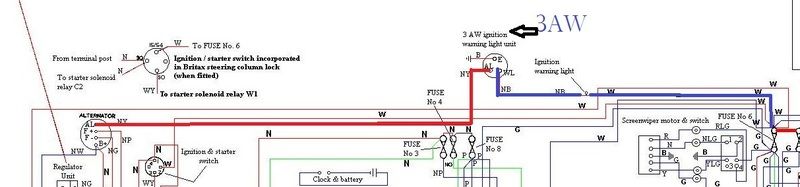
I couldnt find a diagram of what the 3AW actually does, but I checked that it got its AC feed from the alterator, its DC feed from the fusebox and was adequately grounded - and so I concluded that it was failed. Quick google and I discovered that they were available either as like for like replacements or solid state aftermarket, and also that they were orginally fitted on Norton Commando motorcycles - this piqued my interest so I googled on, and found the website http://www.improvingclassicmotorcycles.com/products.htm and I watched their video:
I pinged them an email, we struck up a conversation and the chap, Graham, really went beyond the call to make sure I got the the right product. The lamp goes into a 16mm (approx) orifice, and so we hatched a plot to deal with that. (sorry, I am metric when it comes to measurements less than a mile)

I ordered, and a few days later the product arrived:

Graham had supplied a bit of PVC tubing, which I split and bound making 16mm:

One cable on to the ignition switch. ( I did tidy it up later) I can't I confess tell you which terminal thats on, but my understanding is that my ignition switch only has (effectively) 3 terminals "in", "run" and "start" so I just looked for "run" with my multimeter, and piggy backed off that, it was easier than removing the switch. (the bullet connector disconnected in this photo is the feed to the worlds most annoying key in alarm - I did restore it once finished but its a more peaceful day with it off)

and the other on to a ground.
Cable tied the rest of it away:

and job done.
I should add that the original wiring to the 3AW Relay remains on my car, I have simply isolated the ends, ditto I have retained but tied out of the way, the original lamp holder for the warning light so this is entirely reversible should a future custodian want to re-establish it. But, I think this unit actually gives me better data, so I'm happy.
So, OK, I havent done rocket science, or new art, but what impressed me, as I said above, was the care an attention Graham at http://www.improvingclassicmotorcycles.com/index.htm took in the process making sure I got the right product, and that I thought needed sharing.
Thanks.
Problem:
My ignition warning light didnt work, and the problem wasnt the lamp!
Diagnosis:
The warning light is controlled by a Lucas 3AW relay, a can shaped relay in my car LHD FHC positioned near the battery and looking not unlike a flasher relay.

I couldnt find a diagram of what the 3AW actually does, but I checked that it got its AC feed from the alterator, its DC feed from the fusebox and was adequately grounded - and so I concluded that it was failed. Quick google and I discovered that they were available either as like for like replacements or solid state aftermarket, and also that they were orginally fitted on Norton Commando motorcycles - this piqued my interest so I googled on, and found the website http://www.improvingclassicmotorcycles.com/products.htm and I watched their video:
I pinged them an email, we struck up a conversation and the chap, Graham, really went beyond the call to make sure I got the the right product. The lamp goes into a 16mm (approx) orifice, and so we hatched a plot to deal with that. (sorry, I am metric when it comes to measurements less than a mile)
I ordered, and a few days later the product arrived:

Graham had supplied a bit of PVC tubing, which I split and bound making 16mm:

One cable on to the ignition switch. ( I did tidy it up later) I can't I confess tell you which terminal thats on, but my understanding is that my ignition switch only has (effectively) 3 terminals "in", "run" and "start" so I just looked for "run" with my multimeter, and piggy backed off that, it was easier than removing the switch. (the bullet connector disconnected in this photo is the feed to the worlds most annoying key in alarm - I did restore it once finished but its a more peaceful day with it off)

and the other on to a ground.
Cable tied the rest of it away:

and job done.
I should add that the original wiring to the 3AW Relay remains on my car, I have simply isolated the ends, ditto I have retained but tied out of the way, the original lamp holder for the warning light so this is entirely reversible should a future custodian want to re-establish it. But, I think this unit actually gives me better data, so I'm happy.
So, OK, I havent done rocket science, or new art, but what impressed me, as I said above, was the care an attention Graham at http://www.improvingclassicmotorcycles.com/index.htm took in the process making sure I got the right product, and that I thought needed sharing.
Thanks.