


Does anyone have a typical value of the total turning torque for a refurbished diff. By this I mean the inch pound value of the input shaft when the diff is fully assembled on the bench
A
Differential turnjng torque
#1 Differential turnjng torque
Al
Series 1, 2+2
undergoing renovation
Series 1, 2+2
undergoing renovation
| Link: | |
| BBcode: | |
| HTML: | |
| Hide post links |

#2 Re: Differential turnjng torque
Not off the top of my head but pretty sure you’ll find it in the manual. I’ll have a look when I get home from work.
Andrew.
881824, 1E21538. 889457. 1961 4.3l Mk2. 1975 XJS. 1979 MGB (supercharged).
Adelaide, Australia
881824, 1E21538. 889457. 1961 4.3l Mk2. 1975 XJS. 1979 MGB (supercharged).
Adelaide, Australia
| Link: | |
| BBcode: | |
| HTML: | |
| Hide post links |

#3 Re: Differential turnjng torque
Typically you would measure seperatly the pinion and out shafts as you assemble the diff....you then have a cumulative effect of all and the new seals....all I could say is it will be tight to turn by hand.....Steve
Steve
69 S2 2+2 (sold) ..Realm C type replica, 1960 xk150fhc
69 S2 2+2 (sold) ..Realm C type replica, 1960 xk150fhc
| Link: | |
| BBcode: | |
| HTML: | |
| Hide post links |
#4 Re: Differential turnjng torque
As Steve states, you would measure the turning torques separately as the diff is assembled. These photos below are the pinion torque settings from a later Jaguar publication - I think the XJS if I recall as I don’t think these torque figures are given in the Jaguar E type Service Manuals. It is for a later differential using the double taper rolling bearings. Initially the pinion torque figure is taken and recorded, to then be added to the torque figure obtained once the backlash has been set, but interestingly before the output shaft assemblies are finally torqued up.
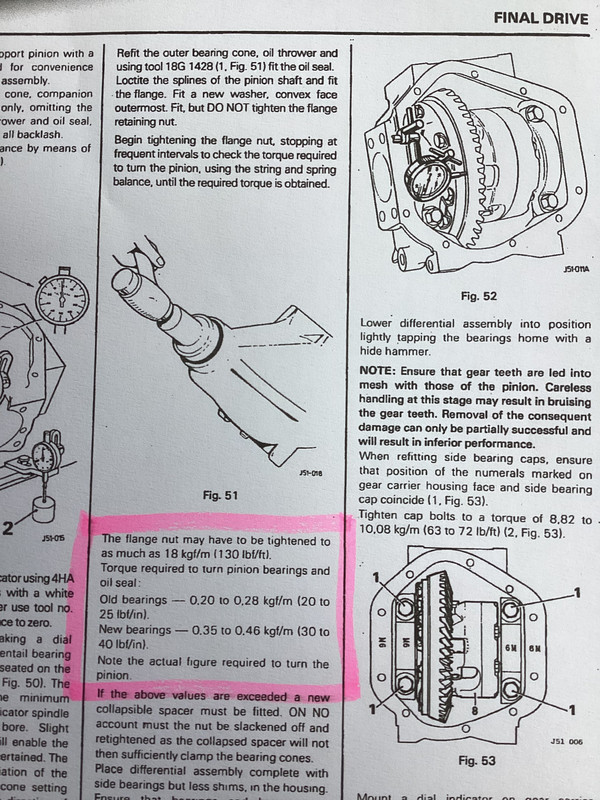
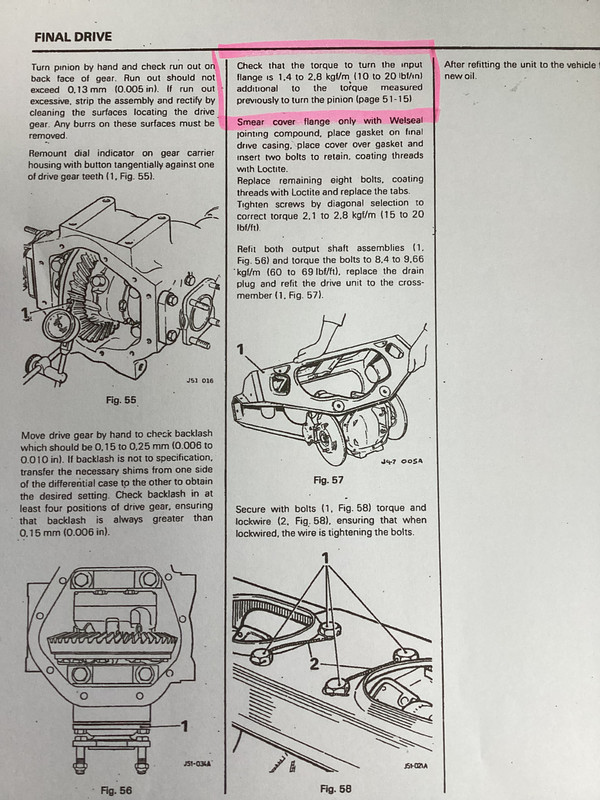
Hopefully of use.
Cheers,
Dave
Hopefully of use.
Cheers,
Dave
Dave Rose
1967 Series 1 4.2 FHC
1967 Series 1 4.2 FHC
| Link: | |
| BBcode: | |
| HTML: | |
| Hide post links |
#5 Re: Differential turnjng torque
I recently had my diff refurbished by Alan Slawson, I could not move the input shaft by hand and had to use 2 bolts and a screwdriver to turn it
1965 series 1 ots
1972 triumph spitfire
2016 Caddy van
1972 triumph spitfire
2016 Caddy van
| Link: | |
| BBcode: | |
| HTML: | |
| Hide post links |
#6 Re: Differential turnjng torque
Iansparky, if you know your torques, the range given in my information above for differentials with new bearings, could total between 40 to 50 lbs/in, which as Steve states at post #3, would be very tight to turn by hand.
My local “metal refurbishing” company - used to be my local scrapyard - knows what parts I’m always interested in and one time called to say they had a Jaguar XJS come in. I removed the rear suspension cage and took the differential out. The rear suspension cage looked to be in considerably better condition than the rest of the car which was being scrapped. I was surprised how hard the input flange was to turn - as Steve states - I needed a lever to get it moving, but noted the following two stickers on the cage and differential which I hadn’t seen before.
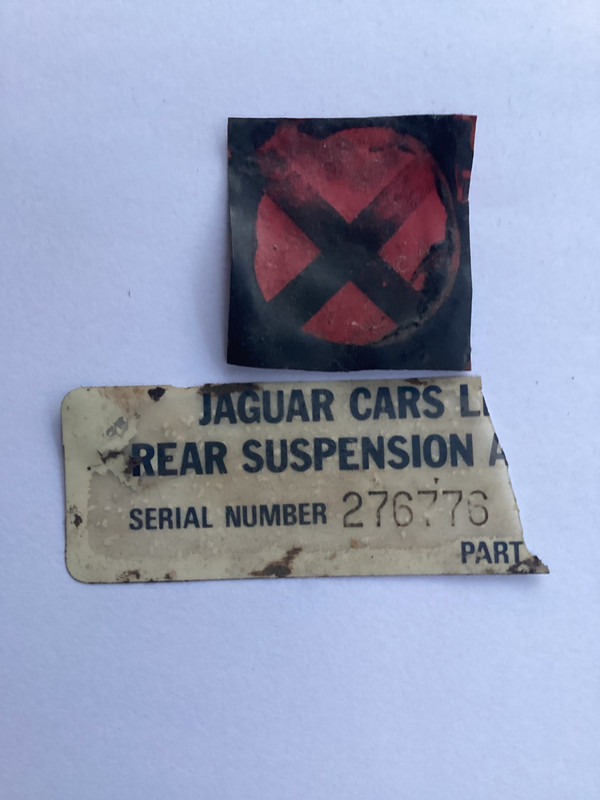
On opening the rear cover the differential was absolutely like brand new, so I’ve assumed the black cross on the red background which was stuck on the differential cover indicated it was part of a Jaguar replacement exchange rear suspension assembly containing a new differential unit. Unless anyone else knows any different ?
Cheers,
Dave
My local “metal refurbishing” company - used to be my local scrapyard - knows what parts I’m always interested in and one time called to say they had a Jaguar XJS come in. I removed the rear suspension cage and took the differential out. The rear suspension cage looked to be in considerably better condition than the rest of the car which was being scrapped. I was surprised how hard the input flange was to turn - as Steve states - I needed a lever to get it moving, but noted the following two stickers on the cage and differential which I hadn’t seen before.
On opening the rear cover the differential was absolutely like brand new, so I’ve assumed the black cross on the red background which was stuck on the differential cover indicated it was part of a Jaguar replacement exchange rear suspension assembly containing a new differential unit. Unless anyone else knows any different ?
Cheers,
Dave
Dave Rose
1967 Series 1 4.2 FHC
1967 Series 1 4.2 FHC
| Link: | |
| BBcode: | |
| HTML: | |
| Hide post links |
#7 Re: Differential turnjng torque
Dave Many thanks for the xjs info.
Al
Al
Al
Series 1, 2+2
undergoing renovation
Series 1, 2+2
undergoing renovation
| Link: | |
| BBcode: | |
| HTML: | |
| Hide post links |
#8 Re: Differential turnjng torque
Dave Wrote:
I refurbish a lot of differentials, and like a lot of information in Jaguar Manuals, the second highlighted text doesn't make a lot of sense, particularly if (without the benefit of other pages of your manual), the torque is measured "before the output shaft assemblies are finally torqued up" is correct.
One bit of instruction that is incorrect in S3 E Type, and XJ6 manuals, is that the pinion preload is set by merely torquing the companion flange nut to between 120 and 140 lb/ft torque, with no reference whatsoever to the amount of torque required to turn the pinion shaft, and that if 140 lb/ft torque is exceeded, then the collapsible spacer must be replaced. The elephant in the room with this instruction, is that it generally takes over 200 lb/ft torque just to get the collapsible spacer to start to collapse. As the process continues, the amount of torque drops off.
The double (opposing) taper roller bearings you refer to are on the Output Shafts, but you state that the torque referred to in the second highlighted text is before the output shaft assemblies are torqued up, accordingly, it wouldn't matter what type of bearing systems the output shafts were equipped with.
The preload of the diff centre bearings is obtained by adding a specified thickness of shims once zero end float is measured in relation to sideways movement of the diff centre between its opposing taper roller bearings, then the backlash is set by moving shims from one side of the diff centre bearings to the other. There would be a corresponding torque requited to turn the diff centre assembly, but that is not specified, but relies on the shim thickness removed to obtain the correct preload.
The torque referred to in the second highlighted text, which would be a combination of the pinion torque by its self and the amount of torque needed by the pinion shaft to turn the diff centre assembly. This would NOT be purely the addition of the torque needed to turn the diff centre by its self, with the pinion shaft omitted from the assembly, but more the torque involving the mechanical advantage the pinion has via gear ratio between the pinion and crown wheel gears. This torque measured at the pinion companion flange would vary depending on the gear ratio of the pinion and crown wheel, given a constant preload of the diff centre bearings. Accordingly, unless the Jaguar model your manual is referring to only came out with one specific diff ration, which is not the case with an XJS, then I can't see the validity of the second highlighted text.
As Al's car is an S1, his differential would use opposing taper roller bearings in the output shaft assembles, the same as the XJS, but with solid spacers and shims to set the output shaft bearing preload, as opposed to the crushable spacers of the XJS. The Backlash setting is also adjusted in a different, and far simpler method than that employed in later differentials.
Regards,
Bill
Hello Dave,It is for a later differential using the double taper rolling bearings. Initially the pinion torque figure is taken and recorded, to then be added to the torque figure obtained once the backlash has been set, but interestingly before the output shaft assemblies are finally torqued up.
I refurbish a lot of differentials, and like a lot of information in Jaguar Manuals, the second highlighted text doesn't make a lot of sense, particularly if (without the benefit of other pages of your manual), the torque is measured "before the output shaft assemblies are finally torqued up" is correct.
One bit of instruction that is incorrect in S3 E Type, and XJ6 manuals, is that the pinion preload is set by merely torquing the companion flange nut to between 120 and 140 lb/ft torque, with no reference whatsoever to the amount of torque required to turn the pinion shaft, and that if 140 lb/ft torque is exceeded, then the collapsible spacer must be replaced. The elephant in the room with this instruction, is that it generally takes over 200 lb/ft torque just to get the collapsible spacer to start to collapse. As the process continues, the amount of torque drops off.
The double (opposing) taper roller bearings you refer to are on the Output Shafts, but you state that the torque referred to in the second highlighted text is before the output shaft assemblies are torqued up, accordingly, it wouldn't matter what type of bearing systems the output shafts were equipped with.
The preload of the diff centre bearings is obtained by adding a specified thickness of shims once zero end float is measured in relation to sideways movement of the diff centre between its opposing taper roller bearings, then the backlash is set by moving shims from one side of the diff centre bearings to the other. There would be a corresponding torque requited to turn the diff centre assembly, but that is not specified, but relies on the shim thickness removed to obtain the correct preload.
The torque referred to in the second highlighted text, which would be a combination of the pinion torque by its self and the amount of torque needed by the pinion shaft to turn the diff centre assembly. This would NOT be purely the addition of the torque needed to turn the diff centre by its self, with the pinion shaft omitted from the assembly, but more the torque involving the mechanical advantage the pinion has via gear ratio between the pinion and crown wheel gears. This torque measured at the pinion companion flange would vary depending on the gear ratio of the pinion and crown wheel, given a constant preload of the diff centre bearings. Accordingly, unless the Jaguar model your manual is referring to only came out with one specific diff ration, which is not the case with an XJS, then I can't see the validity of the second highlighted text.
As Al's car is an S1, his differential would use opposing taper roller bearings in the output shaft assembles, the same as the XJS, but with solid spacers and shims to set the output shaft bearing preload, as opposed to the crushable spacers of the XJS. The Backlash setting is also adjusted in a different, and far simpler method than that employed in later differentials.
Regards,
Bill
Last edited by angelw on Mon Oct 19, 2026 12:14 am, edited 1 time in total.
| Link: | |
| BBcode: | |
| HTML: | |
| Hide post links |
#9 Re: Differential turnjng torque
Bill,
Perfectly explained and I accept my weakness in my reply, but I take comfort in your comment that “like a lot of information in Jaguar Manuals, the xxxxx text doesn't make a lot of sense”.
The information originally requested regarding a specific torque value to turn the pinion flange is not a parameter that I have not really thought about before or needed to know in my rebuilds, but I remembered that I had seen that unusual figure mentioned somewhere, hence my over eager response once I found that information in one of my various documents in my “Differential Rebuild notes”. I believe that documentation was unique in that other Jaguar or independent Service documents don’t mention it and I fell into the trap of repeating information without fully questioning the Jaguar documentation.
Now with hindsight and your detailed explanation I realise my response was flawed, but your detailed response greatly helps to explain there is no straight answer to a specific torque range unless all the relevant parameters are known.
Regards,
Dave
Dave Rose
1967 Series 1 4.2 FHC
1967 Series 1 4.2 FHC
| Link: | |
| BBcode: | |
| HTML: | |
| Hide post links |