Page 1 of 2
#1 My mpg, what do you think?
Posted: Wed Feb 23, 2011 12:58 pm
by chuffer
I took the E Type for its first really decent run since I bought it. My wife and I went to St Ives, Cornwall this weekend, a round trip of 770 miles.
Motorway and dual carriageway miles amounted to about 700 at speeds varying between 70 and 80 (2200 and 2500 revs in T5 5th gear), with 70 miles pottering around Cornwall.
I rebuilt the 3.8 engine to standard configuration about 2000 miles ago so I assume it's now well run in and loose, the needles are UB though. (cos of tubular manifold and ITG filter).
Consumption on the trip was 24.4 mpg. What does anyone think? Is that OK or should I be rechecking mixture etc?
By the way, the car performed beautifully and it was a treat to be driving a classic car, keeping up with modern vehicles and traffic conditions. :D
cheers
Ray
#2
Posted: Wed Feb 23, 2011 3:30 pm
by christopher storey
I would say that your 24.4 suggests that your engine tune is spot-on! On both of mine , 4.2 and 4 speed , with engines in standard tune, (and using UM needles) I have consistently got about 23 mpg in running broadly similar to yours . It does seem , however, from David ( Heuer's) experience that once you start to gain extra HP, it has to be paid for substantially, since I recall that he never seems to better 17 mpg
#3
Posted: Wed Feb 23, 2011 4:06 pm
by MarkE
I rather suspect that David's mpg is due as much to his abnormally heavy right foot as the state of tune of the engine. I have the same problem with most cars!
#4 Re: My mpg, what do you think?
Posted: Wed Feb 23, 2011 10:32 pm
by PeterCrespin
chuffer wrote: Consumption on the trip was 24.4 mpg. What does anyone think? Is that OK or should I be rechecking mixture etc?
Ray
My OTS gets the same mileage as your car, at the same speeds on a 3.54 diff with Getrag overdrive top gear. Triple SUs, S3 big valve head, ported, plus narrow bore headers. 2500rpm on transplanted electronic S3 XJ tach internals = 70 mph. Top down on an OTS hurts fuel consumption at speed and I think David drives top-down a lot. Even so, i do find his mpg horrible and even my Series 3 managed close to 17 mpg on a motorway run at 70, top up.
#5
Posted: Thu Feb 24, 2011 11:34 am
by Heuer
Sorry I don't buy it - your optimism is understandable but flawed! Both Autocar and Motor tested the E-Type and they averaged 18.5mpg; Jaguar themselves suggested 21 mpg. These tests were on the relatively traffic free roads of the time meaning most of their motoring was done in top gear. It seems odd that everyone, regardless of the diff or gearbox installed, seems to achieve the 'magic' 23mpg. Indeed my own calculations over 30,000 miles led me to believe that my car was regularly returning 21mpg. Unfortunately my new Garmin SatNav included a fuel calculator which used its GPS to calculate distance travelled and merely required us to input fuel filled at each petrol station. If you forget, it is going to show a better consumption than reality (so call it fail safe) and it is unlikely you will input too high a number of litres especially as it instantly displays mpg for the last tankful, along with the rolling average. As I have related elsewhere on the Forum it returned 14mpg at a fairly constant 90mph rising to 16mpg on the back roads of France over 3,200 miles. I put the increase in consumption at high speed down to the poor CD value of the E-Type and the overall increase to the tuned engine compared to standard, heavy right foot not withstanding
So if you really want to know (and I wish I now didn't :? ) your true mpg you need to use a GPS to map distance as the variations in tyre size, gear ratio and the woefully inaccurate Smith's speedometer/odometer will produce vague consumption figures.
#6
Posted: Thu Feb 24, 2011 1:09 pm
by chuffer
Hi David,
I presume your reply was directed to Peter and others who commented upon your mpg but it made me check the distance I actually covered this weekend, on Multimap.
It turns out I travelled 794 miles, not the 770 on the odometer, so my consumption was actually 25.21mpg. (inaccuracies in diff, rev counter, gearbox, tyres, speedo etc are irrelevant).
Based on the figures you gave from the magazines and Jaguar themselves, I think I'll stick with that - and the overdrive 5th gear
8)
Ray
#7
Posted: Thu Feb 24, 2011 2:03 pm
by PeterCrespin
David, sorry, no can agree.
My biggest client for some time has been a commute of EXACTLY 30 miles door to door. This is as measured on my motorcycle and two different cars, all with digital odometers. In all honesty, I think one says 29.9, another says 30 and one may say 30.1 or something - I forget as I haven't measured it for a while. My GPS says the same, 29.9 IIRC. I think there may be a shade difference on the outward and return legs IIRC. Anyway, a five day week nets exactly 300 miles unless I do other bits. On all my vehicles I have at some point used a standard routine of driving them for one week on this 300 mile run and for anything else I have used one of the others not 'on test'. Of course I generally fill up around the 250 mile mark, sometimes a tad earlie, depending on vehicle range.
My E-type actually shows the distance as 25.6 miles on the Smiths odometer so I correct for that in my calculations.
My other test route on all the cars is the run up to Merseyside which I do often, which is of course a straight shot with nothing but dual carriageways/motorway. So I have two very reproducible runs where I know the exact distances,
For my commute test I always fill up at the same station and mostly the same pump. All spaces are dead level so the only error between pumps would be pump calibration, which is very tightly checked AFAIK. It is a Shell station and my normal fill is Fuelsaver Unleaded, although I do splash out on the Optimax sometimes (but not 'on test').
The motorcycle and the D-type can be visibly filled to the base of the neck - i.e. an identical fill point each time. I don't fill the E-type to fully visible but we know it is easy enough to fill one of our cars to a pretty fixed cut-off point every time at the same pump. If there's an error it may be half a litre?
Either way, on the motorway or the weekly commute I have about as reproducible a test as is possible, short of draining the tank each time and putting in a fixed quantity and running to dry. On my bike I do actually have a reserve light and it is dead easy to look at the trip meter to see when that comes on (circa 220) so on that I laso have a pretty fixed end point, but I digress.
My 995 cm3 bike consumption varies maybe one mpg from week to week at around 54 mpg. The current E-type figure was about 23.6, from memory, and on the motorway run about 13-15 for the auto V12 (I didn't have that car on this commute run). The D-type is slightly better than the E, *almost* touching 25 mpg on twin SUs. That car has a 2.88 and MOD, not that I run in such a high gear for more than maybe 5 miles of my commute. What it gets when I upgrade to triple SUs remains to be seen. My previous D-type was still circa 22 on Webers IIRC but not on Fuelsaver petrol and not on the commute test.
All were normal-ish driving, well, normal for me in non 'go-for-it' mode. The motorway runs are normally at 70 or just over on GPS.
So I'm sorry, but the numbers speak for themselves. I have no idea of your driving style but we should go on a run some day. I bet it's 'enthusiastic', which is as it should be.

Your E-type uses about the same as my old Daimler 4.2 did on dual SUs. That car was an auto and obviously much heavier, Not sure what the diff ratio was. As for why yours uses more than other road E-types I've heard of (though about the same as my Series 2 Daimler 4.2) the head work may be a cause.
I can't remember which Jag expert I was talking to (probably Roger Bywater), but I do recall that I was cautioned against opening out the Series 3 XJ inlet tracts when I flowed my head. They are already bigger than E-type and theoretically there *is* a touch more performance available if done properly. But I was told Jaguar kept the slight venturi effect on purpose, as the small increase in top end performance was at the cost of a noticeable increase in fuel consumption on what was already a thirsty saloon.
If your tune involved significant headwork that could be one cause. The only thing that's certain is your engine has been breathed on and is no longer standard. At some point the weight of other evidence, warts and all, from E-type drivers getting far better consumption ought to suggest you have an unusually thirsty car compared to many others, or your 'normal' driving is harder than most others.
Pete
#8
Posted: Thu Feb 24, 2011 2:32 pm
by 1954Etype
I'mgoing to Norwich in the E tomorrow so will calibrate my 3.54 speedo (2.88 diff now) against my sat nav.
#9
Posted: Thu Feb 24, 2011 2:38 pm
by christopher storey
The roadtest figures are wholly misleading. For a start they include all the performance testing, including the maximum speed runs in Belgium . Secondly, they were done before the age of overall speed limits and having met one or two of the road test teams many years ago, their style of driving was hard and much much faster than we adopt today : reaching 100mph on any short straight was regarded as quite normal
My odometers are all of known calibration . I calibrate them against the 100m marker posts on motorways. My FHC is accurate to about 1%, and my OTS is fast by 14%
Further, one only has to compare other Jaguars of the time to have a reasonable yardstick. Thus my father's Mark IX ( Automatic) averaged 17.2 mpg over 105,000 miles from new between 1959 and 1963 . His 3.8 Mark 10 did 18.0 mpg , and his 4.2 did 19 . After that he ceased to keep records, but it is very clear that these much heavier cars could be expected to use more fuel than an E
I put it down to the fact that there is a ( fallacious) view that the richer the mixture, the more powerful the engine. This is one of the reasons why people are always dickering with the needles and erring on the side of richness - often quite gross richness .In fact power falls away quite rapidly if the stoichiometric ratio falls below about 14.5 although there can be reasons such as cooler running for using a richer mixture. A friend has an XK150S 3.4 . He was advised to use UE needles by a well meaning tuner and did so. The car was always a bit fluffy and did between 14 and 17 mpg , and was an absolute pig if the car got hot in traffic . A change to the correct specification of UM produced better running, no loss of acceleration, and over 20 mpg on the Euroclassic last year. It is very significant that Jaguar specified UM for all the 3 carburetter engines irrespective of capacity. Why people always know better than the manufacturer has always puzzled me . I accept that there is a case for a marginal richening where the airflow is increased by e.g different intake filtration, but my own tests over a number of years on Minis and MGBs have shown that when these changes are measured objectively, the difference is indeed marginal. Frankly, Modern Air Filters are the modern equivalent of go faster tape : just because the car sounds faster, people convince themselves that it is. A few minutes with a data logger can be a salutary experience for those of that ilk ( including me!!)
#10
Posted: Thu Feb 24, 2011 3:25 pm
by Heuer
Pete
OK, I admit I tend to drive the E-Type 'enthusiastically' with little thought for fuel consumption whenever I am out in it. In addition the engine has been modified and shows 280bhp and 350lb/ft on the Road Dyno which is about 25% more than a standard XK engine (assuming 225bhp) and as you do not get 'owt for 'nowt there will be a price to pay at the pump. So without the 25% hike in power I reckon I could get 4 more on the 16 mpg I am seeing. But then I am running a 2.88 diff and a 0.8 5th gear so cruising at 90mph means about 2,650 rpm, nicely on the torque curve. Your car, based on your quoted figures, will be running at 3,250 to cruise at 90mph so I would expect our respective fuel consumption figures to be about the same on such a run. Obviously different driving styles will alter things on a more mixed route but I am still surprised by the difference. Are you suggesting putting 2.88 diff in your car will improve fuel consumption by a further 18% - up to 28.7mpg?
Christopher
"The roadtest figures are wholly misleading. For a start they include all the performance testing, including the maximum speed runs in Belgium . Secondly, they were done before the age of overall speed limits and having met one or two of the road test teams many years ago, their style of driving was hard and much much faster than we adopt today : reaching 100mph on any short straight was regarded as quite normal."
Err - that is exactly how I drive! As the Constabulary recently pointed out "Have you any idea what speed you were doing? We were clocking XXmph and you were pulling away from us! If you are going to test it do it on the back roads - now clear off".
As to fitting different intake filters: "Engineering tests at the factory showed the standard exhaust system reduced power output by 10% (23bhp) and
the air silencer reduced power by 6% (12bhp)." Rob Bere supplies UE needles with the ITG filter but CMC found they were too rich so fitted UU after a rolling road test. I don't think my car is running rich as I have a air/fuel digital tester which shows the mixture bang on at 12.1 AFR :
http://www.innovatemotorsports.com/
When I took my car to CMC for the head overhaul I asked Andrew Turvey about his experiences of E-Type fuel consumption to which his response was "no more than 20mpg unless you drive it like a Saint of the Road". But in defference to the fact Christopher and I have being playing ping pong with this subject for some time I have asked them to look into the car's thirst.
#11
Posted: Thu Feb 24, 2011 3:56 pm
by PeterCrespin
We're not that far apart really David. Although I cited the consumption of 23.6 mg on that test, in normal summer evening driving I don't do that well - probably 20-21 would be closer, but for that money I'd be having a lot of fun, whilst still below track pace obviously. If I was having serious cross-country fun I might drop to 18-19? Not sure yet.
I have always liked cars and bikes that are torquey and I do change up before hitting peak power and I like overtaking without changing down if I can get away with it. I'm guessing that 70% of the time I change at around 3-3500 rpm? That's why the steady state cruise numbers are handy, because Mr Leadfoot and Mr Lightfoot act exactly the same when keeping station at 70-75 mph. Yes, Mr Leadfoot may put his boot in occasionally on the motorway, to shade it past a marginally slower car, where Mr Lightfoot would use momentum or time his gentler pass to match traffic gaps more. But 70 mph steady cruise is 70 mph steady cruise, no matter how you drive and so the numbers ought to be more comparable. On the V12 I found having the top down knocked roughly 2 mpg off at high speed cruise. Something of that order. I've noticed a similar effect in the current car but have not measured it. Come to think of it, I MAY have had the hardtop fitted when I did the 'mpg week'...
Pete
#12
Posted: Thu Feb 24, 2011 5:01 pm
by Heuer
Practically all our driving through Europe was hood down so that could explain a drop of couple of miles per gallon. Like you I tend to change up at 4,000 rpm because of the torque but I will take any excuse to blip the throttle and down change for an overtake or corner. However I must admit when I first got the Garmin I decide to try their 'Eco-challenge' - a score of 100 puts a green leaf on the screen - with a fast evening run on my favourite back roads with the sole object of getting the score as low as possible

. I managed to get it to zero many times and the resulting graphic was a wilted brown leaf icon. After a 15 mile run it told me I averaged 9.6mpg! Then again my rear Michelin XVS tyres only lasted about 10,000 miles.
This is a partial readout from our last trip through Europe:
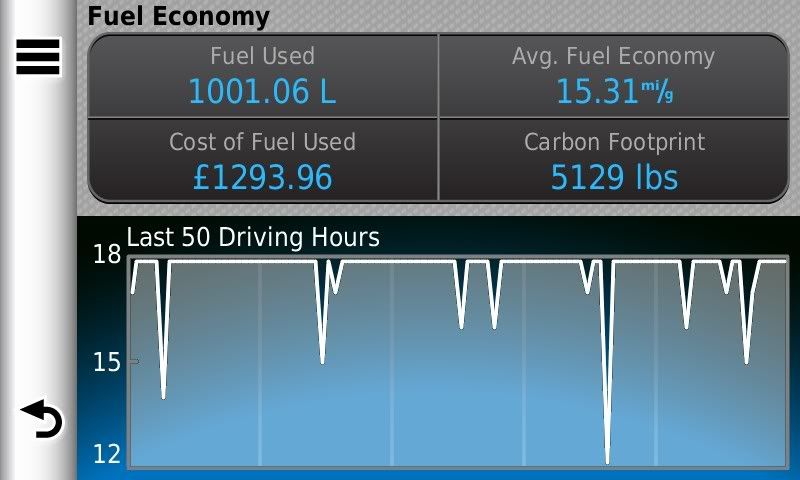

So maximum seems to be about 18mpg, you can see my worst recorded was 12mpg. Right hand screen shows how well I observed speed limits (65%), how efficient my braking was (80%) and how hard I accelerated.
#13 My 3.8 with T5 box does 25 MPG on the motorway
Posted: Thu Feb 24, 2011 7:30 pm
by pmansson
doing about 75-80 MPH but being careful with the accelerator.
It still has its US 3.54 final drive and the Watson T-5 box. The engine is very well sorted. Obviously I am on 5th gear 90% of the time under such conditions. 2500 RPM or thereabouts.
My 420G does about 20 MPG with its ZF 5-speed automatic gearbox (same as the XJ40 used, but I got a brand new one).
#14
Posted: Thu Feb 24, 2011 7:38 pm
by christopher storey
Well David, I have a feeling that I fall into Andrew Turvey's " Saint of the Road" category, at least as far as speed is concerned. I cruise at somewhere between 2800 rpm and 3250 rpm which equates on both my 3.07 cars to 70-80 mph, and I don't often use the lower grears hard except for the hell of it. It may be that this accounts for the difference , but I must say that the change on the 150 from UE to UM was a salutary experience, and on at least 2 occasions the 150 used less fuel between fills than either of the Es which were in our party on the Euroclassic, which was an unheard of happening. Just as a matter of interest, where is your sensor positioned for measuring the ratio?
#15
Posted: Thu Feb 24, 2011 9:11 pm
by Heuer
Christopher
The Lamda sensor is on a special bracket that holds it inside the tail pipe. The kit does come with a set of bungs which require a hole to be drilled in the manifolds (or lower down) and the fitting welded in place. You can then screw in the sensor and take readings for each carb. The tail pipe method does mean you are measuring carbs 1 & 2 or 2 & 3 but assuming the SU's are set up properly it is a reasonable compromise for occasional use.
#16
Posted: Thu Feb 24, 2011 10:40 pm
by PeterCrespin
Interesting readout. Instructive of course to remind us how much CO2 you get from fuel, although rather confusing to mix lbs and litres!!! Inevitable really because you couldn't easily measure the gas in the same units as a liquid in a meaningful way but suffice it to say that the weight (actually, the mass) of CO2 produced is about three times the weight of petrol burned. If you try and think how big a cloud of CO2 you'd need for the gas to weigh as much as three gallon containers of fuel, you can imagine how huge that volume would be. So the norm is to talk of pounds of CO2 from gallons of gasoline (if your'e a Yank). The rest of us talk about kilos of CO2 from litres of fuel but the Garmin muddles it a bit.
#17
Posted: Fri Feb 25, 2011 9:52 am
by Heuer
The Garmin can show everything in metric or imperial. I used litres because that is what the pump said but I can't get my head around L/100km and Kg leaves me without a frame of reference (I can visualise a 2lb bag of sugar or a hundredweight of coal) so my setting preferences are somewhat bizzare although how many people here can say how many litres/100km their E-Type returns without resorting to a calculator?
#18
Posted: Fri Feb 25, 2011 2:53 pm
by Heuer
#19
Posted: Thu Mar 03, 2011 5:13 pm
by Woolfi
Hello David !
Do I understand well, that your motor is running with a AFR of 12,1 ? Do you have 12,1 when you are accelatering strong or also when cruising ?
"I don't think my car is running rich as I have a air/fuel digital tester which shows the mixture bang on at 12.1 AFR"
Normally I motor should have a AFR when cruising of roundabout 15,5 up to 17. This is lean and you will have a high mileage . When crusing up to 110 m/h my EV12 is running with a AFR of roundabout 16:1. If you have a AFR of 12,1 : 1 the mixture is muuuuuuch to rich. When driving with heavy load, AFR should be 14.1 to 12,5 :1.
Regards Wolfgang Gatza
#20
Posted: Thu Mar 03, 2011 5:57 pm
by Heuer
Woolfi
That was a typo - it should be 14.1 dropping to 12.1 under heavy acceleration according to my records, which clearly I need to read properly! Thanks for pointing it out.


