Dave Wrote:
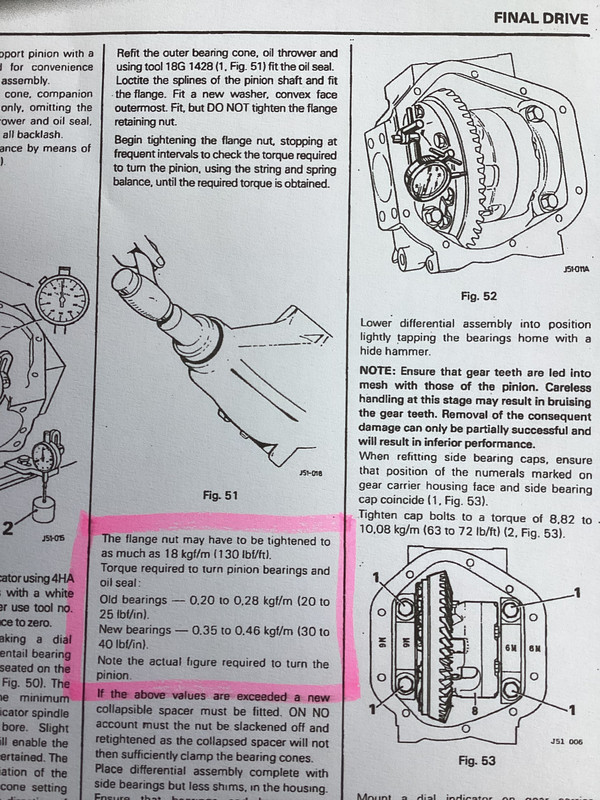
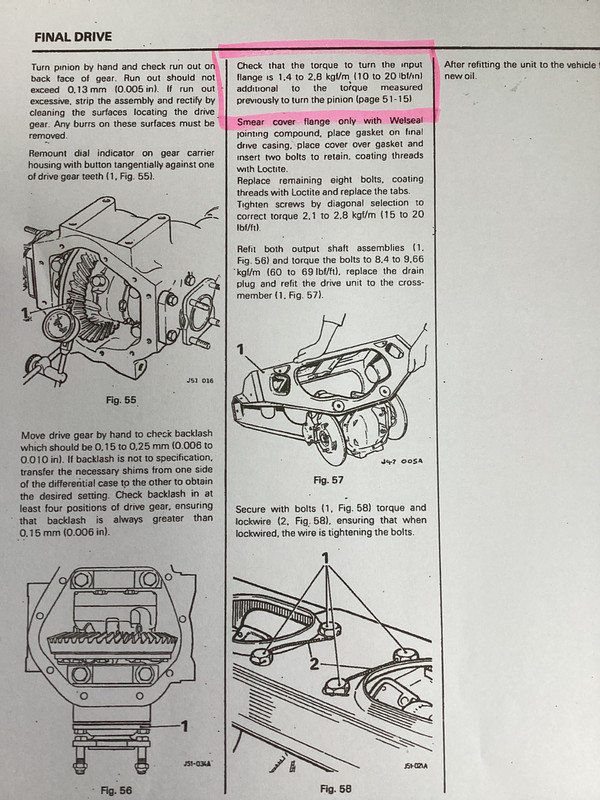
It is for a later differential using the double taper rolling bearings. Initially the pinion torque figure is taken and recorded, to then be added to the torque figure obtained once the backlash has been set, but interestingly before the output shaft assemblies are finally torqued up.
Hello Dave,
I refurbish a lot of differentials, and like a lot of information in Jaguar Manuals, the second highlighted text doesn't make a lot of sense, particularly if (without the benefit of other pages of your manual), the torque is measured "before the output shaft assemblies are finally torqued up" is correct.
One bit of instruction that is incorrect in S3 E Type, and XJ6 manuals, is that the pinion preload is set by merely torquing the companion flange nut to between 120 and 140 lb/ft torque, with no reference whatsoever to the amount of torque required to turn the pinion shaft, and that if 140 lb/ft torque is exceeded, then the collapsible spacer must be replaced. The elephant in the room with this instruction, is that it generally takes over 200 lb/ft torque just to get the collapsible spacer to start to collapse. As the process continues, the amount of torque drops off.
The double (opposing) taper roller bearings you refer to are on the Output Shafts, but you state that the torque referred to in the second highlighted text is before the output shaft assemblies are torqued up, accordingly, it wouldn't matter what type of bearing systems the output shafts were equipped with.
The preload of the diff centre bearings is obtained by removing a specified thickness of shims once zero end float is measured in relation to sideways movement of the diff centre between its opposing taper roller bearings, then the backlash is set by moving shims from one side of the diff centre bearings to the other. There would be a corresponding torque requited to turn the diff centre assembly, but that is not specified, but relies on the shim thickness removed to obtain the correct preload.
The torque referred to in the second highlighted text, which would be a combination of the pinion torque by its self and the amount of torque needed by the pinion shaft to turn the diff centre assembly. This would NOT be purely the addition of the torque needed to turn the diff centre by its self, with the pinion shaft omitted from the assembly, but more the torque involving the mechanical advantage the pinion has via gear ratio between the pinion and crown wheel gears. This torque measured at the pinion companion flange would vary depending on the gear ratio of the pinion and crown wheel, given a constant preload of the diff centre bearings. Accordingly, unless the Jaguar model your manual is referring to only came out with one specific diff ration, which is not the case with an XJS, then I can't see the validity of the second highlighted text.
As Al's car is an S1, his differential would use opposing taper roller bearings in the output shaft assembles, the same as the XJS, but with solid spacers and shims to set the output shaft bearing preload, as opposed to the crushable spacers of the XJS. The Backlash setting is also adjusted in a different, and far simpler method than that employed in later differentials.
Regards,
Bill