Page 1 of 1
#1 Oscillating Ammeter Needle
Posted: Fri May 29, 2009 2:09 pm
by ian68
The needle on my ammeter oscillates back and forth quite fast with the end of the needle waving back and forth between, say 5 - 10mm.
All the other instruments are fine with no undue needle movement. Any idea what's causing this?
Ian
#2
Posted: Fri May 29, 2009 2:54 pm
by Heuer
Ian
Is it oscillating around the zero mark or in the charge or discharge sector? Normal operation would be seeing the needle flick to the left when charging correctly and drop back to the centre afterwards. It would only go to the right if the alternator was not working. First check the bolt connectors on the back of the ammeter are tight as they have a habit of working loose and causing problems (smoke usually!). Next would be to check all the alternator connectors are tight and finally check the TR4 voltage regular is working correctly (see handbook). Next step is to check the alternator is working correctly as the diode packs have a habit of failing due to heat (make sure the alternator heat shield is in place). Finally I suggest you consider putting a voltmeter in to replace the ammeter, the latter being pretty useless on an alternator equipped car. There is a thread on the conversion in the Upgrades part of the forum.
#3
Posted: Fri May 29, 2009 11:46 pm
by ian68
Cheers David,
It only oscillates i've now noticed once the engine is running above about 1200 rpm. the needle shows a good swing to charge after starting up as you would expect and the needle is very stable until you rev the engine. at any engine speed above 1200rpm the needle then starts flickering back and forth quite quickly.
I will check the items you suggest, but to be honest, other than for originality I agree that an ammeter would be better replaced with a voltmeter on an alternator car. I also don't like heavy current carrying wires behind the dash for the very reasons you suggest.
I will look for a period voltmeter at Thoresby next week.
Ian
#4 Volt meter instead of original ammeter
Posted: Fri Aug 26, 2011 7:46 am
by pmansson
will the volt meter look identical to the original instrument? Or at least close enough to not stand out as a later replacement...?
#5
Posted: Fri Aug 26, 2011 9:17 am
by PeterCrespin
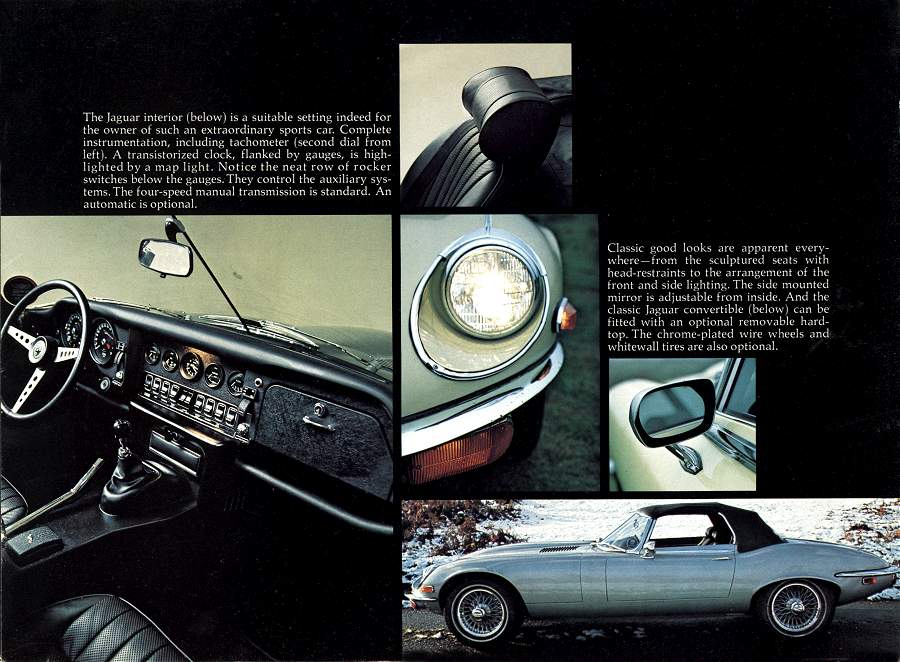
Yes if you buy a voltmeter from a Series 2 or Series 3 E-type. Look on XKEdata.com for interior photos and you will see some pictures of the dash, or in any good book of the E-type there will be photos of the Series 2/3 dash which has very similar minor instruments. If the voltmeter has the later rounded bezel you would have to swap it with an earlier triangular one for Series 1.
You can just about see the instruments in this brochure shot from Jag-lovers.
http://www.jag-lovers.org/brochures/xke ... 12_8_l.jpg
I would avoid the ones with red/green bands as these do stand out a bit, although there's nothing wrong with them.
#6
Posted: Fri Aug 26, 2011 10:01 am
by Heuer
#7
Posted: Fri Aug 26, 2011 12:39 pm
by Nick
Ian,
My ammeter sometimes oscillates like this at idle after starting, but it stops oscillating when the engine is revved above about the 1200 rpm that you mention. I had assumed it is caused by a sort of charge/discharge resonance in the 4TR regulator but I haven't looked into the actual cause.
Nick
#8
Posted: Tue Sep 18, 2012 5:02 am
by RobMason
In my newly restored '66 E-type, my ammeter needle also swings wildly when above 1200-1500 rpm. On startup, it shows slight discharge, at idle, which seems normal, then when driving, it begins to swing back and forth going all the way to the right, then all the way to the left at about 4 swings/sec. We have tried replacing the alternator, voltage regulator, and ammeter. Any suggestions?
#9
Posted: Tue Sep 18, 2012 9:08 am
by Tony
Mine oscillates and jumps around a bit on the charge side until the battery is fully charged and then stabilises. It can take an hour or so doing this until the battery get up to full charge. It goes negative at tick over as I would expect with a dynamo.
I have just driven around Ireland (approx 1000 miles) with no implication.
However, having said this I did have a bad experience with a faulty regulator in France which ended up costing me a ?1,000, but that is another story which I will not bore you with. It ended up being a burnt out regulator which seemed to stick on full charge. After that experience I cannot take my eyes of the amp meter. If you can afford to carry a spare at ?60 it is not a bad investment to give you some comfort. I maybe wrongly presuming you are running a dynamo on positive earth as I do not know when they started putting in alternators.
#10
Posted: Wed Sep 19, 2012 5:48 am
by RobMason
The alternator was placed on all 4.2 Series I (and subsequent) E-types. The oscillation starts at 1200-1500 rpm. On startup, the ammeter shows slight discharge (normal), then as it picks up speed, the needle starts jumping. We have tried replacing the voltage regulator, replacing the alternator, tightened everything down. I am wondering if a higher output alternator could be the culprit?
#11
Posted: Wed Sep 19, 2012 9:29 am
by Heuer
If you fit a higher output alternator you need to make sure the cables are correctly specified for the increase ampage. Have you checked the connectors on the back of the ammeter are clean and tight? Personally I would (and have) install a voltmeter.
#12
Posted: Sun Mar 02, 2014 9:03 pm
by mrc.engr
RobMason wrote:The alternator was placed on all 4.2 Series I (and subsequent) E-types. The oscillation starts at 1200-1500 rpm. On startup, the ammeter shows slight discharge (normal), then as it picks up speed, the needle starts jumping. We have tried replacing the voltage regulator, replacing the alternator, tightened everything down. I am wondering if a higher output alternator could be the culprit?
By design the ampmeter is suppose to reflect what is occuring in the charging system when the car is running......and the flickering back and forth is exactly what is occuring and is perfecly normal, so there's no reason to be concerned, alarmed or to do anything to "correct" this perfectly normal situation.
#13
Posted: Mon Mar 03, 2014 8:49 am
by christopher storey
Well, I'm afraid I cannot agree that it is normal as stated above. ( The normal behaviour should be that immediately after a start you will get a high rate of charge, which rapidly diminishes until it shows merely a trickle charge of perhaps 2-3 amps ). However, the spiking is very common, along with flickering on and off of the red ignition warning light . The cause is never easy to determine , but usually is a combination of ageing of all the components , dirty contact at the cables , and often the fact that the 4TR alternator control is past its best . The new ones, like so many aftermarket replacements of electrical equipment, are often no better than the originals . Also, just possibly it is that the ammeter itself is getting very old and the natural damping of the moving coil is diminishing . If you have replaced the alternator, is this one with internal regulation , or are you still using the 4TR ?
Anyway, whatever the cause, providing you are getting a charge , the spiking is nothing more than a nuisance and I would not worry about it
#14
Posted: Mon Mar 03, 2014 12:34 pm
by ALAN COCHRANE
Rob
I have also had exactly the same problem with my ammeter and replaced all the usual suspects-battery, alternator, 4TR regulator and even changed the ammeter for a spare. All to no avail. The needle swings widly on start up and shows a noticeable constant charge when on a long drive.
I've had no problems with a flat battery and so have just learned to ignore it.
If anyone else can shed some light on this phenomenon then I'd love to hear from them.
I fitted an ammeter to my Triumph GT6 many years ago and the needle normally returns to zero after the initial start-up and re-charge phase. Even at idle with all the electrical load applied the needle only shows a slight discharge and it flicks back and forth in sync with the hazzard lights. It never fluctuates wildy.
The only difference here is the Lucas alternator is a later type with an integral regulator. Could the 4TR regulator be the culprit even when healthy?
Cheers
Alan
#15
Posted: Mon Mar 03, 2014 6:43 pm
by mrc.engr
christopher storey wrote: Well, I'm afraid I cannot agree that it is normal as stated above. ( The normal behavior should be that immediately after a start you will get a high rate of charge, which rapidly diminishes until it shows merely a trickle charge of perhaps 2-3 amps ).
However, the spiking is very common, along with flickering on and off of the red ignition warning light . The cause is never easy to determine , but usually is a combination of aging of all the components , dirty contact at the cables , and often the fact that the 4TR alternator control is past its best .
Anyway, whatever the cause, providing you are getting a charge , the spiking is nothing more than a nuisance and I would not worry about it
Really Chris ? I describe what the ampmeter does and you disagree...... then you go about describing a completely different set of circumstances and rephrase what the ampmeter does.
Of course the ampmeter swings to a high rate of charge right after the car is started...... THAT"S what it's designed to do......but we weren't discussing that circumstance......we were discussing what a ampmeter flickers back and forth well AFTER the car has been running for some time. So please......get your story straight and let's stay on topic.
By design the ampmeter is suppose to reflect what is occurring in the charging system when the car is running......and the flickering back and forth is exactly what is occurring. This is perfectly normal as the voltage regulator momentarily calls for resupplying the battery with power as the power is consumed by the electrical system.
Bottom line.... there's no reason to be concerned, alarmed or to do anything to "correct" this perfectly normal situation.
Of course there are 100,000 other set of circumstances that could have the ampmeter flickering, but to say flickering is something not normal and cause for concern is misleading those who do not understand the Jag's electrical system.
#16
Posted: Mon Mar 03, 2014 6:59 pm
by Heuer
My observations of the ammeter on my 3.8 reflect what Chris is saying. I get about 1/4 scale deflection in either direction depending on supply/demand - no flicker, rock solid. Actually when I first bought the car the ammeter did flicker as you describe which was at odds with what I had observed on my 4.2. I installed a spare ammeter I had on the shelf out of curiosity and it worked as expected. Seems there was a fault with the ammeter (despite the instruments being recently professionally overhauled) although I never bothered to investigate what it was. I have the 'faulty' ammeter in a box so I can go and run some tests on it if anyone is interested.
#17
Posted: Tue Mar 04, 2014 1:18 am
by mrc.engr
Heuer wrote:My observations of the ammeter on my 3.8 reflect what Chris is saying. I get about 1/4 scale deflection in either direction depending on supply/demand - no flicker, rock solid. Actually when I first bought the car the ammeter did flicker as you describe which was at odds with what I had observed on my 4.2. I installed a spare ammeter I had on the shelf out of curiosity and it worked as expected. Seems there was a fault with the ammeter (despite the instruments being recently professionally overhauled) although I never bothered to investigate what it was. I have the 'faulty' ammeter in a box so I can go and run some tests on it if anyone is interested.
That's good to hear David. I will say there's a considerable difference between a flicker and 1/4 scale deflection. Large deflections do need to be investigated.
Cheers........ Mike
#18 Re: Oscillating Ammeter Needle
Posted: Sat Sep 10, 2016 12:38 am
by RobMason
I would like to respond belatedly to the solution to the problem I had with the ammeter oscillation problem. It turns out the ignition switch was faulty. I was getting bad connections when jiggling the key in the switch, so when we replaced the ignition switch, the ammeter oscillation problem was gone and never came back. Undoubtedly, the ammeter was reflecting the bad connection in the ignition switch.