Page 1 of 2
#1 where the hell is my engine number ?
Posted: Fri Oct 30, 2015 11:40 am
by rolando38
Hello
today my E-type was inspected for insurance value
...and we were not able to see the engine number
in the handbook it's written that on later series 2 it is "stamped on the crankcase bell housing flange on the left hand side of the engine adjacent to the oil dipstick"
here is what it looks like on my engine


the scratches are my attempts to remove paint/dirt with sandpaper
where else could it be ? (2+2 series 2 June 1970)
#2
Posted: Fri Oct 30, 2015 12:25 pm
by UK Muppet
Hi Rolando,
my 69 2+2 is the same, no engine number anywhere on the block.
I have the engine out and can see every square inch.
Some might say these were replacement engines supplied without numbers but I disagree, I think they just didn't get stamped. Maybe the best solution is to stamp them ourselves.
regards
Tony
#3
Posted: Fri Oct 30, 2015 12:40 pm
by Paul71a
My may 1970 FHC has it exactly where is says in the handbook
I've taken a pic but can't seem to post it here I'm afraid
#4
Posted: Fri Oct 30, 2015 1:13 pm
by malcolm
My 2+2 has it on the right hand side; really hard to see without engine out. Round about the oil filter.
#5
Posted: Fri Oct 30, 2015 2:57 pm
by Gfhug
Mine is top of the engine at the rear, it is quoted in Clausager's reference book as moving to there later in the S2. Geoff
#6
Posted: Fri Oct 30, 2015 5:16 pm
by rolando38
thanks a lot guys
Malcom and Geoff: could you possibly display a picture ?
#7
Posted: Fri Oct 30, 2015 5:16 pm
by Red Kite
Mine is on the right hand side by the oil filter flange. Had to remove paint to find it.
#8
Posted: Sat Oct 31, 2015 9:52 am
by malcolm
Rolando, sorry, but won't be able to post a pic. Simple reason, you can't get to it to take a pic! You'd need some sort of flexible, telescopic medical camera. You have to use a mirror and torch with a lot of contortions to view it. If you can get under the car with a torch and mirror, look under the oil filter.
#9
Posted: Sat Oct 31, 2015 10:40 am
by 288gto
As a general guide but not definitive.
Series 1
http://relicrecyclery.com/Jaguar/page31 ... Number.JPG
Series 2
http://i1178.photobucket.com/albums/x37 ... gineNo.jpg
Not wanting to worry you, but if there is no engine number, has it been deliberately removed? The engine number is on the crankshaft as well. Certainly on the series 1 cars.
There should also be a casting date on the block underneath the inlet manifold. This should be within a few months of the production date of your car. Obviously not later that the date your car was manufactured.
Simon
#10
Posted: Sat Oct 31, 2015 10:50 am
by Red Kite
Here is mine, covered by paint so had to rub it down, it is also hidden by a pipe, was quite a relief to find it....

#11
Posted: Sat Oct 31, 2015 2:06 pm
by rolando38
thanks Gerry !
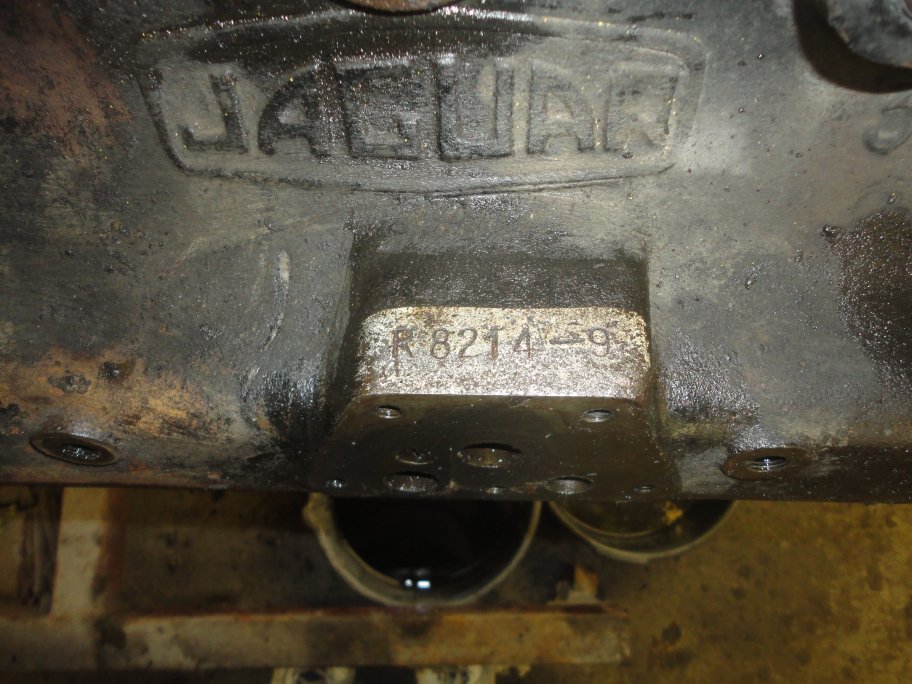
got it ! just below the engraved Jaguar Logo; mine was covered with paint/dust/rust
surprise; it's not matching (as per the seller's claims, but how could he have checked it) it should be 7R40104 but it is 7E1672X;

this would suggest it comes from a series 1 1/2, yet it's surprizing because it has the black cross-over pipe and last version of the inlet manifold
could it be a mistake at Jaguar factory ?? I doubt it also because the number plate states 7R4010; or more probably a change of the lower engine while keeping the upper part ?

#12
Posted: Sat Oct 31, 2015 2:29 pm
by christopher storey
I'm afraid that neither of the numbers you have given would ever have been originally fitted to a 2+2 . All 2+2 engines have 5 figure numbers , and in the case of S2 cars these start at 7R 35000 . Have you missed a digit from the 7R 4010 ? 7E 1672 ( there should be an 8 0r 9 suffix as well ) probably comes from a fairly early S1 4.2
#13
Posted: Sat Oct 31, 2015 5:31 pm
by rolando38
it's 7R40104-9 actually
can't read the last digit of 7E1672X
#14
Posted: Sun Nov 01, 2015 10:27 am
by malcolm
The "9" at the end is good - means it's a 9:1 compression ratio engine as per UK models; if it ends in an "8" it's 8:1, which I think was later USA or a replacement using (eg) an XJ6 engine. Yours I see is Strombergs though, so later USA, which I would have thought would have been an 8:1?
#15
Posted: Sun Nov 01, 2015 1:38 pm
by Mark Gordon
Yes, the -9 does mean that it was originally built as a 9:1 compression ratio engine, but not all Series 2 US engines were 8:1. My current engine (US delivery) I have been told is an early Series 2, 7R10195-9, which is stamped on the left side on the bell housing flange. The thing that really determines the ratio is the dome on the pistons, with the 9:1 pistons having a larger dome than the 8:1's. Of course, that applies to a newly manufactured block and head. Once the block and/or head have been skimmed (as most every one of the E Type engines have by now), all bets are off on what the actual compression ratio of the rebuilt engine is. And don't forget that the thickness of the head gasket will also play a role in determining the actual compression ratio.
#16
Posted: Sun Nov 01, 2015 6:57 pm
by rolando38
hi Mark,
by "skinned" you mean replaced the upper part of the engine ?
this is what could hae happened to mine
#17
Posted: Sun Nov 01, 2015 8:16 pm
by Mark Gordon
No, I said "skimmed" which means that the top of the block and/or the bottom of the head have been machined, removing a slight amount of metal, in order to make the surfaces flat and allow a good seal between the block and the head. The head particularly often gets warped due to overheating and "skimming" makes it flat in two planes. If an excessive amount of metal has to be removed in order to return things to flat, a thicker gasket can be fitted to return the compression ratio to around 9:1.
#18
Posted: Mon Nov 02, 2015 5:56 am
by rolando38
got it , thanks Mark
is it common that the lower part of the engine is changed and the top part is kept (with or without machining ) ?
this is what seems to have happened on mine
#19
Posted: Mon Nov 02, 2015 7:34 am
by 288gto
You have to remember that in your case the car is 46 years old, all sorts of things could have happened requiring a change of block. When the car was worth less and matching numbers irrelevant, a second hand block would have been the most economical way of getting the car back on the road. A con rod could have gone through the side of the block, a bearing slipped or a crack appeared.
My daily Mercedes is only 6 years old and on it's second engine!
Simon
#20
Posted: Mon Nov 02, 2015 11:41 am
by malcolm
My dad was a mechanic in an "old" style garage back in the 70's; they would often do an exchange bottom end when a customer ran the bearings out or otherwise knackered it.