


series 3 vs Series 1
-
 Mark Gordon
- Posts: 1008
- Joined: Tue Jun 23, 2009 3:33 pm
- Location: Columbus, Ohio

#21 Re: series 3 vs Series 1
This has been an interesting thread of opinions and it seems to me that those opinions are similar to political opinions in that some facts and factoids are used to arrive at one's final analysis. When the Series 2's were introduced, I felt strongly that the looks of the car had been downgraded and I felt that the Series 3's were even worse. I've only driven Series 1's and 2's but to my unrefined senses, I really don't feel much difference between the two in terms of handling. I think that it's absolutely wonderful that some of us have strong preferences for each of the models and OTS vs. FHC. If it were not so, one model would be in high demand with even more insane prices than we now see while the other two would be languishing and rusting away in some junk yard or barn. The main thing is be proud of which ever flavor of E that you're fortunate enough to own and enjoy the experience!
Mark
67 OTS 1E14988, 2015 Camry XSE
67 OTS 1E14988, 2015 Camry XSE
| Link: | |
| BBcode: | |
| HTML: | |
| Hide post links |

#22 Re: series 3 vs Series 1
Hi Andrew
The brakes are AP Racing, and the dampers are a set of Ohlins all round. Both those advised and fitted by Eagle. I had Gaz on originally, but the Ohlins are in a different league, and so they should be for the price! Easier to set up, rebound much better, body control far superior, and handling improved without compromising ride. Upgraded trailing arm bushes, and suspension re-bushed of course. Wheels are 16” x 7” with the latest Continental 225/60 tyres. Standard Jag 4 speed gearbox, after having had an awful experience with a Tremec 5 speed on my S1. But, I am using a 2.88 lsd diff from an XJS.
The brakes are AP Racing, and the dampers are a set of Ohlins all round. Both those advised and fitted by Eagle. I had Gaz on originally, but the Ohlins are in a different league, and so they should be for the price! Easier to set up, rebound much better, body control far superior, and handling improved without compromising ride. Upgraded trailing arm bushes, and suspension re-bushed of course. Wheels are 16” x 7” with the latest Continental 225/60 tyres. Standard Jag 4 speed gearbox, after having had an awful experience with a Tremec 5 speed on my S1. But, I am using a 2.88 lsd diff from an XJS.
| Link: | |
| BBcode: | |
| HTML: | |
| Hide post links |
-
 AussieEtype
- Posts: 635
- Joined: Wed Jun 24, 2009 10:59 am
- Location: Canberra, Australia

#23 Re: series 3 vs Series 1
Its simples.
Series 1 are girlie with their little engines, narrow wheels and body too big for the track - quite effeminate .
.
They needed to fudge performance figures by using specially tuned cars to make them seem better than they were.
Series 3 are masculine with wide stance, wheels that fill the wheel arches and decent brakes, steering and handling - all for a match for the Series 1 if not modified. The wheelbase for the OTS is a little long but is OK.
If series 1 and series 3 are compared side by side as built and not modified - a series 3 will always out handle and out perform a series 1.
Series 3


Garry
Series 1 are girlie with their little engines, narrow wheels and body too big for the track - quite effeminate
. They needed to fudge performance figures by using specially tuned cars to make them seem better than they were.
Series 3 are masculine with wide stance, wheels that fill the wheel arches and decent brakes, steering and handling - all for a match for the Series 1 if not modified. The wheelbase for the OTS is a little long but is OK.
If series 1 and series 3 are compared side by side as built and not modified - a series 3 will always out handle and out perform a series 1.
Series 3
Garry
1971 Series 3 E-type OTS
1976 Series 2 XJ 12 Coupe
1976 Series 2 XJ 12 Coupe
| Link: | |
| BBcode: | |
| HTML: | |
| Hide post links |
#24 Re: series 3 vs Series 1
See? There's you answer.
Andrew.
881824, 1E21538. 889457. 1961 4.3l Mk2. 1975 XJS. 1979 MGB (supercharged).
Adelaide, Australia
881824, 1E21538. 889457. 1961 4.3l Mk2. 1975 XJS. 1979 MGB (supercharged).
Adelaide, Australia
| Link: | |
| BBcode: | |
| HTML: | |
| Hide post links |
#25 Re: series 3 vs Series 1
Malcolm Wrote:
I own seven S3 E Types (4 x OTS + 3 x Coupes) and a 1962 S1 TSC; accordingly, I think its fair to say that I have a bias towards the S3. I also have nine client cars currently in work; 2 x S3 OTS, 1 x S2 OTS, 2 x S2 2+2s, 1 x S1 2+2, 1 x S2 TSC, 1 x S1 TSC and a MK2. Accordingly, I’m not a complete stranger to the marque.
I assume your reference to the wider door is the length of the door fore to aft. The longer door (by nine inches) hadn’t escaped my attention and if the S3 and 2+2 cars are built on a longer wheel base than the S1/S2 OTS, some part of the body has to be lengthened. It’s through the door area and I made reference to that in my earlier Post
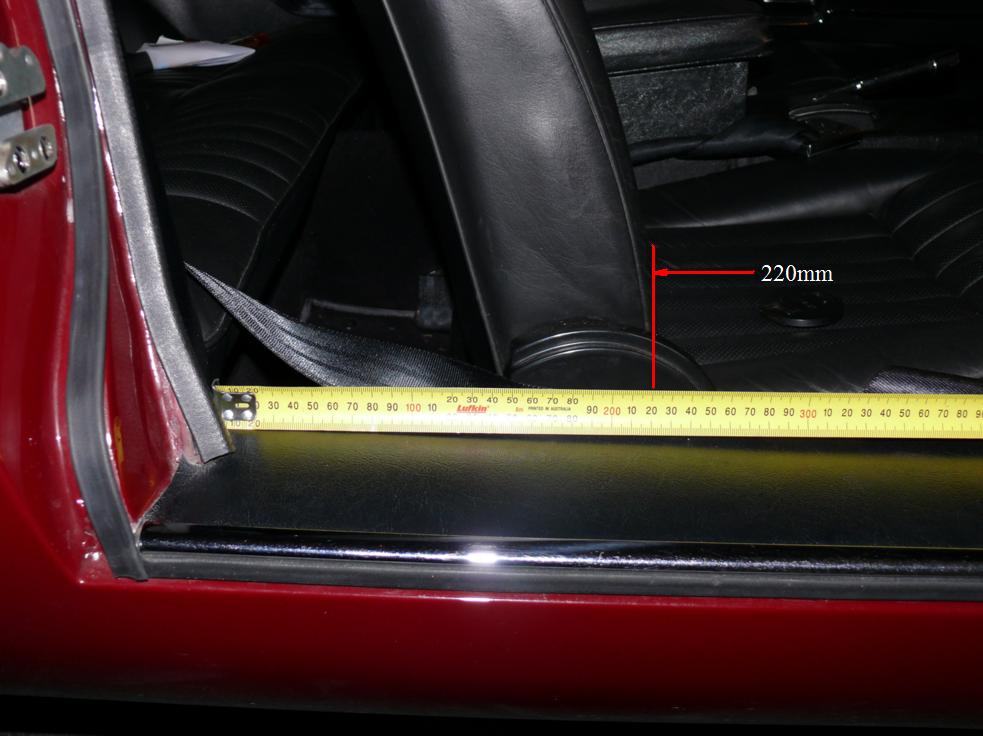
The following picture shows the Seat Position in a client’s S2 2+2, he is 6’1” tall. The distance is 220mm from the B Pillar. Nine inches, the increased length through the door area over a S1/S2 TSC, is 228.6mm. Accordingly, the position of the B Pillar of S1/S2 TSC is about where the front of the seat backrest is in the following picture. So, not a whole lot of difference unless one were to push the seat back in the 2+2 when getting in and out.
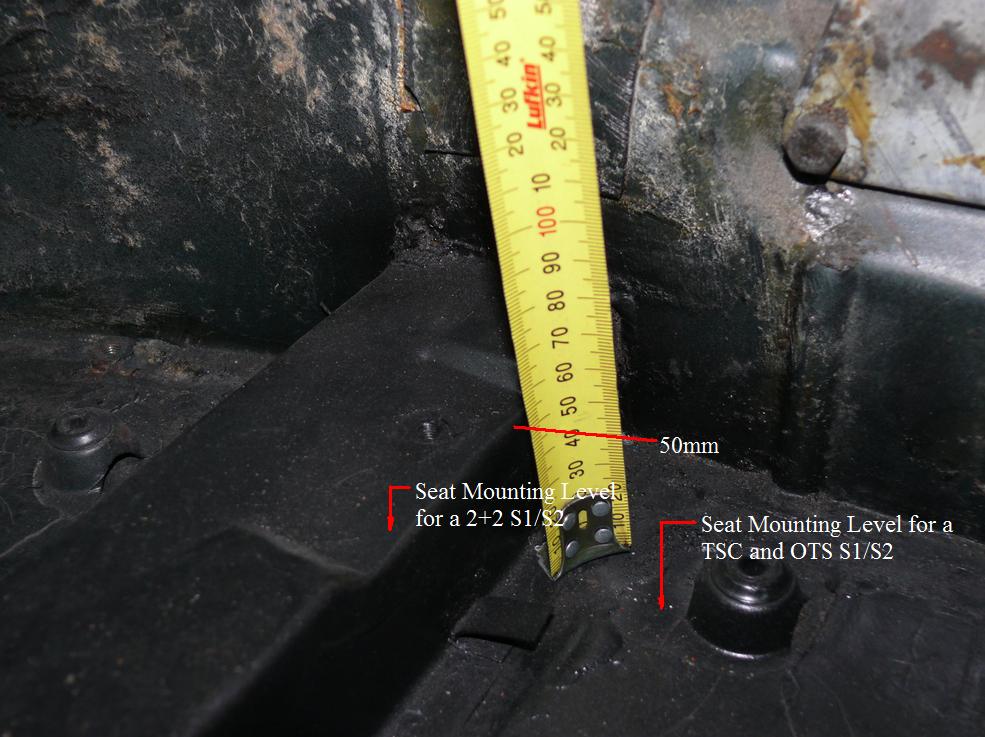
With regards the 2” increase in roof height you referred to, what you gain on the roundabouts, you lose on the swings. The front seats of an S1(later model)/S2 2+2 are the same as the seats of an S1(later model)/S2 TSC. Both body styles have a floor cross brace. In the 2+2, this cross brace is used as a seat riser, the purpose of which was to give slightly more foot room to those unfortunate enough to be sitting in the back seats. The seats of a TSC are mounted directly to the floor. The following picture shows the seat mounting level for the 2+2 and the TSC. So you gain 2” in roof height and you loose its effectiveness, in terms of access, with the seat riser.
I’m in and out of multiple E Types, of all body configurations, multiple times a day, every day of the week. Its my observation that the TSC is no harder to get in to, or out of, than a 2+2 and because of the seat backrest position relative to the B pillar, the extra length through the door area of the LWB cars, in terms of getting in and out of the front seats, is irrelevant in my opinion.
Regards,
Bill
Hello Malcolm,Andrew is right about the ease of getting in and out. Bill, it's not just the LWB; the doors are also much wider and the roof is 2 inches higher. Getting in my series 2 2+2 is a doddle; i've tried many FHCs and OTSs and they are far harder for me (I'm 6ft 1in)
I own seven S3 E Types (4 x OTS + 3 x Coupes) and a 1962 S1 TSC; accordingly, I think its fair to say that I have a bias towards the S3. I also have nine client cars currently in work; 2 x S3 OTS, 1 x S2 OTS, 2 x S2 2+2s, 1 x S1 2+2, 1 x S2 TSC, 1 x S1 TSC and a MK2. Accordingly, I’m not a complete stranger to the marque.
I assume your reference to the wider door is the length of the door fore to aft. The longer door (by nine inches) hadn’t escaped my attention and if the S3 and 2+2 cars are built on a longer wheel base than the S1/S2 OTS, some part of the body has to be lengthened. It’s through the door area and I made reference to that in my earlier Post
The following picture shows the Seat Position in a client’s S2 2+2, he is 6’1” tall. The distance is 220mm from the B Pillar. Nine inches, the increased length through the door area over a S1/S2 TSC, is 228.6mm. Accordingly, the position of the B Pillar of S1/S2 TSC is about where the front of the seat backrest is in the following picture. So, not a whole lot of difference unless one were to push the seat back in the 2+2 when getting in and out.
With regards the 2” increase in roof height you referred to, what you gain on the roundabouts, you lose on the swings. The front seats of an S1(later model)/S2 2+2 are the same as the seats of an S1(later model)/S2 TSC. Both body styles have a floor cross brace. In the 2+2, this cross brace is used as a seat riser, the purpose of which was to give slightly more foot room to those unfortunate enough to be sitting in the back seats. The seats of a TSC are mounted directly to the floor. The following picture shows the seat mounting level for the 2+2 and the TSC. So you gain 2” in roof height and you loose its effectiveness, in terms of access, with the seat riser.
I’m in and out of multiple E Types, of all body configurations, multiple times a day, every day of the week. Its my observation that the TSC is no harder to get in to, or out of, than a 2+2 and because of the seat backrest position relative to the B pillar, the extra length through the door area of the LWB cars, in terms of getting in and out of the front seats, is irrelevant in my opinion.
Regards,
Bill
Last edited by angelw on Mon Jan 06, 2020 12:01 pm, edited 2 times in total.
| Link: | |
| BBcode: | |
| HTML: | |
| Hide post links |
#26 Re: series 3 vs Series 1
Hi Bill. What do you mean by a TSC? FHC or OTS
| Link: | |
| BBcode: | |
| HTML: | |
| Hide post links |
#27 Re: series 3 vs Series 1
Andrewh Wrote:
A FHC (Two Seater Coupe as opposed to a 2+2, or Open Two Seater)
Regards,
Bill
Hello Andrew,Hi Bill. What do you mean by a TSC? FHC or OTS
A FHC (Two Seater Coupe as opposed to a 2+2, or Open Two Seater)
Regards,
Bill
Last edited by angelw on Mon Jan 06, 2020 9:41 am, edited 1 time in total.
| Link: | |
| BBcode: | |
| HTML: | |
| Hide post links |

#29 Re: series 3 vs Series 1
Understand your (well argued) points Bill, and I'm sure you're right. However, I can only say that when I'm in my 2+2, I have heaps more room than when I'm in a FHC or OTS. Headroom wise, in a FHC/OTS, I have to have the seat reclined so much that I'm staring at the roof. In my 2+2, I can wear a crash helmet and still fit comfortably. Maybe it's just the way my car is fitted, although my seats are on the risers you mention. Je ne comprend pas!
Malcolm
I only fit in a 2+2, so got one!
1969 Series 2 2+2
2009 Jaguar XF-S
2015 F Type V6 S
I only fit in a 2+2, so got one!
1969 Series 2 2+2
2009 Jaguar XF-S
2015 F Type V6 S
| Link: | |
| BBcode: | |
| HTML: | |
| Hide post links |
#30 Re: series 3 vs Series 1
Just thought. One reason why it seems easier getting in and out.
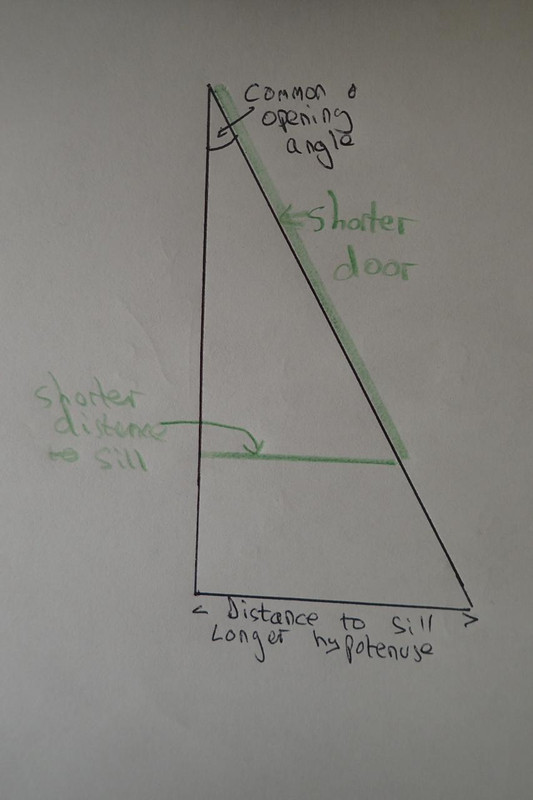
The doors on my 2+2 open to the same angle as a FHC or OTS. However, being 9 inches "longer", the distance between the car sill and the rear edge of the door is bigger, making it easier to get in and out.
Using good old "square on the hypotenuse is equal to the sum......" on the same angle of opening with a 9 inch shorter door, the straight line gap from rear edge of door to sill is 5 inches less on an OTS/FHC compared to 2+2.
The doors on my 2+2 open to the same angle as a FHC or OTS. However, being 9 inches "longer", the distance between the car sill and the rear edge of the door is bigger, making it easier to get in and out.
Using good old "square on the hypotenuse is equal to the sum......" on the same angle of opening with a 9 inch shorter door, the straight line gap from rear edge of door to sill is 5 inches less on an OTS/FHC compared to 2+2.
Malcolm
I only fit in a 2+2, so got one!
1969 Series 2 2+2
2009 Jaguar XF-S
2015 F Type V6 S
I only fit in a 2+2, so got one!
1969 Series 2 2+2
2009 Jaguar XF-S
2015 F Type V6 S
| Link: | |
| BBcode: | |
| HTML: | |
| Hide post links |
-
christopher storey
- Posts: 5698
- Joined: Sun Mar 09, 2008 3:07 pm
- Location: cheshire , england

#31 Re: series 3 vs Series 1
This debate could go on for ever but I would make two points
1. The S1 and S2 cars are fundamentally different from the S3 cars , so different in my opinion that they are really quite different cars, with the earlier cars being sports cars, and the S3 cars being much heavier and softer genuine Grand Touring cars, or put even more brutally California Boulevard cars . As a result, one is comparing apples and oranges
2. I have rather peculiar proportions, being 6 feet tall with an inside leg measurement of about 30 inches. As a result, the only way I can get into any SWB car ( except an OTS with hood down ) is to put my head in first, face backwards, place backside on seat, swivel round and get my legs in . In a 2+2 I have no such difficulties! - and nor does my head touch the roof which it does in the SWB cars
1. The S1 and S2 cars are fundamentally different from the S3 cars , so different in my opinion that they are really quite different cars, with the earlier cars being sports cars, and the S3 cars being much heavier and softer genuine Grand Touring cars, or put even more brutally California Boulevard cars . As a result, one is comparing apples and oranges
2. I have rather peculiar proportions, being 6 feet tall with an inside leg measurement of about 30 inches. As a result, the only way I can get into any SWB car ( except an OTS with hood down ) is to put my head in first, face backwards, place backside on seat, swivel round and get my legs in . In a 2+2 I have no such difficulties! - and nor does my head touch the roof which it does in the SWB cars
| Link: | |
| BBcode: | |
| HTML: | |
| Hide post links |
#32 Re: series 3 vs Series 1
Malcolm Wrote:
The part of the 2+2 door that is in line with the Seat Backrest position is the same distance from the sill as the corresponding point on the door of the SWB car (at the same open angle). Cut 9 inches off the back of the 2+2 door to make it the same length as the FHC door; does it make the 2+2 any harder to get in to and out of? I think not. When getting into the Front Seat, you do so where the Front Seat is; you're not getting into the Back Seat in the 2+2 and the Front Seat of the FHC. And the difference in distance from the sill of the points at a 9 inch different length hypotenuse varies with the angle. Irrelevant to the discussion, but simple geometry.The doors on my 2+2 open to the same angle as a FHC or OTS. However, being 9 inches "longer", the distance between the car sill and the rear edge of the door is bigger, making it easier to get in and out.
Using good old "square on the hypotenuse is equal to the sum......" on the same angle of opening with a 9 inch shorter door, the straight line gap from rear edge of door to sill is 5 inches less on an OTS/FHC compared to 2+2.
| Link: | |
| BBcode: | |
| HTML: | |
| Hide post links |
#33 Re: series 3 vs Series 1
Don't want to keep this going forever, and I always concur over technical matters because almost everyone knows more than me! However, geometry i'm fine with, having studied maths to a high level, including spherical geometry for my astro navigation qualifications. Simple geometry tells you that if the hypotenuse is longer on a right angled triangle, with the same opening angle, then the adjacent and opposite sides must be longer. Hence distance to sill is different. And as when fully opened the rear edge of the door is level with the back of my seat, not the rear seats, the difference is relevant. when closed, it is as you say in your post more level with the rear cabin, but not when open. Hence Christopher Storey's comments above agree with what I find with my car.
Malcolm
I only fit in a 2+2, so got one!
1969 Series 2 2+2
2009 Jaguar XF-S
2015 F Type V6 S
I only fit in a 2+2, so got one!
1969 Series 2 2+2
2009 Jaguar XF-S
2015 F Type V6 S
| Link: | |
| BBcode: | |
| HTML: | |
| Hide post links |
#34 Re: series 3 vs Series 1
Malcolm Wrote:
The length variation (distance variation from the sill) of the opposite sides to the open angle of the door, of two triangles where the hypotenuse of one is nine inches longer that the other is not always 5 inches. The difference in length varies with the angle; period,
'
As I said in my previous post:
1. Open the door of both the 2+2 and FHC fully to the same angle.
2. Get the Angle grinder out and lop nine inches off the back end of the 2+2 door to make it the same length as the FHC.
3. Does that make the 2+2 any harder to get in to and out of? NO!
The length of the door is irrelevant, only the opening. Go one further; take the doors off so as not to confuse them with being relevant in any way. The back rest of the seats of the two cars are the same distance back from the "A" pillar and its the space between the "A" pillar and the seat backrest that you have to get in and out of.
As part of my living, I write CAM Software and Software to communicate with CNC machines; I have a rather good grasp of geometry.on the same angle of opening with a 9 inch shorter door, the straight line gap from rear edge of door to sill is 5 inches less on an OTS/FHC
The length variation (distance variation from the sill) of the opposite sides to the open angle of the door, of two triangles where the hypotenuse of one is nine inches longer that the other is not always 5 inches. The difference in length varies with the angle; period,
'
As I said in my previous post:
1. Open the door of both the 2+2 and FHC fully to the same angle.
2. Get the Angle grinder out and lop nine inches off the back end of the 2+2 door to make it the same length as the FHC.
3. Does that make the 2+2 any harder to get in to and out of? NO!
The length of the door is irrelevant, only the opening. Go one further; take the doors off so as not to confuse them with being relevant in any way. The back rest of the seats of the two cars are the same distance back from the "A" pillar and its the space between the "A" pillar and the seat backrest that you have to get in and out of.
| Link: | |
| BBcode: | |
| HTML: | |
| Hide post links |
-
AussieEtype
- Posts: 635
- Joined: Wed Jun 24, 2009 10:59 am
- Location: Canberra, Australia
#35 Re: series 3 vs Series 1
My door is bigger than your door 
So Series 3s must be better
Garry
So Series 3s must be better
Garry
1971 Series 3 E-type OTS
1976 Series 2 XJ 12 Coupe
1976 Series 2 XJ 12 Coupe
| Link: | |
| BBcode: | |
| HTML: | |
| Hide post links |
#36 Re: series 3 vs Series 1
Last post from me on this subject. Your statement quoted above is the point I made - with the same angle of door opening, which they are, distances to the sill are different. As per my diagram earlier.
Regarding headroom, Jaguars own sales brochure quoted 2 inches more headroom, and every one I've spoken to says this is the case - such as Christopher's earlier post. I've often chatted with FHC owners at meetings and shows who talk about struggling in and out, and have invited them to try my car. They always comment on the difference. To me, the proof of the pudding is in the eating.
But in all other respects, from reading your posts, I know you are far more knowledgeable about E Types than I, so what the heck.
Over and out!
Malcolm
I only fit in a 2+2, so got one!
1969 Series 2 2+2
2009 Jaguar XF-S
2015 F Type V6 S
I only fit in a 2+2, so got one!
1969 Series 2 2+2
2009 Jaguar XF-S
2015 F Type V6 S
| Link: | |
| BBcode: | |
| HTML: | |
| Hide post links |
#37 Re: series 3 vs Series 1
Malcolm Wrote:
Your above statement is true only when the doors are open at an angle of 33.749degs. If each door is opened to only twenty degrees, thus fulfilling your above criteria of the same angle of opening, the gap represented by the perpendicular line from sill to rear edge of door is only 3.078” less on an OTS/FHC, not 5”. Accordingly, as I've stated many times, the difference in the gap between the two length doors varies with the angle of opening. The length of the door remains irrelevant with regards to getting in to and out of either the 2+2, or OTS/FHC models.
Further, if you take the point on the 2+2 door that corresponds with the rear of the OTS/FHC door, ie., 9” forward of the rear of the 2+2 door, the perpendicular line gap from the sill to that point is no different to that for the OTS/FHC door. The extra 9 inch length of the 2+2 door has Zero affect on how hard, or easy it is to get in to and out of the car.
I’ve already addressed the issue of the 2” higher roof. The seats in a 2+2 are mounted 2” higher on seat risers, than OTS/FHC seats, which are mounted directly to the floor pan. Accordingly, the 2” extra roof height of the 2+2 is negated by their 2” higher seat mounting. In fact, many have issues with their legs fitting between the Seat and the Steering Wheel Rim with the extra height of the 2+2 seat. The seat cushion of the Regency Red 2+2 pictured in an earlier Post, had a wedge of foam, starting at 1" thick at the front and 1/4" at the rear, cut off to lower the seat. When restoring 2+2 cars, I give the client an option of a lower seat riser.
It’s unequivocal, that for the same seat adjustment in a 2+2 and OTS/FHC, the distance from the seat’s back rest to the “A” pillar in each case will be the same. Now you can stretch the car a bit more and put the B pillar 20” further back if you like, but it doesn’t alter the space between the Seat Back Rest and the “A” pillar. And it’s through this space you have to fit your body.
There are none so blind as those who will not see.on the same angle of opening with a 9 inch shorter door, the straight line gap from rear edge of door to sill is 5 inches less on an OTS/FHC
Your above statement is true only when the doors are open at an angle of 33.749degs. If each door is opened to only twenty degrees, thus fulfilling your above criteria of the same angle of opening, the gap represented by the perpendicular line from sill to rear edge of door is only 3.078” less on an OTS/FHC, not 5”. Accordingly, as I've stated many times, the difference in the gap between the two length doors varies with the angle of opening. The length of the door remains irrelevant with regards to getting in to and out of either the 2+2, or OTS/FHC models.
Further, if you take the point on the 2+2 door that corresponds with the rear of the OTS/FHC door, ie., 9” forward of the rear of the 2+2 door, the perpendicular line gap from the sill to that point is no different to that for the OTS/FHC door. The extra 9 inch length of the 2+2 door has Zero affect on how hard, or easy it is to get in to and out of the car.
I’ve already addressed the issue of the 2” higher roof. The seats in a 2+2 are mounted 2” higher on seat risers, than OTS/FHC seats, which are mounted directly to the floor pan. Accordingly, the 2” extra roof height of the 2+2 is negated by their 2” higher seat mounting. In fact, many have issues with their legs fitting between the Seat and the Steering Wheel Rim with the extra height of the 2+2 seat. The seat cushion of the Regency Red 2+2 pictured in an earlier Post, had a wedge of foam, starting at 1" thick at the front and 1/4" at the rear, cut off to lower the seat. When restoring 2+2 cars, I give the client an option of a lower seat riser.
It’s unequivocal, that for the same seat adjustment in a 2+2 and OTS/FHC, the distance from the seat’s back rest to the “A” pillar in each case will be the same. Now you can stretch the car a bit more and put the B pillar 20” further back if you like, but it doesn’t alter the space between the Seat Back Rest and the “A” pillar. And it’s through this space you have to fit your body.
Last edited by angelw on Wed Jan 08, 2020 11:03 am, edited 1 time in total.
| Link: | |
| BBcode: | |
| HTML: | |
| Hide post links |

#38 Re: series 3 vs Series 1
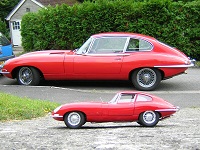
Those of us that have driven both LWB and SWB E-Types know the truth. There is more room in the LWB and it is easier to get in and out of the LWB. There is also exactly the same view down the (identical) bonnet. If only the LWB coupe wasn't such a hunchback it would be every bit a better car.
Chris '67 S1 2+2
| Link: | |
| BBcode: | |
| HTML: | |
| Hide post links |
#39 Re: series 3 vs Series 1
chrisfell Wrote:
We will just have to agree to disagree. Most days of the week, I dive every model E Type from Flat Floor S1s through to S3, in every body configuration. I don't experience any difference, in terms of difficulty, in getting in to, or out of any of these cars, except for the flat floor cars with non adjustable seats; these are harder for a tall person.
Unless you push the seat back before getting in to and out of the 2+2, you have the same space between Seat Back Rest and "A" pillar to fit through. There is little scope to pushing the seat of a FHC back further (initial adjustment for a tall person) as that would bring the "B" pillar into play.
Regards,
Bill
Hello Chris,Those of us that have driven both LWB and SWB E-Types know the truth. There is more room in the LWB and it is easier to get in and out of the LWB. There is also exactly the same view down the (identical) bonnet. If only the LWB coupe wasn't such a hunchback it would be every bit a better car.
We will just have to agree to disagree. Most days of the week, I dive every model E Type from Flat Floor S1s through to S3, in every body configuration. I don't experience any difference, in terms of difficulty, in getting in to, or out of any of these cars, except for the flat floor cars with non adjustable seats; these are harder for a tall person.
Unless you push the seat back before getting in to and out of the 2+2, you have the same space between Seat Back Rest and "A" pillar to fit through. There is little scope to pushing the seat of a FHC back further (initial adjustment for a tall person) as that would bring the "B" pillar into play.
Regards,
Bill
| Link: | |
| BBcode: | |
| HTML: | |
| Hide post links |
#40 Re: series 3 vs Series 1
As I said, I'm not replying personally anymore, but I was helpfully sent this by an expert on the forum by pm which kinda explains all, so I thought I should share -
"Hi Malcolm...when you next get yours next to a fhc you can tell the difference....door opening 2in higher and the bulk of the B post isnt level with the seat backreast.......so more room to access..." - " the 2+2 B post is further back by 9in.."
"Hi Malcolm...when you next get yours next to a fhc you can tell the difference....door opening 2in higher and the bulk of the B post isnt level with the seat backreast.......so more room to access..." - " the 2+2 B post is further back by 9in.."
Malcolm
I only fit in a 2+2, so got one!
1969 Series 2 2+2
2009 Jaguar XF-S
2015 F Type V6 S
I only fit in a 2+2, so got one!
1969 Series 2 2+2
2009 Jaguar XF-S
2015 F Type V6 S
| Link: | |
| BBcode: | |
| HTML: | |
| Hide post links |