Page 1 of 1
#1 How to test voltage regulator.
Posted: Thu Jul 18, 2019 10:28 am
by markhooper
Hi. I replaced my voltage regulator with a new unit from SNG as the battery indicator in the car was showing a full-scale overcharge and the battery had begun swelling and leaking.
Trouble is, the new unit has made no difference. Still overcharges the battery and has caused some loss of electrolyte from the new battery.
Can anyone recommend any tests I can do on the regulator before I send it back as I suspect the new replacement is also faulty.
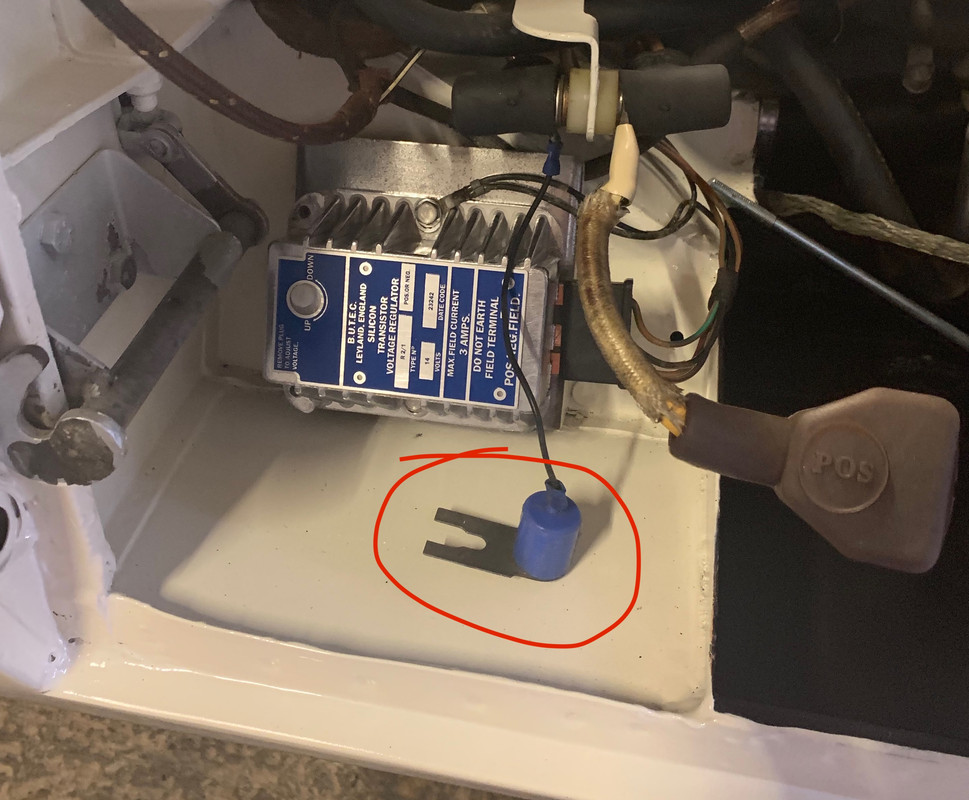
Also can anyone tell me what the blue component (circled) is in the attache pic?
It goes from the positive post to the voltage regulator mounting bolt. I have disconnected it here for clarity. I just can't think what it's purpose is and it's not in the repair manual or on any parts catalogue.
Thanks for any advice.
#2 Re: How to test voltage regulator.
Posted: Thu Jul 18, 2019 10:52 am
by abowie
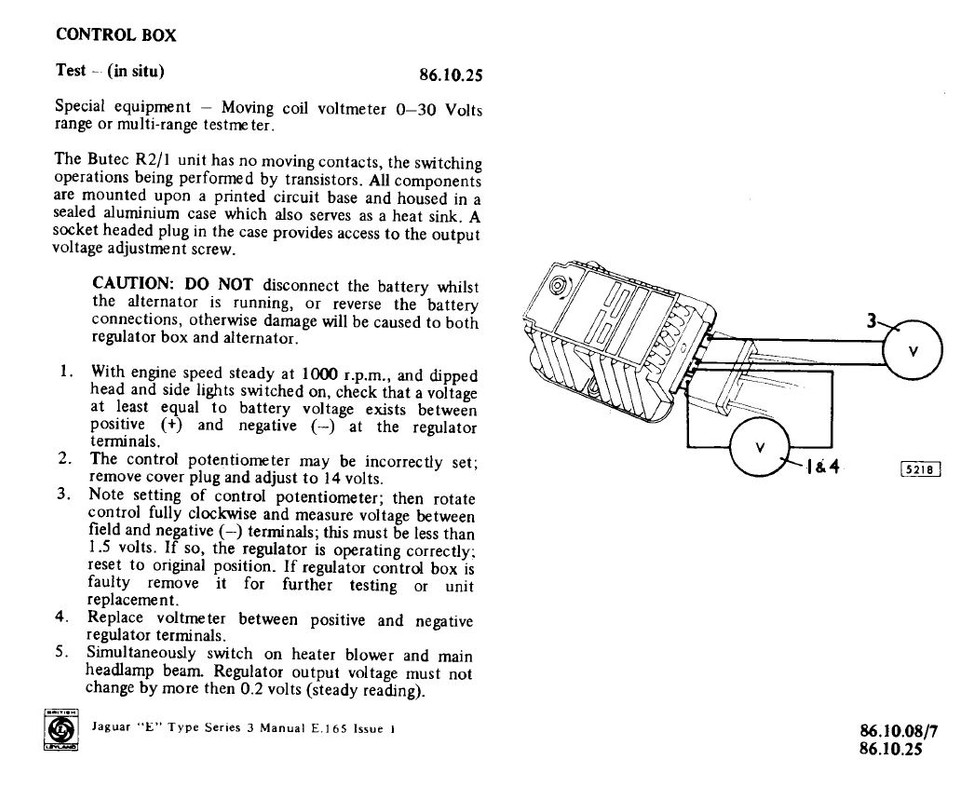
The blue thing is a capacitor. Now I don't know anything about S3 charging systems so others will chime in. But this is from the manual.
#3 Re: How to test voltage regulator.
Posted: Fri Jul 19, 2019 8:28 am
by MarekH
Dear Mark,
The regulators have very little circuitry in them and they are very reliable. The fact that swapping in a new item made no difference ought to alert you to the possibility that that wasn't the problem.
You should test the integrity of the wiring on the alternator to the regulator, through to the little red light, the bulb, back to the battery, then the field circuit, the earths until you get to the corroded connector on the field circuit.
The blue component is a capacitor to dampen out any voltage spikes from appearing on your regulator. A good and well charged battery performs the same function.
kind regards
Marek
#4 Re: How to test voltage regulator.
Posted: Fri Jul 19, 2019 9:16 am
by markhooper
Thanks for the advice so far.
As the problem persisted after replacing the regulator I too thought that the issue might reside elsewhere but I have fallen into that trap before with other cars with different components eg. starter motor, wasting entire weekends troubleshooting only to find that the replacement was indeed just faulty.
Here's what I've checked so far:
Battery is brand new and fully charged.
With engine running at 1000 rpm, voltage between battery terminals is 18volts
I conducted the tests from the Service Manual last night:
Test no. 1: "check...voltage is at least equal to battery voltage between + and - at regulator terminals"
My result : 2.1 volts
Test no. 3: "turn pot. fully clockwise...check voltage between field and negative...should be less than 1.5v"
My result : 4 volts
So according to the Service Manual I should remove the regulator for further tests but it doesn't say what tests these are. Does anyone have details of what bench tests I can perform on the regulator? I have seen them described somewhere but I can't for the life of me find them anymore.
Thanks in advance.
#5 Re: How to test voltage regulator.
Posted: Fri Jul 19, 2019 10:26 am
by MarekH
Take a look at David Lacey's website.
It'll have a few tests to áscertain whether the silicon components are performing, e.g. the diode nature of transistor junctions and the expected voltage drop across the zener.
kind regards
Marek
#6 Re: How to test voltage regulator.
Posted: Fri Jul 19, 2019 10:42 am
by markhooper
Do you have a link for David Lacey's website?
Many Thanks
#7 Re: How to test voltage regulator.
Posted: Fri Jul 19, 2019 11:19 am
by abowie
markhooper wrote: ↑Fri Jul 19, 2019 10:42 am
Do you have a link for David Lacey's website?
Many Thanks
http://www.xketype.com/news.php
#8 Re: How to test voltage regulator.
Posted: Fri Jul 19, 2019 11:23 am
by malcolm
markhooper wrote: ↑Fri Jul 19, 2019 9:16 am
Here's what I've checked so far:
Battery is brand new and fully charged.
With engine running at 1000 rpm, voltage between battery terminals is 18volts
Thanks in advance.
18V??? How long did it stay at that level after turning everything off? Major overcharge. I'd refit an old battery if you've still got it for further tests to avoid destroying your new battery.
#9 Re: How to test voltage regulator.
Posted: Fri Jul 19, 2019 11:41 am
by markhooper
Thanks for the heads up. That had crossed my mind too. Old battery from now on then

#10 Re: How to test voltage regulator.
Posted: Fri Jul 19, 2019 11:45 am
by markhooper
Thanks. Just had a quick read through of site. Looks to be just what I need
#11 Re: How to test voltage regulator.
Posted: Fri Jul 19, 2019 11:57 am
by markhooper
Thinking about it. Assuming the regulator is not faulty. With the ignition on but without the engine running, I should get 12.5 volts at the pos and neg terminals of the regulator presumably?
I’m only getting about 2 v. Therefore, assuming the above, maybe my issue is just a bad connection to the battery? I assume that the regulator will not work correctly if it’s only receiving 2 volts?
Tell me if I am safe to conduct the following: I could test this by disconnecting the moulded connector, running a direct connection between the battery pos and the regulator pos, same for the neg terminals. And then connecting the field terminal by inserting just that part of the connector. If the regulator then does it’s job, then at Least I know it’s ok and which wiring I need to chase up.
Any thoughts?
#12 Re: How to test voltage regulator.
Posted: Fri Jul 19, 2019 12:58 pm
by MarekH
In case you haven't noticed, you have miserably failed your voltage test number 1.
That's why the regulator isn't regulating - it doesn't have anything to regulate.
You either have lost it on the +ive wire on the way to the regulator because of a very high resistance, on the negative way back to the battery because of a very high resistance or are successfully conducting it away without any smoke escaping. (My private bet is that you have no ground strap on your alternator.)
The way the regulator works is that it either switches its big transistor on, or off.
When it actually has an input voltage (and you don't), it takes it through a 50:50 potential divider so it is set at a knife edge above or below the zener voltage of ~7v. If the result is below 7v, no voltage comes through the 7v zener, the first little transistor doesn't conduct and the big transistor does, field current flows and the alternator voltage goes up. That's where you're at. If the alternator voltage output arriving is high enough, the excess over the zener voltage makes the little transistor conduct and it turns on. This brings the big transistor down and it turns off so no field current flows and the alternator turns off. It then goes round in circles turning on and off many times a second. You don't ever get to the second half of this paragraph.
EDIT: this post was written some time ago
kind regards
Marek
#13 Re: How to test voltage regulator.
Posted: Fri Jul 19, 2019 1:09 pm
by MarekH
Dear Mark,
Disconnect both battery terminals so you don't do yourself any harm.
Then measure the resistance between alternator field to regulator field, alternator plus to regulator plus, alternator plus to disconnected battery plus lead, alternator case to disconnected battery neg, alternator case to regulator neg, regulator neg to disconnected battery neg lead.
Don't forget to wiggle the wiring a bit as you do it.
You should then be in a position to find what causes your missing volts and you can tell us whether it was a corroded connector, fraying wire or lack of earth.
kind regards
Marek
#14 Re: How to test voltage regulator.
Posted: Fri Jul 19, 2019 1:12 pm
by markhooper
Brilliant, thanks for the info. I'll give it a try this evening or tomorrow
#15 Re: How to test voltage regulator.
Posted: Mon Jul 22, 2019 5:11 pm
by markhooper
Just a quick update to say my issue has been resolved.
After checking the wiring at the alternator a positive wire was found to have detached from its connector. A new connector was crimped on and now everything works perfectly again.
Many thanks for your support.