


Now that I've sorted the over revving issue I've been able to run the engine up to temperature for the first time.
I got a little alarmed because the temperature guage rose to just below the red sector and the cooling fans did not kick in. My thermocouple temp guage gave readings of 74 degsC on the cylinder head and 47 degsC on the radiator. As the thermostat only opens at 74 degs I am assuming that it hadn't quite got to the opening temp, so the radiator was not receiving the full flow of water at 74 degs and as the otter switch only switches the fans on at 85 degs and off at 78 degs it is the temperature guage which is over reading. Any comments on this assumption are welcome
I connected the fans to a spare battery and they ran ok. I bypassed the otter switch and the fans didnt run but I could hear the new relay clicking in.
Temperature gauge and otter switch
-
Heronscourt
Topic author - Posts: 86
- Joined: Thu Jul 09, 2020 4:19 pm

#1 Temperature gauge and otter switch
Alan R
Etype series 1.5 roadster 1968
Etype series 1.5 roadster 1968
| Link: | |
| BBcode: | |
| HTML: | |
| Hide post links |

#2 Re: Temperature gauge and otter switch
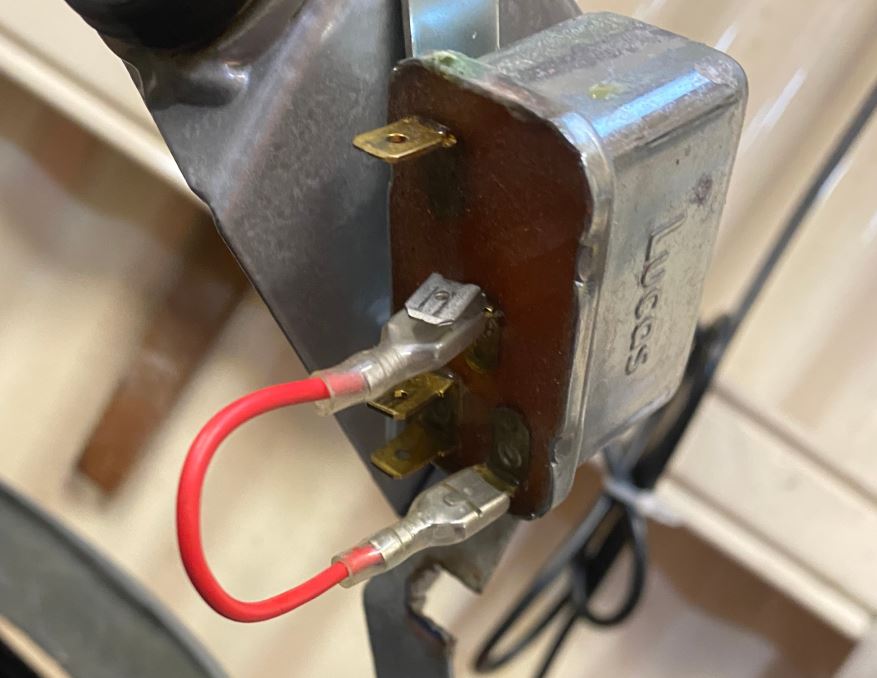
You'll need to sort this out. You may need to put a skip wire on to complete the connection.Heronscourt wrote: ↑Sat Apr 29, 2023 11:03 pmI bypassed the otter switch and the fans didnt run but I could hear the new relay clicking in.
Check your temp gauge is correctly connected to the 10V supply (GB) from the voltage regulator behind the dash.
Andrew.
881824, 1E21538. 889457. 1961 4.3l Mk2. 1975 XJS. 1979 MGB (supercharged).
Adelaide, Australia
881824, 1E21538. 889457. 1961 4.3l Mk2. 1975 XJS. 1979 MGB (supercharged).
Adelaide, Australia
| Link: | |
| BBcode: | |
| HTML: | |
| Hide post links |
-
Heronscourt
Topic author - Posts: 86
- Joined: Thu Jul 09, 2020 4:19 pm
#3 Re: Temperature gauge and otter switch
Is that the fan relay on the picture frame? If so it’s different to mine which only has three terminals. Is that why you need the jump wire. I’m sure that the required relay is number 6RA but you seem to have relay 111SRB.
Alan
Alan
Alan R
Etype series 1.5 roadster 1968
Etype series 1.5 roadster 1968
| Link: | |
| BBcode: | |
| HTML: | |
| Hide post links |

#4 Re: Temperature gauge and otter switch
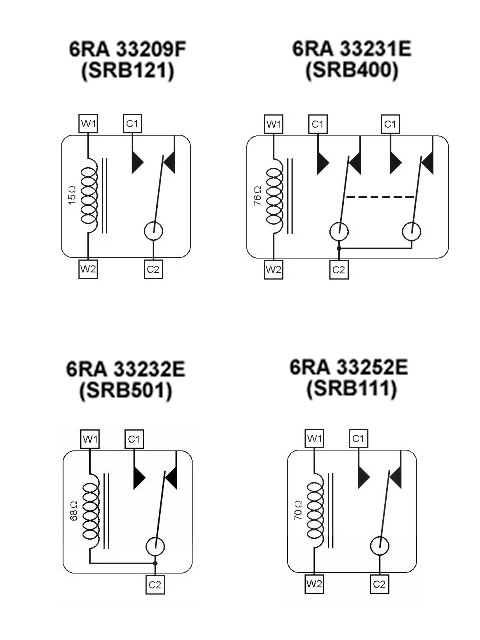
The 6RA is the general number for the metal can type relays......you need to refer to the wireing diagram for you model and parts catalogue to check your relay.......alternatives can be used but you will need to posdibly alter your wireing....Steve
Steve
69 S2 2+2 (sold) ..Realm C type replica, 1960 xk150fhc
69 S2 2+2 (sold) ..Realm C type replica, 1960 xk150fhc
| Link: | |
| BBcode: | |
| HTML: | |
| Hide post links |
#5 Re: Temperature gauge and otter switch
I think this pic is from a 3.8 but the concept is the same.
In the example above the relay needed to have the skip from the high current side to the triggering side in order to make it work. As you say it looks like the SRB511 in Steve's diagram, whereas the SRB501 might be correct with the 3 wires. I hadn't seen that diagram before but it's very useful.
As Steve says, you need to work out what's actually going on inside the relay so that you can ensure that you have power to both circuits, which may be the problem in your case.
A new relay may not be the same as the original, despite the sellers saying that it is. What you get is often dependant on what they are able to source. Irritating, I know.
Andrew.
881824, 1E21538. 889457. 1961 4.3l Mk2. 1975 XJS. 1979 MGB (supercharged).
Adelaide, Australia
881824, 1E21538. 889457. 1961 4.3l Mk2. 1975 XJS. 1979 MGB (supercharged).
Adelaide, Australia
| Link: | |
| BBcode: | |
| HTML: | |
| Hide post links |
-
Heronscourt
Topic author - Posts: 86
- Joined: Thu Jul 09, 2020 4:19 pm
#6 Re: Temperature gauge and otter switch
Thanks for the responses, my relay is definitely 3 pin. It's a new relay but the original relay was also 3 pin. Additionally the wiring loom only has 3 wiring connections at that point. It occurs to me that I have a new twin fan alluminium radiator and I need to check that the relay is adequate for those fans.
Alan
Alan
Alan R
Etype series 1.5 roadster 1968
Etype series 1.5 roadster 1968
| Link: | |
| BBcode: | |
| HTML: | |
| Hide post links |
-
Heronscourt
Topic author - Posts: 86
- Joined: Thu Jul 09, 2020 4:19 pm
#7 Re: Temperature gauge and otter switch
Today I checked out the temperature switch which completed the circuit at 82 degrees and broke it at 76 degrees so that wasn't the problem. I tested the relay and that clicked in ok so I had a wiring problem somewhere. Working through the wiring by section I found that there was no earth from the fans. Checking the earthing points there was good contact so it looked like a fault with the new loom. I wired in direct earths from the fan wires to the same earth points and when the engine was up to temperature the fans kicked inand out as required by the switch.
The temperature guage however continues to stay in the red section so I'm guessing that the guage us faulty or the new temperature sensor in the inlet manifold is faulty but how do I determine which.
The temperature guage however continues to stay in the red section so I'm guessing that the guage us faulty or the new temperature sensor in the inlet manifold is faulty but how do I determine which.
Alan R
Etype series 1.5 roadster 1968
Etype series 1.5 roadster 1968
| Link: | |
| BBcode: | |
| HTML: | |
| Hide post links |

#8 Re: Temperature gauge and otter switch
Is the gauge supply coming from the voltage regulator and if so is it working correctly. both the fuel and temp gauges are supplied regulated 10V. If not the regulator should be replaced.
Danny
1962 S1 3.8 FHC (1012/1798)
2015 Range Rover Sport SVR
"Experience is something you don't get until just after you need it."
1962 S1 3.8 FHC (1012/1798)
2015 Range Rover Sport SVR
"Experience is something you don't get until just after you need it."
| Link: | |
| BBcode: | |
| HTML: | |
| Hide post links |
#9 Re: Temperature gauge and otter switch
Since both the temperature and fuel use the same gauges and are supplied by the same voltage, their senders must run over the same ranges if the needles are to deflect by the same amount on each gauge.Heronscourt wrote: ↑Sat May 13, 2023 10:46 pmThe temperature guage however continues to stay in the red section so I'm guessing that the guage us faulty or the new temperature sensor in the inlet manifold is faulty but how do I determine which.
You can rule out the gauge by swapping the fuel signal with the temperature signal. If the needles on both gauges also swap over and you were happy with the fuel sender, then it isn't the temperature gauge that was the problem.
It also follows that the ohm range that the temperature sender must run over will be the same as that which the fuel sender must run over to deflect the needle by the same amount. It's relatively easy to pull the fuel sender and set the arm in different places to make the gauge needle read what you want it to read. You can then turn the power off and measure the ohms across the fuel sender. This should tie in with what the temperature sender ohms are at various temperatures which you can measure on the bench. From memory, 70'c equals 70 ohms when the needles points straight down.
When quoting temperatures, it helps to say where and how they are measured. It's not obvious from the post whether the Otter opening and closing temperatures quoted are the temperatures at the Otter switch or the corresponding temperatures of the coolant sender which is not located in the same place as the Otter or made via some external meter. Additionally, the Otter switch location changed from the header tank to the bottom of the radiator and the spec would probably have changed as one was before the radiator and the other was after the radiator so all of the parts need to be matched to work together properly.
kind regards
Marek
| Link: | |
| BBcode: | |
| HTML: | |
| Hide post links |
-
Heronscourt
Topic author - Posts: 86
- Joined: Thu Jul 09, 2020 4:19 pm
#10 Re: Temperature gauge and otter switch
Thanks Danny and Marek for prompt responses. The fuel guage appears to be reading correctly therefore I think the regulator is working ok. The operating temperature of the otter switch was checked at the otter switch. ie switch removed and current applied across the switch and test bulb. The make and break temperatures were recorded with an infra red thermometer.
When the switch was reinstalled and the engine run up to temperature the cylinder head temp was 76degs and the alluminium radiator only recorded 55 degrees .
The thermostat opened at a head temp of 78 degrees. I'm guessing that there was a 4 degree difference between cylinder head temp and the thermostat opening due to heat loss at the alloy thermostat housing.
It's possible that the new temp sensor in the manifold is inaccurate so I'll swap it out for an old unit to see if the guage still records high. So far given the cylinder head temp, rad temp and thermostat opening surely it can only be a faulty guage or sender.
When the switch was reinstalled and the engine run up to temperature the cylinder head temp was 76degs and the alluminium radiator only recorded 55 degrees .
The thermostat opened at a head temp of 78 degrees. I'm guessing that there was a 4 degree difference between cylinder head temp and the thermostat opening due to heat loss at the alloy thermostat housing.
It's possible that the new temp sensor in the manifold is inaccurate so I'll swap it out for an old unit to see if the guage still records high. So far given the cylinder head temp, rad temp and thermostat opening surely it can only be a faulty guage or sender.
Alan R
Etype series 1.5 roadster 1968
Etype series 1.5 roadster 1968
| Link: | |
| BBcode: | |
| HTML: | |
| Hide post links |