Stuart Wrote:
Also, there seems to be a misconception that shims are case hardened. They are actually through hardened, so don't worry about spoiling the temper.
Hello Stuart,
How have you determined that the original, or after market shims are through hardened?
For quite awhile, I've been considering manufacturing tappet shims, but haven't got around to determining the material to use. A hardness test indicates a surface hardness of circa 60 RHC, with my first thought that a through hardened piece of the typical thickness of these shims would be too brittle for the cyclic pounding they are subjected to. My next step in the dance, which is the one I've not got around to, is to definitely determine if the shims are case hardened, by a process called macro-etching or metallographic cross-sectioning. This can be done by cutting a shim circa in half along a chord of its circular shape, not in half thickness wise, then polishing the cut face. After polishing, apply Nitric acid to the cut face to etch the surface. In case-hardened carburized steels, the core is lower in carbon and will appear dark, while the high-carbon case will appear lighter.
Stuart Wrote:
They are high precision machines that generally incorporate a magnetic bed. When items are quite small you need to make sure they are positioned on the bed so they get maximum magnetic field to avoid them being thrown off when the wheel hits them. It's a skilled process.
It's not just a case of having a magnetic bed (magnetic chuck) and positioning, the magnetic chuck needs to be fine-pole (or micro-pitch) magnetic chuck, which is engineered specifically to prevent the magnetic field from passing completely through thin material. Unless a machine shop does thin thickness work piece surface grinding, its unlikely they will have the required magnetic chuck to do the work. Accordingly, you won't be able to take shims along to any machine shop to have them ground to size.
One other method of work holding thin material for surface grinding, and it works for non magnetic material, is to use a "freeze chuck" or "ice chuck". It uses water as a bonding agent, rapidly freezing it into a thin, solid layer of ice that firmly holds parts in place without applying clamping pressure. This is very useful where the surface of a thin part that would interface with a magnetic chuck is not perfectly flat, and due to its thinness, the not so flat surface is pulled down flat onto the surface of the chuck. When the magnetic clamping force is released, the part will generally revert back to its original state, and the surface that has just been surface ground flat, will no longer be flat. A Freeze Chuck will normally only be found in shops that do a lot of thin, or non-magnetic material grinding.
Regards,
Bill



 ". Your explanation is welcome, however.



 !
!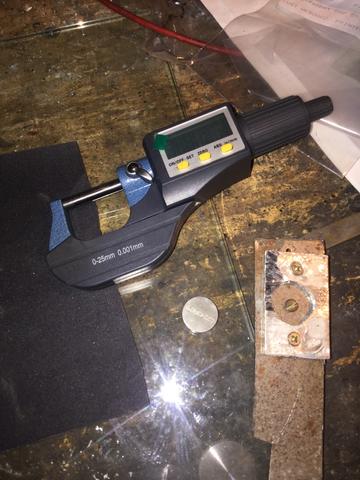

 , and results in a week delay due to postage. Or, grinding the shims myself, which takes a lot of effort and time, but less than a day (so I thought). I took the later path. Actually it took me the whole week-end, in a try and error process, some valves required 4 or 5 steps before converging to the famous 0.004" and 0.006" clearances (which validates the choice not to purchase the shims at each step).

