


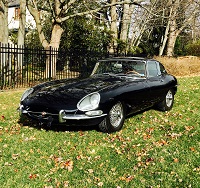
So I've rebuilt the triple SU HD8's on my '66 FHC and replaced two bent throttle shafts. I also replaced the worn original linkage with a replacement from SNG Barrat. After a little fettling I got the butterflies to nicely cycle from full throtte and snap shut to full closure. I was able to get the carbs synched with a Uni-Syn synchronizer and set the idle to 700 rpm. The manual choke cycles nicely back and forth. I was a little confused as to how to determine the proper oil level in the carbs. I understand the SU HD8's on the 4.2 engines should have the level 13mm below the piston (3.8's 13mm above), but How does one measure that? You can't see the level with the piston in place. I tried to estimate it as best I could, which ended up being 45 drops of 20wt in each carb.
Out for a road test the car started right up and idled nicely. It pulled strongly, but when shifting from full throttle the engine would rev up while the clutch was depressed between shifts. The butterflies snap closed strongly when the throttle is released, so I'm thinking I probably have too much oil in the pots which is slowing the descent of the piston. I would try removing some and testing again, but we just got dumped with a bunch of snow so it will be a week or two until I can test it again. In the meantime, is the "shift over-rev" symptomatic of over filled pots? Any other ideas? The car did not do this previously.
Any help is greatly appreciated.
SU Dashpot oil level? - Over-rev between shifts


#2 Re: SU Dashpot oil level? - Over-rev between shifts
Hi John,
The level of the oil in the dumper is just to don't put oil out of the dumper.
I think that your carbs are really too rich. Did you check it with the help of jaguar book?
Mich
The level of the oil in the dumper is just to don't put oil out of the dumper.
I think that your carbs are really too rich. Did you check it with the help of jaguar book?
Mich
Michel
1965 E Type FHC - On the road / 1963 E Type OTS - on the road after Angus Restoration
1965 E Type FHC - On the road / 1963 E Type OTS - on the road after Angus Restoration
| Link: | |
| BBcode: | |
| HTML: | |
| Hide post links |

#3 Re: SU Dashpot oil level? - Over-rev between shifts
The book says the oil in the damper should be to 1/4 in h of the top. Simple way to check the oil level. Unscrew the dash pot piston and lift an inch or so. Drop back in. It should hit the pool of oil in the main carb piston about 8 or so mm before the threaded cap reaches the dash pot top. As Mich says it sounds over rich. Each carb has a lift pin that allows the dash pot piston to be raised . With the engine running raise each dash pot piston about 0.8 mm (a tiny amount) using the lift pin. If the engine revs drop then that carb is running lean. If the engine revs immediately increase that carb is running rich. If the revs momentarily rise and then settle back the mix is correct. It is a delicate job.
Julian the E-type man
1962 FHC
1966 MGB....fab little car too
1962 FHC
1966 MGB....fab little car too
| Link: | |
| BBcode: | |
| HTML: | |
| Hide post links |
#4 Re: SU Dashpot oil level? - Over-rev between shifts
Thanks so much guys!
I think you guys are right. I went through the carb tuning procedure again and did have to weaken the mixture a couple turns on each carb to get the "rise and return".
I also made a dipstick out of some brazing rod to measure the oil level. I took one piece and marked the top of the plunger cap threads with a file and made a second mark 13mm below the bottom of the piston. I made sure it would not bottom in the slide. This can be used to measure the oil level, but the top mark must be aligned with the top of the carb to do so. I wanted an easier version so I made second rod that would take the same measurement but off the bottom of the slide where the piston and oil go. I inserted the first piece until the top mark aligned with the top of the carb. then inserted a second piece until it bottomed in the slide. I took them out together and carefully marked the second piece where the oil level mark on the first piece was. Bottom line, the oil should be 32mm or 1 1/4" deep in the slide to be 13mm below the plunger when it's screwed in. Said another way, the bottom of the piston is 19mm above the bottom of the slide when the plunger is screwed in and the slide is bottomed in the carb. The oil should be 13mm above that, or 32 mm (1 1/4") deep.
To make a simple dipstick, make a mark 1 1/4" up a rod and fill the oil to there.
The jury's still out on a road test as were still snow-bound, but I'll report back after I test it.
I think you guys are right. I went through the carb tuning procedure again and did have to weaken the mixture a couple turns on each carb to get the "rise and return".
I also made a dipstick out of some brazing rod to measure the oil level. I took one piece and marked the top of the plunger cap threads with a file and made a second mark 13mm below the bottom of the piston. I made sure it would not bottom in the slide. This can be used to measure the oil level, but the top mark must be aligned with the top of the carb to do so. I wanted an easier version so I made second rod that would take the same measurement but off the bottom of the slide where the piston and oil go. I inserted the first piece until the top mark aligned with the top of the carb. then inserted a second piece until it bottomed in the slide. I took them out together and carefully marked the second piece where the oil level mark on the first piece was. Bottom line, the oil should be 32mm or 1 1/4" deep in the slide to be 13mm below the plunger when it's screwed in. Said another way, the bottom of the piston is 19mm above the bottom of the slide when the plunger is screwed in and the slide is bottomed in the carb. The oil should be 13mm above that, or 32 mm (1 1/4") deep.
To make a simple dipstick, make a mark 1 1/4" up a rod and fill the oil to there.
The jury's still out on a road test as were still snow-bound, but I'll report back after I test it.
| Link: | |
| BBcode: | |
| HTML: | |
| Hide post links |

#5 Re: SU Dashpot oil level? - Over-rev between shifts
If you put too much oil in it just runs out.
Check your tune and that the return springs are pulling the butterflies fully closed.
Check your tune and that the return springs are pulling the butterflies fully closed.
Andrew.
881824, 1E21538. 889457. 1961 4.3l Mk2. 1975 XJS. 1979 MGB (supercharged).
Adelaide, Australia
881824, 1E21538. 889457. 1961 4.3l Mk2. 1975 XJS. 1979 MGB (supercharged).
Adelaide, Australia
| Link: | |
| BBcode: | |
| HTML: | |
| Hide post links |
-
 Moeregaard
- Posts: 763
- Joined: Thu Mar 13, 2008 7:23 pm
- Location: Thousand Oaks, California

#6 Re: SU Dashpot oil level? - Over-rev between shifts
I'm going to go out on a limb here and suggest that your throttle linkage might be fouling the upper subframe rail. On the 4.2, worn/failed engine mounts can allow the entire lump to sit low enough for the linkage to sit dangerously close to the frame. When full throttle is applied, engine torque will cause everything to roll to the right, with the linkage now in full contact--and on the wrong side of things. I had this happen when I got my first E-Type running after it had been sitting in a garden for several years. Rounded a corner, gave it some stick, and I suddenly had a real handful. Releasing the throttle had no effect and I had to turn the ignition off to stop the excitement--at which point the throttles returned to the closed position. All of the engine mounts had deteriorated sufficiently
If you see any witness marks from the linkage on the subframe, have a look at the rear gearbox mount under the car, to see if its rubber bits are perished or missing, and inspect the front engine mounts as well. Also take a look at the rear engine stabilizer and see if it's damaged. Ham-fisted mechanics often over-tighten the stabilizer and in some cases this will cause its mount to break away from the firewall.
SU carbs are not that sensitive to oil level in the dashpots, and you've got the proper weight oil in there. All the oil does is regulate the carb pistons' movement during acceleration and prevent them from chattering during idle and cruise. If there's oil in there, you're OK. For initial setting of the carbs, refer to the owner's manual, as it provides the best starting point.
Sorry for making this so long-winded, but when I read your description of the problem my first thought was "Been there, done that." Hope this helps.
If you see any witness marks from the linkage on the subframe, have a look at the rear gearbox mount under the car, to see if its rubber bits are perished or missing, and inspect the front engine mounts as well. Also take a look at the rear engine stabilizer and see if it's damaged. Ham-fisted mechanics often over-tighten the stabilizer and in some cases this will cause its mount to break away from the firewall.
SU carbs are not that sensitive to oil level in the dashpots, and you've got the proper weight oil in there. All the oil does is regulate the carb pistons' movement during acceleration and prevent them from chattering during idle and cruise. If there's oil in there, you're OK. For initial setting of the carbs, refer to the owner's manual, as it provides the best starting point.
Sorry for making this so long-winded, but when I read your description of the problem my first thought was "Been there, done that." Hope this helps.
Mark (Moe) Shipley
Former owner '66FHC, #1E32208
Former owner '65FHC, #1E30036
Planning on getting E-Type No. 3 as soon as possible....
Former owner '66FHC, #1E32208
Former owner '65FHC, #1E30036
Planning on getting E-Type No. 3 as soon as possible....
| Link: | |
| BBcode: | |
| HTML: | |
| Hide post links |