


Having played about recently with the Mini's rear camber and tracking, where toe-out was giving some distinctly leery steering behaviour under hard cornering, I'm now wondering whether my E-Type's current minor toe-out condition at the back isn't responsible for (what might be) rather odd rear-steering effects.
At 11' and 4' respectively, right and left, that's between 19' - 26' and 12' - 19' insufficient toe in, if the figures I have (no idea where from) for the ideal toe-in are right - at between 8' and 15'.
It's obviously not adjustable per-se on the Jag, although it could be modified if need be, by changing the positions of the ends of the fulcrum shafts.
Can anyone point me in the direction of anything published regarding this, or offer comments/advice as to what they have lived with, or successfully corrected ?
We all chewed the cud over this in spring 2014 :
viewtopic.php?f=3&t=4991&start=20
but I there's no clear conclusion, and whilst I can see how you could crab the IRS slightly by tweaking the length of the radius arms with some clever heat/quench, the idea that - quote
The car was raised up and a Technician fired up the Oxy Acetylene and started to heat one of the rear lower wishbones Chris informed me he prefers 2-3 degrees toe-in but has had customers who prefer 5 degree. We settled on 3 deg from memory. As the heat was applied you could see the toe in changing on the gauge.
seemed to defy my understanding of what we were talking about.
Essentially, the position of the IRS fulcrum shafts dictate the "attitude" of the hub-carriers, in relation to each other, and all you can ever do is try and balance that attitude Left-Right.
So in my case, for example, with 11' and 4', I could at best hope for 15/2 or 8' on both sides.
I can now see that it never had anything to do with the radius-arms, but involved heating the lower wishbone tubes to skew their alignment - which is indeed very clever.
However, unless my Trigonometry is orders of magntiude adrift, even just 1° of toe actually corresponds to 3.5mm of movement at the rim - so 5° would be 17.5mm, and over both wheels that is 70mm of pinch at the rims, or a full 84mm measured at the tyre-wall beads !
So there's something wrong somewhere in there.
(So we're all using the same terminology and base-lines, I'm basing this on a rim radius of 200mm, a tyre-wall bead radius of 250mm, and assuming that the lateral movement that occurs at a given radius is multipled by 2 to take account of the fact that its effect is felt across a diameter, and again by 2 because the same thing is happening with the other wheel, to give an "overall" pinch which is the measured difference between the front and rear widths at a given radius on the tyres.
And considering that for low values sin = tan etc)
Does the CKL account talk about "degrees" instead of "minutes" ?
But divide 70mm or 84mm by 60 and it all seems improbably twee.
The 8' to 15' I mentioned, as having picked up somewhere, work out at between 2mm and 4mm of overall pinch measured at the tyre-wall beads, which sounds more plausible.
Somebody might like to check my maths please, while I go and fetch the blue-tipped universal adjusting wrench .............
Rear Tracking and Toe-In
#1 Rear Tracking and Toe-In
Rory
3.8 OTS S1 Opalescent Silver Grey - built May 28th 1962
3.8 OTS S1 Opalescent Silver Grey - built May 28th 1962
| Link: | |
| BBcode: | |
| HTML: | |
| Hide post links |

#2 Re: Rear Tracking and Toe-In
Rory,
As you state, the tracking is not adjustable per-se on the standard E type rear suspension as the fulcrum shafts and their cast mounting brackets align directly into the rear suspension cross member - or "the cage".
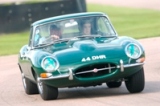
However, the ubiquitous "Jag Back End" is still used extensively in Hot Rods and in kit cars such as Cobras, for example. When I was much younger in the late 1970s and early 1980s, the customising era was in full swing in the UK. A chromed Jag Back End was de rigueur in a custom car and these were mounted rigidly out of the standard cage to give maximum effect to highlight the chromed half shafts and knuckles spinning round - especially when illuminated by a red light at night !! It was common practice to narrow the widths by shortening the lower wishbones and drive shafts. Still, we all grow up at some point and I attach two photos of two of my cars wearing the same number plate 35 years apart.
January 1982 Hot Rod & Custom Magazine :-

2017 :-

Still plenty of shiny bits ! At the time, I wrote quite a few articles on how to mount Jag axles into cars and the key parameters on getting them to safely work out of the standard cage now that by rigidly mounting them, the suspension had to operate correctly and not quickly pull itself apart. One of these was that it was critical to ensure that the now longer tie rods - which were replacing the short rubber mounted forward facing Jaguar radius arms on the wishbones - had their forward mounting aligned directly with the fulcrum shafts to effectively give a rigid triangle, as without this both would perform two distinctly different radii when moving up and down.
Hot Rods and Cobra replicas using components of or based on Jaguar rear ends are certainly alive and well now and perhaps this is an area to search to see what developments are now currently used as most of the applications I saw in the States a month ago, they had fabricated their own lower wishbones and were fully adjustable. Check out the change to the dampers, now horizontally operated !
October 2017 Petersen Automotive Museum, L.A. :-

Perhaps a starting point to see how they set up their rear suspensions by searching their related forums ?
regards,
Dave
As you state, the tracking is not adjustable per-se on the standard E type rear suspension as the fulcrum shafts and their cast mounting brackets align directly into the rear suspension cross member - or "the cage".
However, the ubiquitous "Jag Back End" is still used extensively in Hot Rods and in kit cars such as Cobras, for example. When I was much younger in the late 1970s and early 1980s, the customising era was in full swing in the UK. A chromed Jag Back End was de rigueur in a custom car and these were mounted rigidly out of the standard cage to give maximum effect to highlight the chromed half shafts and knuckles spinning round - especially when illuminated by a red light at night !! It was common practice to narrow the widths by shortening the lower wishbones and drive shafts. Still, we all grow up at some point and I attach two photos of two of my cars wearing the same number plate 35 years apart.
January 1982 Hot Rod & Custom Magazine :-
2017 :-
Still plenty of shiny bits ! At the time, I wrote quite a few articles on how to mount Jag axles into cars and the key parameters on getting them to safely work out of the standard cage now that by rigidly mounting them, the suspension had to operate correctly and not quickly pull itself apart. One of these was that it was critical to ensure that the now longer tie rods - which were replacing the short rubber mounted forward facing Jaguar radius arms on the wishbones - had their forward mounting aligned directly with the fulcrum shafts to effectively give a rigid triangle, as without this both would perform two distinctly different radii when moving up and down.
Hot Rods and Cobra replicas using components of or based on Jaguar rear ends are certainly alive and well now and perhaps this is an area to search to see what developments are now currently used as most of the applications I saw in the States a month ago, they had fabricated their own lower wishbones and were fully adjustable. Check out the change to the dampers, now horizontally operated !
October 2017 Petersen Automotive Museum, L.A. :-
Perhaps a starting point to see how they set up their rear suspensions by searching their related forums ?
regards,
Dave
Last edited by 44DHR on Wed May 02, 2018 9:51 am, edited 1 time in total.
Dave Rose
1967 Series 1 4.2 FHC
1967 Series 1 4.2 FHC
| Link: | |
| BBcode: | |
| HTML: | |
| Hide post links |
#3 Re: Rear Tracking and Toe-In
Thanks for those insights Dave.
I did find some Cobra-based stuff but the comments were rather what I feared, in that they were based on puffery and not science - suggestions that the toe was controlled by the shims between the cage and the diff-mountings whereas "any fule kno" that the position of the inner fulcrum shafts is cast in stone by the holes in the IRS cage.
My reading of Wikipedia is that until 1995, when an eccentric was introduced, the toe could not be adjusted full-stop.
Unless you bent the arms.
I now have some inside knowledge, from someone who does this professionally, that I have vowed to keep anonymous !
They aim for 15' toe-in on both sides, 30' in all.
The trick is apparently to heat the front of the lower wishbone tube with a fierce oxy-acetylene flame, and chase a cherry-red spot up the front-edge at a rate that takes you approximately 20 seconds to run it between the shock anchorage and the upper end fork.
This - counterintuitively to me at least - returns, upon cooling, to a shorter length, and skews the toe inwards.
It used to be done by welding a bead along the front edge .......... Same effect.
Not exactly precise and requires cooling before judging the result, and then doing again. And again ?
But I'm right up for having a go if I can persuade the local Quick-Fit to let me on the ramp with their lasers and my oxy-acetylene !
I did find some Cobra-based stuff but the comments were rather what I feared, in that they were based on puffery and not science - suggestions that the toe was controlled by the shims between the cage and the diff-mountings whereas "any fule kno" that the position of the inner fulcrum shafts is cast in stone by the holes in the IRS cage.
My reading of Wikipedia is that until 1995, when an eccentric was introduced, the toe could not be adjusted full-stop.
Unless you bent the arms.
I now have some inside knowledge, from someone who does this professionally, that I have vowed to keep anonymous !
They aim for 15' toe-in on both sides, 30' in all.
The trick is apparently to heat the front of the lower wishbone tube with a fierce oxy-acetylene flame, and chase a cherry-red spot up the front-edge at a rate that takes you approximately 20 seconds to run it between the shock anchorage and the upper end fork.
This - counterintuitively to me at least - returns, upon cooling, to a shorter length, and skews the toe inwards.
It used to be done by welding a bead along the front edge .......... Same effect.
Not exactly precise and requires cooling before judging the result, and then doing again. And again ?
But I'm right up for having a go if I can persuade the local Quick-Fit to let me on the ramp with their lasers and my oxy-acetylene !
Rory
3.8 OTS S1 Opalescent Silver Grey - built May 28th 1962
3.8 OTS S1 Opalescent Silver Grey - built May 28th 1962
| Link: | |
| BBcode: | |
| HTML: | |
| Hide post links |