


I have an early S1 4.2 OTS with low mileage and little wear with a 3.54 diff and EJ box (ratios 2.68, 1.74, 1.27 and 1.0) and realise that the car will accelerate like mad but wont have long legged performance.
I want a fast road spec if possible and am trying to decide whether to change the diff to a 3.07 and leave the box alone, or install a 5 speed box and leave the diff. Or do both.
In both cases, the diff and box will need new seals, probably bearings as I'm told they are likely to have become corroded thro years of inactivity. There seems a lot of divided opinion on this matter. I also realise this may affect the speedo calibration, so I am looking for the most cost effective overall solution.
Diff and gearbox options advice please
#1 Diff and gearbox options advice please
64 S1 4.2 OTS 1E10012 73 S3 2+2 manual 2013 V6 F type OTS
| Link: | |
| BBcode: | |
| HTML: | |
| Hide post links |
-
 PeterCrespin
- Posts: 4561
- Joined: Fri Mar 05, 2010 8:22 pm
- Location: Gaithersburg, Maryland.
- Contact:

#2
Fast or slow the answer is the same - it depends what type of roads. An overdrive 5-speed and 3.54 gives you the widest performance envelope. 5 + 3.07 is too tall for maximum oomph off the line but great for motorways. The EJ plus 3.54 is great for winding country roads where all four gears will keep the car on the boil. Unless the 5-speed has a lower first than the EJ you will lose off the mark by going to 3.07 but unless you indulge in traffic light sprints it doesn't matter. Most people would spend a lot of money to get a guaranteed 15% torque increase throughout the range, but others give it up happily swapping from 3.54 to 3.07.
There IS no right answer, only YOUR choice. The facts are just numbers easily checked with rpm/speed charts in the manual, or two minutes with a calculator. My only advice would be to ignore fuel consumption (as it is such a tiny variable in a leisure car between spec A and spec B) and to remember that an XK using it's full rev range is a wondrous thing. We all love the way they stomp along in high gears but to cruise and use one consistently around the 4000+ mark takes you right back to the Mulsanne Straight, Reims and Monthlery. True, a 4.2 isn't quite as sweet as a 3.8 up there in the higher reaches but it will sit all day at 4500 and thank you for it.
In the end it's just choice. You can't have it all, but the low diff/tall firth or MOD (LWB cars) gives you the widest range.
There IS no right answer, only YOUR choice. The facts are just numbers easily checked with rpm/speed charts in the manual, or two minutes with a calculator. My only advice would be to ignore fuel consumption (as it is such a tiny variable in a leisure car between spec A and spec B) and to remember that an XK using it's full rev range is a wondrous thing. We all love the way they stomp along in high gears but to cruise and use one consistently around the 4000+ mark takes you right back to the Mulsanne Straight, Reims and Monthlery. True, a 4.2 isn't quite as sweet as a 3.8 up there in the higher reaches but it will sit all day at 4500 and thank you for it.
In the end it's just choice. You can't have it all, but the low diff/tall firth or MOD (LWB cars) gives you the widest range.
1E75339 UberLynx D-Type; 1R27190 70 FHC; 1E78478; 2001 Vanden Plas
| Link: | |
| BBcode: | |
| HTML: | |
| Hide post links |

#3
Everything Pete says, plus ....
My own experience is with my 2.88 diff and T5 box. The car is superb for what we use it for (touring Europe) but there are some caveats with this setup:
1. For a 2.88 diff you need an upgraded high torque engine - 340lb/ft in my case - otherwise it will bog down at around 2,000 - 2,500 rpm unless you are circumspect with the gears
2. The 2.88 is great on most roads however you need to be in one gear lower than with a higher ratio diff. Only problem I have had is uphill hairpin bends in the Alps where 1st was still too high and I had to slip the clutch to stop the car bogging down. Also town driving can be a problem as 2nd is too low and 3rd is too high to maintain reasonably smooth and quiet progress at 30mph.
3. On the plus side, in 5th, 3,000rpm equates to 100mph so cruising is effortless and exhaust noise muted. I can floor it from there and the car is off like the proverbial scalded cat.
4. For best all round performance, with a near standard engine, 3.07 is as high as you want to go. Add a 5 speed or MOD box and you will have the best of all worlds.
5. My FHC has a 3.07/Moss box and it is a perfectly tractable very fast car - nothing passed me on a recent 250 mile round trip down the A1 to see Angus
You can use this superb little calculator to work out the effect of different ratios: http://wahiduddin.net/calc/calc_speed_rpm.htm
My own experience is with my 2.88 diff and T5 box. The car is superb for what we use it for (touring Europe) but there are some caveats with this setup:
1. For a 2.88 diff you need an upgraded high torque engine - 340lb/ft in my case - otherwise it will bog down at around 2,000 - 2,500 rpm unless you are circumspect with the gears
2. The 2.88 is great on most roads however you need to be in one gear lower than with a higher ratio diff. Only problem I have had is uphill hairpin bends in the Alps where 1st was still too high and I had to slip the clutch to stop the car bogging down. Also town driving can be a problem as 2nd is too low and 3rd is too high to maintain reasonably smooth and quiet progress at 30mph.
3. On the plus side, in 5th, 3,000rpm equates to 100mph so cruising is effortless and exhaust noise muted. I can floor it from there and the car is off like the proverbial scalded cat.
4. For best all round performance, with a near standard engine, 3.07 is as high as you want to go. Add a 5 speed or MOD box and you will have the best of all worlds.
5. My FHC has a 3.07/Moss box and it is a perfectly tractable very fast car - nothing passed me on a recent 250 mile round trip down the A1 to see Angus
You can use this superb little calculator to work out the effect of different ratios: http://wahiduddin.net/calc/calc_speed_rpm.htm
David Jones
S1 OTS OSB
1997 Porsche 911 Guards Red
2024 Lexus LBX
Add your E-Type to our World Map: http://forum.etypeuk.com/viewtopic.php?f=1&t=1810
S1 OTS OSB
1997 Porsche 911 Guards Red
2024 Lexus LBX
Add your E-Type to our World Map: http://forum.etypeuk.com/viewtopic.php?f=1&t=1810
| Link: | |
| BBcode: | |
| HTML: | |
| Hide post links |
#4
Wow, brilliant advice thanks guys.
Is there much difference Dave between 2.88 and 3.07 or are they quite similar ?
We are seriously thinking about upgrading the engine a little from standard with gas flowed heads, bigger valves, better manifolds/exhausts and any other tweaks that you could suggest. Would a lightweight flywheel make much difference?
It sounds like a 5 speed box with 3.07 diff is ideal, we intend to keep the car a very long time and so its use maywell change, certainly a lot of use on smaller roads with some touring and Mways as well. I am sure my son would also love to be doing traffic light sprints but I'm less keen on him doing that
Is there much difference Dave between 2.88 and 3.07 or are they quite similar ?
We are seriously thinking about upgrading the engine a little from standard with gas flowed heads, bigger valves, better manifolds/exhausts and any other tweaks that you could suggest. Would a lightweight flywheel make much difference?
It sounds like a 5 speed box with 3.07 diff is ideal, we intend to keep the car a very long time and so its use maywell change, certainly a lot of use on smaller roads with some touring and Mways as well. I am sure my son would also love to be doing traffic light sprints but I'm less keen on him doing that
64 S1 4.2 OTS 1E10012 73 S3 2+2 manual 2013 V6 F type OTS
| Link: | |
| BBcode: | |
| HTML: | |
| Hide post links |
#5
As a matter of interest, is any performance data published on S1 4.2's with EJ box and 3.54 diffs, acceleration etc?
64 S1 4.2 OTS 1E10012 73 S3 2+2 manual 2013 V6 F type OTS
| Link: | |
| BBcode: | |
| HTML: | |
| Hide post links |
-
PeterCrespin
- Posts: 4561
- Joined: Fri Mar 05, 2010 8:22 pm
- Location: Gaithersburg, Maryland.
- Contact:
#6
American road tests, articles in the Brochure section of Jag-Lovers etc.?
1E75339 UberLynx D-Type; 1R27190 70 FHC; 1E78478; 2001 Vanden Plas
| Link: | |
| BBcode: | |
| HTML: | |
| Hide post links |
#7
Avoid an after market lightweight flywheel it will make the car difficult to drive around town. The original flywheel was called 'lightweight' by Jaguar to differentiate it from the heavier saloon version.
Can't really compare my two cars as they are very different. The OTS is a hooligan machine designed for touring through Europe. Very quick (same as our Porsche 993) but probably too high geared for the UK. At 3,000rpm it is doing 100mph. Pulling away from traffic lights seems a tad slow but speed very quickly builds and because most cars need three gears to get to 70mph the one change on this one beats them every time. Apart from the 2.88 diff and T5 box the car is relatively standard with cast manifolds, Boge standard shocks, 1.75" exhaust with straight through silencers and 185 Michelin XVS tyres on 5" wheels. It does have Zeus brakes, EDIS/Megajolt ignition and a Mangoletsi cable throttle system. Engine is built to VSE02 spec but nothing exotic and has been dyno'd at 280bhp and 340lb/ft.
The FHC is totally standard (including points) with a 3.07 diff but is a joy to drive although it will not win any traffic light Grand Prix (Moss box). Once into top it is fairly quick and if you floor it at 70mph it is into three figures fairly quickly. On the move I only ever need to use 3rd and 4th.
Things to think about:
1. Avoid tubular manifolds as they increase heat/noise and cause a power dip between 2,250 and 2,750
2. Avoid big bore exhaust systems as you will quickly tire of the noise
3. Avoid Weber conversions unless you really know what you are doing because they are time consuming and expensive to set up correctly. You also need to be in love with the smell of petrol. They make no difference to power on a road car unless you regularly get up to 6,000rpm.
4. Avoid wide low profile tyres, go for 185 section tyres because they increase ground clearance and make the car a delight to drive. Dunlop SP Sports are very good as the tread pattern makes them look a lot wider than they have a right to be. For ultimate handling the Michelin 185 XVS is hard to beat but the soft compound means I go through a set of rears every 8,000 miles.
5. Go for the Medatonics JT5 box if you can get hold of one but avoid the other T5 variants. I have not had any feedback from owners of the ETF 5 speed as yet.
6. Bear in mind the more you modify the XK engine the more you will compromise all round performance
Can't really compare my two cars as they are very different. The OTS is a hooligan machine designed for touring through Europe. Very quick (same as our Porsche 993) but probably too high geared for the UK. At 3,000rpm it is doing 100mph. Pulling away from traffic lights seems a tad slow but speed very quickly builds and because most cars need three gears to get to 70mph the one change on this one beats them every time. Apart from the 2.88 diff and T5 box the car is relatively standard with cast manifolds, Boge standard shocks, 1.75" exhaust with straight through silencers and 185 Michelin XVS tyres on 5" wheels. It does have Zeus brakes, EDIS/Megajolt ignition and a Mangoletsi cable throttle system. Engine is built to VSE02 spec but nothing exotic and has been dyno'd at 280bhp and 340lb/ft.
The FHC is totally standard (including points) with a 3.07 diff but is a joy to drive although it will not win any traffic light Grand Prix (Moss box). Once into top it is fairly quick and if you floor it at 70mph it is into three figures fairly quickly. On the move I only ever need to use 3rd and 4th.
Things to think about:
1. Avoid tubular manifolds as they increase heat/noise and cause a power dip between 2,250 and 2,750
2. Avoid big bore exhaust systems as you will quickly tire of the noise
3. Avoid Weber conversions unless you really know what you are doing because they are time consuming and expensive to set up correctly. You also need to be in love with the smell of petrol. They make no difference to power on a road car unless you regularly get up to 6,000rpm.
4. Avoid wide low profile tyres, go for 185 section tyres because they increase ground clearance and make the car a delight to drive. Dunlop SP Sports are very good as the tread pattern makes them look a lot wider than they have a right to be. For ultimate handling the Michelin 185 XVS is hard to beat but the soft compound means I go through a set of rears every 8,000 miles.
5. Go for the Medatonics JT5 box if you can get hold of one but avoid the other T5 variants. I have not had any feedback from owners of the ETF 5 speed as yet.
6. Bear in mind the more you modify the XK engine the more you will compromise all round performance
David Jones
S1 OTS OSB
1997 Porsche 911 Guards Red
2024 Lexus LBX
Add your E-Type to our World Map: http://forum.etypeuk.com/viewtopic.php?f=1&t=1810
S1 OTS OSB
1997 Porsche 911 Guards Red
2024 Lexus LBX
Add your E-Type to our World Map: http://forum.etypeuk.com/viewtopic.php?f=1&t=1810
| Link: | |
| BBcode: | |
| HTML: | |
| Hide post links |

#8
Ian, given that you say your son will be driving it, what implications would the various modifications have in the insurance premium?
I suppose this is also an open question to anyone who has done similar modifications.
Simon
I suppose this is also an open question to anyone who has done similar modifications.
Simon
| Link: | |
| BBcode: | |
| HTML: | |
| Hide post links |
#9
Thanks Dave, really helpful all that info, my son is obsessed with webers and I'm not so your comments are interesting. What manifolds and exhaust systems would you recommend? are Bell s/s ones OK noise wise?
The info on tyres I had already surmised, the S1 car actually has 205/70's on 5.5" wires now and looks wrong and tyres catch bump stops when its jacked up. 185's on 5.5" I was thinking of going for. I have always loved michelins and used lots of XWX's on my S3 over the years and just invested in a set of the new XWX's from Dougal for the S3 and they are much better than the P5's they replaced grip wise.
Simon, I too have concerns about insurance for a 22 yr old if the car isnt standard, but he does have 4 yrs ncb and premiums have come down a lot and the plan was for him to have it when he's 25 and classic insurance kicks in.
So many options :)
:? :? :? :? :? :? :? :? :? :D
The info on tyres I had already surmised, the S1 car actually has 205/70's on 5.5" wires now and looks wrong and tyres catch bump stops when its jacked up. 185's on 5.5" I was thinking of going for. I have always loved michelins and used lots of XWX's on my S3 over the years and just invested in a set of the new XWX's from Dougal for the S3 and they are much better than the P5's they replaced grip wise.
Simon, I too have concerns about insurance for a 22 yr old if the car isnt standard, but he does have 4 yrs ncb and premiums have come down a lot and the plan was for him to have it when he's 25 and classic insurance kicks in.
So many options :)
:? :? :? :?
:? :? :? :? :? :D64 S1 4.2 OTS 1E10012 73 S3 2+2 manual 2013 V6 F type OTS
| Link: | |
| BBcode: | |
| HTML: | |
| Hide post links |

#10
I can only echo this advice. Contact me off list if you wish to hear about the quality and aftermarket support of another T5 clone.Heuer wrote: 5. Go for the Medatonics JT5 box if you can get hold of one but avoid the other T5 variants. I have not had any feedback from owners of the ETF 5 speed as yet.
I have a 3.07 diff in my 4.2 FHC, with standard 4 synchro box. It's a pretty good combination. Personally I wouldn't want first gear to be any longer. This engine does have a Fidanza aluminium flywheel. To be honest I can't feel any difference between it and other 4.2 cars with standard flywheels. The engine is otherwise stock and I have a standard Bell SS exhaust fitted which several people have commented is pleasantly quiet in comparison to their cars.
I have fitted a JT5 box in my 3.8 OTS and have left the standard 3.54 diff in it. The box has the 0.73 overdrive 5th. I'm still waiting to get this car into the trim shop (grrr) so I haven't driven it yet but I expect it will be an excellent combination of zip through the gears and tolerable RPM at highway cruising speed.
Andrew.
881824, 1E21538. 889457. 1961 4.3l Mk2. 1975 XJS. 1962 MGB. 1979 MGB.
http://www.projectetype.com/index.php/the-blog.html
Adelaide, Australia
881824, 1E21538. 889457. 1961 4.3l Mk2. 1975 XJS. 1962 MGB. 1979 MGB.
http://www.projectetype.com/index.php/the-blog.html
Adelaide, Australia
| Link: | |
| BBcode: | |
| HTML: | |
| Hide post links |
#11
The best manifolds are the standard cast ones. Jaguar knew what they were doing with their XK engine and the standard manifolds are brilliantly designed to maximise performance. They act as 'extractors' at lower revs by speeding up the gases. Tubular manifolds do not so the car bogs down between 2,250 and 2,750rpm, just where you need the power when pulling out to overtake. Other issues with tubular manifolds include:Alty Ian wrote:What manifolds and exhaust systems would you recommend? are Bell s/s ones OK noise wise?
1. They produce an annoying tinkling sound at low revs - basically the pipes ringing to the detonation in each cylinder
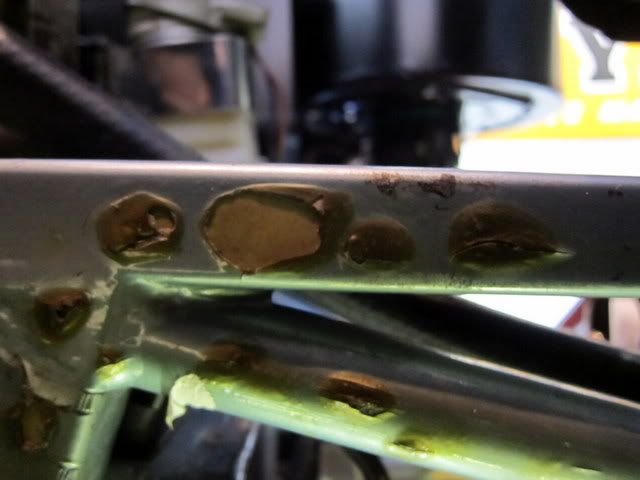
2. They produce an enormous amount of under bonnet heat to the point they can bubble paint on the frames and, occasionally, the bonnet. This is especially a problem with a modified engine
3. That nice shiny look does not last. They start turning yellow, then blue and finally a rust colour. Nothing will remove it
4. You need to make up a frame shield and, on the 4.2, a servo shield
5. Did I mention they can reduce power output?
After 300 miles of hard driving, engine cold:

After 10,000 miles:

State of frames after running tubular manifolds:
More info here: http://etypeuk.com/forum/viewtopic.php? ... folds+heat
As regards Webers give these to your son to read:
Weber Set up Guide 1: http://dl.dropbox.com/u/8496016/Weber%2045DCOE.pdf
Weber Set up Guide 2: http://dl.dropbox.com/u/8496016/Weber%20Wisdom.pdf
Tuning DCOE Carburettors by Kimble & Trindal: http://dl.dropbox.com/u/8496016/Tuning% ... uretor.pdf
David Jones
S1 OTS OSB
1997 Porsche 911 Guards Red
2024 Lexus LBX
Add your E-Type to our World Map: http://forum.etypeuk.com/viewtopic.php?f=1&t=1810
S1 OTS OSB
1997 Porsche 911 Guards Red
2024 Lexus LBX
Add your E-Type to our World Map: http://forum.etypeuk.com/viewtopic.php?f=1&t=1810
| Link: | |
| BBcode: | |
| HTML: | |
| Hide post links |
#12
Ok, I'll bite too !!
Ian, if your son wants to read a balanced forum discussion on Webers, read "Triple webbers (sic) for Series one 4.2 FHC" in the Series 1 Post heading.
http://etypeuk.com/forum/viewtopic.php? ... sc&start=0
This includes posts by people who actually run Webers on their cars - and as Heuer acknowledges - have the fundamental knowledge and know how to set them up to operate correctly - including not smelling of petrol.
Oh - by the way - I also run a Hayward and Scott stainless tubular manifolds, with their bigger bore exhaust system and nice wide 205 tyres on my nice wide 6.5 rims. You need to take off the bump stops with wider tyres. On the manifolds, Heuer is also correct on the heat aspect, the need to fit a heat shield to avoid taking out your servo - and the brake light sensor I have found - plus they do lose their initial shine - but hey they look good !!!
Still - my car - my choice, which is exactly the reason for your quest for informed knowledge on this great forum.
regards,
Dave
Ian, if your son wants to read a balanced forum discussion on Webers, read "Triple webbers (sic) for Series one 4.2 FHC" in the Series 1 Post heading.
http://etypeuk.com/forum/viewtopic.php? ... sc&start=0
This includes posts by people who actually run Webers on their cars - and as Heuer acknowledges - have the fundamental knowledge and know how to set them up to operate correctly - including not smelling of petrol.
Oh - by the way - I also run a Hayward and Scott stainless tubular manifolds, with their bigger bore exhaust system and nice wide 205 tyres on my nice wide 6.5 rims. You need to take off the bump stops with wider tyres. On the manifolds, Heuer is also correct on the heat aspect, the need to fit a heat shield to avoid taking out your servo - and the brake light sensor I have found - plus they do lose their initial shine - but hey they look good !!!
Still - my car - my choice, which is exactly the reason for your quest for informed knowledge on this great forum.
regards,
Dave
Dave Rose
1967 Series 1 4.2 FHC
1967 Series 1 4.2 FHC
| Link: | |
| BBcode: | |
| HTML: | |
| Hide post links |

#13
I have the tubular manifolds too, with the original heat shield (with the three bottles for brake and clutch fluid attached to it) and the paint on the frame is in absolute perfect condition. Same for the bottles (which I guess would melt before the paint :).
And I confirm both last comments: after a thousand miles, the tubular manifolds are becoming dark and matte.
And I confirm both last comments: after a thousand miles, the tubular manifolds are becoming dark and matte.
1E35547
| Link: | |
| BBcode: | |
| HTML: | |
| Hide post links |

#14 diff and gear box options
A few years ago when I was vintage racing an E Type we did a fair amount of work on an engine dyno with 45 dcoe Webers v SU's. This was a 375 hp engine 12.25 : 1 compression, 7000 rpm redline etc. What we found undoubtedly makes me a heretic. A race engine builder that I respect said that I would find no gain in top end but an increase in mid range torque - he was right. The Webers gave 30 -35 ft pd increase in mid range torque but actually produced marginally less hp at the top. This was obvious at the track. With the Webers I could now pull away from other cars out of corners that I'd been equal to with SU's. The race car is gone now. Now I autocross my '68 E Type. It has a mildly modified genuine 265 hp. engine (again engine dyno tested). When I switched to tubular exhaust manifolds I got the results that David suggested. It was - by the seat of the pants, noticeably slower out of corners but faster at the top end. It's still pretty quick - you can see the car on an autocross track at:
Last summer I installed triple Webers - 45 dcoe with smaller chokes (36's) (better low end torque) - but in my opinion it's added nothing to the SU's -I'm no faster with the setup - but having said that, smaller increases in hp don't translate into significantly faster times on an autocross. The car does run noticeably smoother at idle and lower rpm's but if it produces more mid range torque it's not much more. My lesson - Webers will add to the more prepared engines but not much to a stock or mild engine. And oh yeh - setting the Webers up was a real bear and expensive - jetting was totally different from what was recommended, and totally different from the race car - mind you the race car is either flat out or off - transitions from the idle circuit to the full circuit are very brief if at all.. All those bitty brass parts really add up fast. As to fuel smell - it's not noticeable when the car is running - but you may notice it when the car sits. The float chambers on a Weber are much more exposed to external air than on an SU and some fuel will evaporate. I know this because my wife smells it and complains -the smell is lost on me.
The late John Passini's book remains the bible. Setting the float level including drop is critical. The best method is set out in a paper by Keith D. Franck which "may" be available at: https://groups.yahoo.com/neo/groups/sid ... ntral/info
(you need to be a member to ask for it)
Last summer I installed triple Webers - 45 dcoe with smaller chokes (36's) (better low end torque) - but in my opinion it's added nothing to the SU's -I'm no faster with the setup - but having said that, smaller increases in hp don't translate into significantly faster times on an autocross. The car does run noticeably smoother at idle and lower rpm's but if it produces more mid range torque it's not much more. My lesson - Webers will add to the more prepared engines but not much to a stock or mild engine. And oh yeh - setting the Webers up was a real bear and expensive - jetting was totally different from what was recommended, and totally different from the race car - mind you the race car is either flat out or off - transitions from the idle circuit to the full circuit are very brief if at all.. All those bitty brass parts really add up fast. As to fuel smell - it's not noticeable when the car is running - but you may notice it when the car sits. The float chambers on a Weber are much more exposed to external air than on an SU and some fuel will evaporate. I know this because my wife smells it and complains -the smell is lost on me.
The late John Passini's book remains the bible. Setting the float level including drop is critical. The best method is set out in a paper by Keith D. Franck which "may" be available at: https://groups.yahoo.com/neo/groups/sid ... ntral/info
(you need to be a member to ask for it)
1967 E Type coupe
1968 E Type OTS
2007 XKR
1968 E Type OTS
2007 XKR
| Link: | |
| BBcode: | |
| HTML: | |
| Hide post links |
#15
In period the Weber upgrade was to 40DCOE, as used on the Lightweights, which suits the XK engine very well. They no longer seem to be available so people use the 45DCOE's and assume bigger is better but it is not, the engine is over fuelled necessitatingg the complex setup and testiing procedure.
David Jones
S1 OTS OSB
1997 Porsche 911 Guards Red
2024 Lexus LBX
Add your E-Type to our World Map: http://forum.etypeuk.com/viewtopic.php?f=1&t=1810
S1 OTS OSB
1997 Porsche 911 Guards Red
2024 Lexus LBX
Add your E-Type to our World Map: http://forum.etypeuk.com/viewtopic.php?f=1&t=1810
| Link: | |
| BBcode: | |
| HTML: | |
| Hide post links |
#16
I know we are going way off topic, but to avoid incorrect information being repeated about Weber DCOE 45s being "too big" and "overfuelling", this needs clarification.
In simple terms, the 45 refers to the barrel - of which the DCOE has two horizonal ones. Inside the barrel to correctly set up the carburettor, you have to fit the correct main venturi which effectively downsizes the diameter of the bore. You don't just buy a Weber, get it out of the box and bolt it one, but set it up for the particular application. This process can be extremely frustrating for some people and equally rewarding for others who finally get what they want their particular application to do. The previous article by jag68 is the perfect example of this and what can - or can't - be achieved with Webers.
I refer to my previous post which focused on the suitability of Webers and this stated :-
Another misconception stated above about the DCOE 45 being "too big" for the Jaguar engine is that it is not the barrel size, (40 or 45), which determines the airflow, but the main venturi which is a seperate component fitted in the barrel. A DCOE 40 barrel can take up to a maximum 36mm main venturi, which some people use for road use in the Jaguar engine, as shown in the second article guidance, but if you want to go to a 38mm main venturi, (or up to a maximum 40mm), you have to go to the DCOE 45. The DCOE 45 can go down to taking a 28mm main venturi, so the carb itself is certainly not "too big". I personally believe you want 38mm as the size for the main venturi for road use, provided you have a suitable auxiliary venturi to match it. The auxiliary venturi which is like a circular nozzle in which the fuel mix is dispensed into the airflow, then into the main venturi and then through the butterfly throttle and into the engine.
Cheers,
Dave
In simple terms, the 45 refers to the barrel - of which the DCOE has two horizonal ones. Inside the barrel to correctly set up the carburettor, you have to fit the correct main venturi which effectively downsizes the diameter of the bore. You don't just buy a Weber, get it out of the box and bolt it one, but set it up for the particular application. This process can be extremely frustrating for some people and equally rewarding for others who finally get what they want their particular application to do. The previous article by jag68 is the perfect example of this and what can - or can't - be achieved with Webers.
I refer to my previous post which focused on the suitability of Webers and this stated :-
Another misconception stated above about the DCOE 45 being "too big" for the Jaguar engine is that it is not the barrel size, (40 or 45), which determines the airflow, but the main venturi which is a seperate component fitted in the barrel. A DCOE 40 barrel can take up to a maximum 36mm main venturi, which some people use for road use in the Jaguar engine, as shown in the second article guidance, but if you want to go to a 38mm main venturi, (or up to a maximum 40mm), you have to go to the DCOE 45. The DCOE 45 can go down to taking a 28mm main venturi, so the carb itself is certainly not "too big". I personally believe you want 38mm as the size for the main venturi for road use, provided you have a suitable auxiliary venturi to match it. The auxiliary venturi which is like a circular nozzle in which the fuel mix is dispensed into the airflow, then into the main venturi and then through the butterfly throttle and into the engine.
Cheers,
Dave
Dave Rose
1967 Series 1 4.2 FHC
1967 Series 1 4.2 FHC
| Link: | |
| BBcode: | |
| HTML: | |
| Hide post links |
-
PeterCrespin
- Posts: 4561
- Joined: Fri Mar 05, 2010 8:22 pm
- Location: Gaithersburg, Maryland.
- Contact:
#17
Thanks Dave - people don't realise the air doesn't flow through a 40/45 or even 48 mm choke, which would be massive for the revs and displacement. Those numbers mean nothing unless you operate at the extremes. the inlet charge flows through whatever (much smaller) size of venturi you choose to go inside that opening.44DHR wrote:I know we are going way off topic, but to avoid incorrect information being repeated about Weber DCOE 45s being "too big" and "overfuelling", this needs clarification.
In simple terms, the 45 refers to the barrel - of which the DCOE has two horizonal ones. Inside the barrel to correctly set up the carburettor, you have to fit the correct main venturi which effectively downsizes the diameter of the bore. You don't just buy a Weber, get it out of the box and bolt it one, but set it up for the particular application. This process can be extremely frustrating for some people and equally rewarding for others who finally get what they want their particular application to do.
The parameters of cylinder filling as they relate to tract length and diameter, swept volume, CR and valve size/shape can all be predicted when working out cam lift and duration, or vice versa. Like anything else (gearing, suspension, wheels/tyres, you have to choose what you want from your engine and design the right spec to deliver that. Just bolting on go-faster goodies without considering the pros and cons is unlikely to get you what you want.
Pete
1E75339 UberLynx D-Type; 1R27190 70 FHC; 1E78478; 2001 Vanden Plas
| Link: | |
| BBcode: | |
| HTML: | |
| Hide post links |
#18 diff and gear box options
When you have a larger carburettor - say a 45 as opposed to a 40 you can place a smaller primary venturi (commonly called a choke) in it's throat to make it as if it was a smaller carburettor. Venturi's cause the air/fuel mixture to speed up creating a vacuum which sucks the fuel from the float chamber. Fuel atomizes better in a partial vacuum.The problem with this approach is that when the air/fuel mixture passes through the venturi it enters a larger area in the back of the carburettor and then into intake manifold which is sized to the carburettor size as opposed to the venturi, which causes it to slow down as it expands. This has the effect of causing the fuel to drop out of the air and onto the intake walls. Not a good situation.
1967 E Type coupe
1968 E Type OTS
2007 XKR
1968 E Type OTS
2007 XKR
| Link: | |
| BBcode: | |
| HTML: | |
| Hide post links |