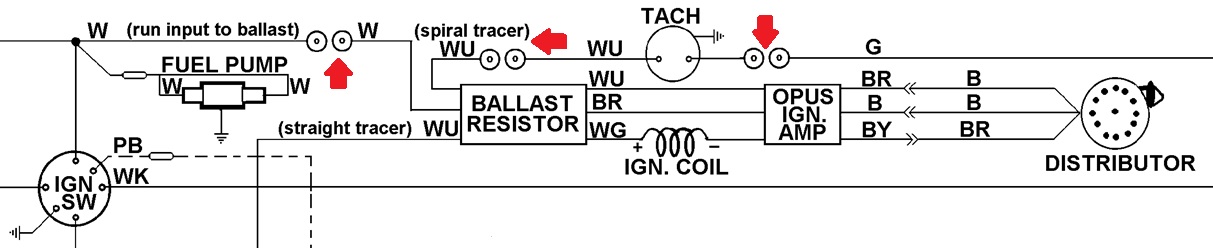
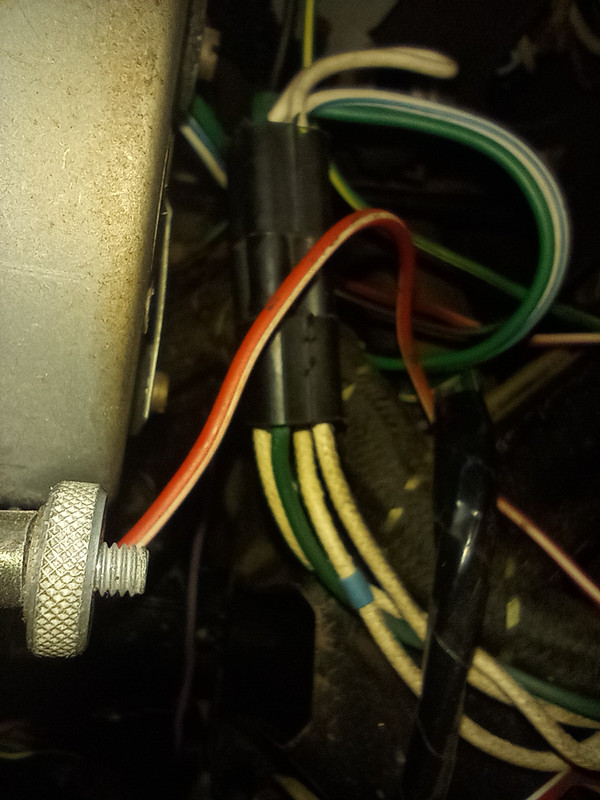
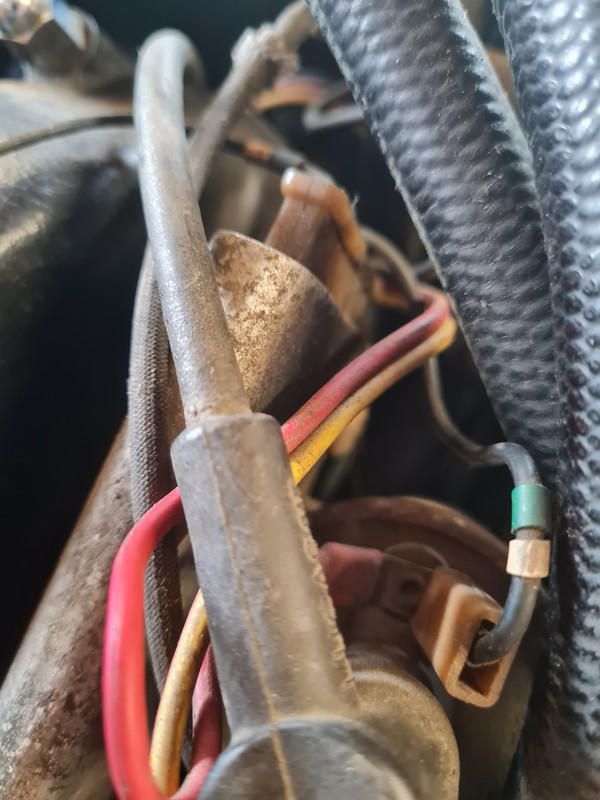
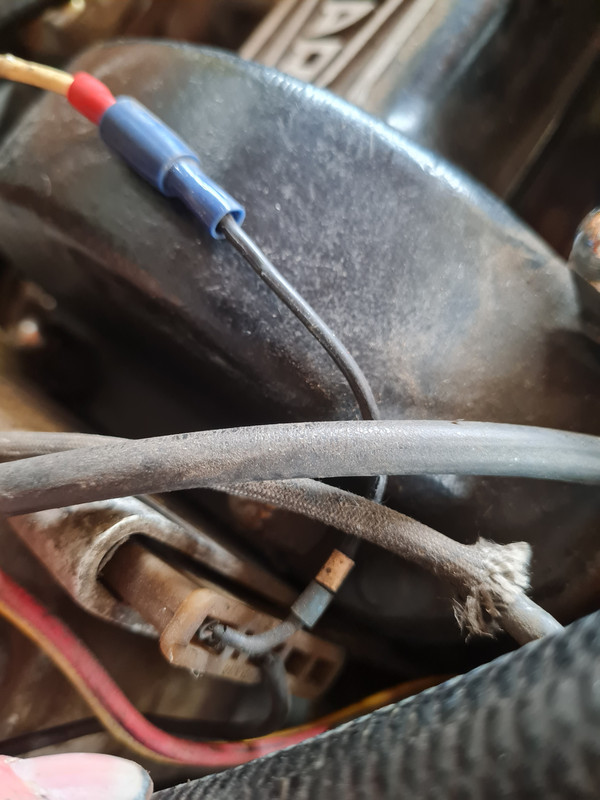
Yes, photos better than words but diag more complete.
Can yr diag be of how it was before your mods?
There were 2 versions of the ballast resistor, before and from engine number 7S7560. My car should have had the early version but had the later, i guess because the earlier became NLA. Below is a pic of my ballast, is yours the same? It was mounted to the front of the A-bank cam cover, same as yours is.
If so, can we use the following names for the ballast resistor terminals?
S = "start sw" side, A = "amplifier" side.
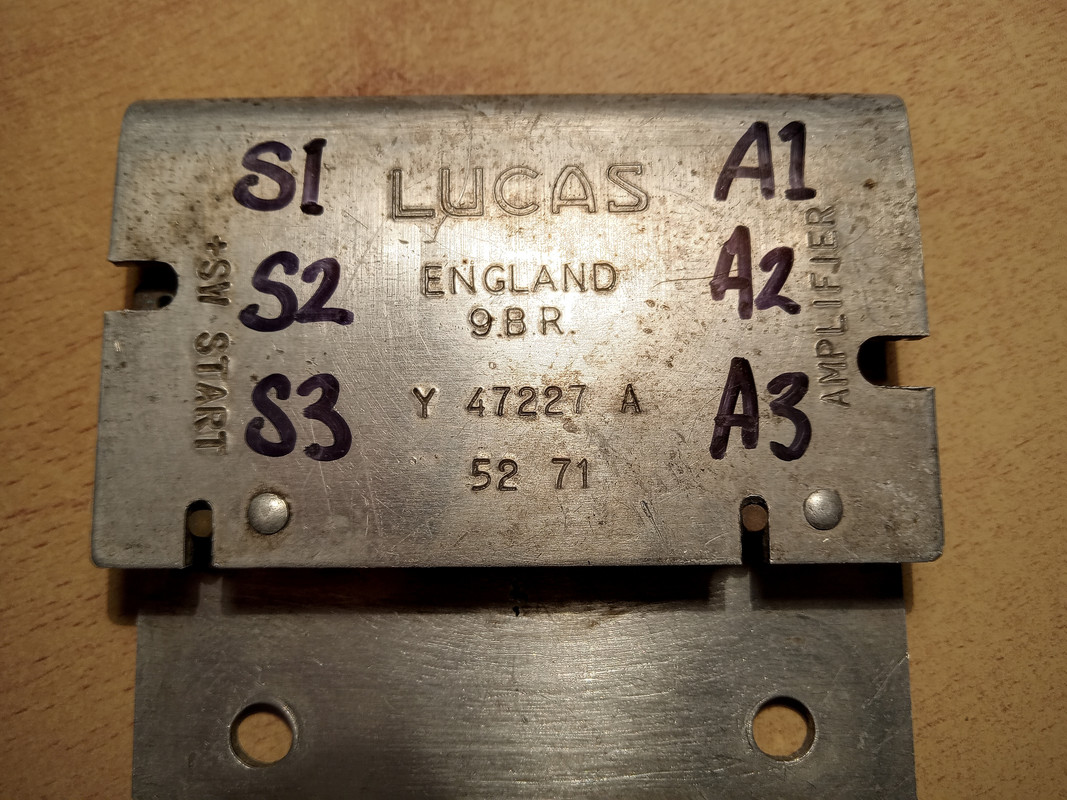
The temperature dependent ballast resistor gets relatively hot. Over time, the S-side wire terminations become brittle and fail, need to be re-terminated. Easiest way to do this is to cut off the common side plug and fit individual spade connectors. Looks like what your PO had done, I also had to do this.
To check yr ballast, disconnect all wires and, using your multimeter, check for continuity from S1 to A3. If there is any non-continuity, yr ballast is stuffed, you need to buy/fit a new one. Or you can have mine.
If there is no continuity probably why your tacho didn’t work.
My opinion on why tacho’s sense from the Opus ballast resistor instead of from the coil -ve, keen to hear from others re this:
The role of the ballast resistor is to ensure that the coil and also the ignition electronics get all the available energy when the engine is cranking and is not overloaded at other times, is why there are 2 inputs, the “run” input from the ign switch (W wire) and the “cranking” input from the start relay (next to the wiper motor, WU straight trace wire). The tacho counts the frequency of the pulses induced by the coil firing. These pulses can be detected in any connected wiring, not just at the coil -ve. The Opus ballast resistor has built-in compensation (via additional resistance) to provide for a tacho signal that has a relatively consistent “amplitude”, irrespective of whether it is starting or cranking voltage that is being applied to the coil, more reliably counted by legacy tachos; this consistency is lost if the tacho sensors directly from the –ve side of the coil. Not that you would notice, with new TI electronics.
Imo an important take from these explanations. You can wire the ballast resistor incorrectly and not realise it. You could even remove it. The car (and tacho) could still run seemingly perfectly well. However cold starting could become an issue and or the coil or amplifier would fail prematurely. I.e just getting it to run is not the solution, getting it to oem, that’s the solution.